Tag Archives: stocks

Market Lab Report – Premarket Pulse 2/25/16

Major averages finished higher yesterday on higher but below average volume, staging upside reversals. Volatility remains elevated. Oil rallied sending the major averages higher after it was reported that U.S. crude inventories were smaller than an earlier industry report suggested. Production numbers also fell. That said, given OPEC’s stance on not curtailing production, the current bounce in oil may be short-lived. Its overall downtrend on a technical basis remains intact. Oil futures are currently trading somewhat lower as of this writing. The correlation between oil and stocks has been high since the start of the year as the price of oil has been approaching levels that may cause institutions such as J.P. Morgan (JPM) into forced liquidation of stocks. Indeed, JPM may increase its loan-loss reserves by $1.5 billion if the price of oil drops to $25 a barrel. Leadership remains scant consisting mostly of defensive stocks such as food and utilities. A number of groups have shown strength with the current bounce but these stocks have mostly staged bounces off lows. Further, finance-related stocks continue to lag. Futures are currently slightly higher at the time of this writing shrugging off the steep overnight drop of -6.4% in China’s Shanghai Composite on liquidity concerns.

Avoiding Unnecessary Risks In Firefighting And Investing

By Roger Nusbaum, AdvisorShares ETF Strategist Over the President’s Day weekend, I saw a big chunk of the movie Backdraft. This is the 1991 firefighting movie with Kurt Russell, Billy Baldwin and Robert De Niro. I was not involved with firefighting back then, so I don’t know how unrealistic the fire ground scenes were, but I can tell you that firefighting has changed dramatically versus how it was portrayed in the movie. There were a couple of different scenes where the crew went into burning buildings where there were no people believed to be, including some sort of chemical facility. There is a phrase in firefighting; risk a lot to save a lot, risk a little to save a little, risk nothing to save nothing. There is no empty building that is worth more than a firefighter’s life, going into a burning chemical factory (with no breathing apparatus mind you) is a totally unnecessary risk. The idea of suitable risk is obviously an important part of investing. About eight months ago I was on CNBC with the bear case for a newly IPO’d stock that I would describe as being a trendy gadget. The gadget itself is pretty neat and I have no doubt about the gadget’s ability to do what it is supposed to; my wife wants to get one. My main thesis was that from the top down the risk associated with buying a very expensive stock that produces a faddish item that had already enjoyed tremendous growth in sales before the IPO was simply unnecessary given how late we were in the market cycle. There was no attempt to predict what the market would do but six years into a bull market is late based on past market cycles. After five or six years or longer of rising markets it makes sense to avoid added risk or volatility in the portfolio. While there can be no absolutes it is a good bet that Giant Soda with 40 straight years of dividend increases is less volatile and less risky than Social Media Gadget Dot Com with a PE of 100 (neither Giant Soda or Social Media Gadget Dot Com are real companies). If there is a time to take on added volatility and risk, and for some investors this is totally unnecessary at any time, it would not be after years of a rallying market but when participants are most fearful after a large decline with media questioning why even own stocks. While most people know that buying low is the right thing to do, actually doing it is very difficult. An investment plan is unlikely to be derailed by being unable to pull the trigger in this manner but can be derailed by succumbing to greed at the market’s high and buying too much stock in a company that makes a trendy gadget. The one from my CNBC visit is down 46% from its first day of trading and down 68% from its peak. Even if it had gone up it would have been an unnecessary risk for most investors. The bigger point here is about probabilities. These things are obvious and plainly stated but are often lost in a forest for the trees type of perspective on markets and investing. Disclosure: I/we have no positions in any stocks mentioned, and no plans to initiate any positions within the next 72 hours. I wrote this article myself, and it expresses my own opinions. I am not receiving compensation for it. I have no business relationship with any company whose stock is mentioned in this article. Additional disclosure: To the extent that this content includes references to securities, those references do not constitute an offer or solicitation to buy, sell or hold such security. AdvisorShares is a sponsor of actively managed exchange-traded funds (ETFs) and holds positions in all of its ETFs. This document should not be considered investment advice and the information contain within should not be relied upon in assessing whether or not to invest in any products mentioned. Investment in securities carries a high degree of risk which may result in investors losing all of their invested capital. Please keep in mind that a company’s past financial performance, including the performance of its share price, does not guarantee future results. To learn more about the risks with actively managed ETFs visit our website AdvisorShares.com .

Salesforce.com Meets And Beats On Q4, Stock Jumps On Outlook

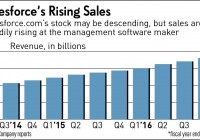
Salesforce.com ( CRM ) matched analyst forecasts on earnings and beat them on revenue with a record fourth quarter, but shares soared in late trade after the enterprise cloud pioneer raised its forecast for sales growth. Announcing earnings after the market close Wednesday, Salesforce said adjusted fourth-quarter earnings rose 36% to 19 cents per share on revenue that rose 25% to $1.81 billion. Earnings were right on the money, according to estimates from analysts polled by Thomson Reuters, but sales were better than the $1.79 billion revenue they had anticipated. The No. 1 developer of customer relationship management software, Salesforce raised full fiscal 2017 revenue guidance to a range of $8.08 billion to $8.12 billion, up from $8.0 billion to $8.1 guided after its third-quarter release. For its first fiscal quarter of 2017, which ends in April, Salesforce said it expects earnings per share of 23-24 cents, up 47% at the midpoint and ahead of analysts’ 21-cent consensus view. That’s on revenue up 25% to $1.89 billion, where analysts expected $1.86 billion, up 23%. Its results seemed to strengthen hope that Salesforce might trigger an upturn in software stocks, reversing  Tableau Software ‘s ( DATA ) profitable but softer fourth quarter and weak guidance that triggered a 49.5% collapse in Tableau stock Feb. 5. Tableau’s misfortune also precipitated a 15% plunge in the entire IBD Computer Software-Database industry group, where legacy software developer Oracle ( ORCL ) also resides. Salesforce stock also fell 13% at the time, and the IBD Computer Software-Enterprise industry group where it lives fell 8%. Neither group has recovered, the most notable exception being steady Oracle, up slightly Wednesday to 36.63, 19% off a six-month high set June 17. Days after the Tableau debacle, Salesforce set a 16-month low at 52.60 on Feb. 8, before rising 19.5% through Tuesday’s close at 63.98.  Salesforce ended the regular session down 0.6% to 62.50  in the stock market today . That was 24% off the stock’s all-time high of 82.90, hit Nov. 19, when Salesforce reported fiscal-third-quarter earnings up 50%. After Wednesday’s earnings release, Salesforce jumped more than 8% to 67.95 in after-hours trading. “By any measure, this was a spectacular finish to the year with 27% revenue growth in constant currency for the fourth quarter and for the full year,” Chief Executive Marc Benioff said in the earnings release. “We are raising our fiscal year 2017 revenue guidance to $8.12 billion at the high end of our range — unprecedented growth for a company of our size and scale.” Chief Financial Officer Mark Hawkins said its adjusted operating margin rose by 177 basis points, driving full-year operating cash flow up 37% to $1.6 billion during the fourth quarter. Said President and Chief Operating Officer Keith Block: “We hit an all-time high in large transactions in fiscal 2016,” adding that Salesforce’s cloud platform is growing sales “across every region, every cloud and every industry.” For full fiscal 2016, revenue rose 24% to $6.67 billion where analysts expected $6.65 billion. Salesforce said subscription and support revenue grew 24% to $6.21 billion and professional services and other revenue rose 28% to $462 million. The full-year adjusted earnings matched Wall Street at 75 cents. Salesforce managed to take a fourth-quarter unadjusted loss of 4 cents, better than the 6-cent loss expected by Wall Street. Beyond predicting Salesforce’s first $8 billion year in fiscal 2017, Benioff repeatedly assures that the company is “well on the path to reach $10 billion faster than any other enterprise software company.” RBC Capital Markets analyst Ross MacMillan said in a recent note to clients that the firm’s Salesforce1 platform for mobile-application development is driving fresh growth, although “there are many avenues to sustain growth, including service and marketing, the platform, and international and future initiatives.” MacMillan went on to say: “We think Salesforce can continue to drive premium growth for its size, and it remains an important strategic asset.” RBC maintains an outperform rating on Salesforce.com stock, with a price target of 80, as “one of the best positioned companies in large-cap software.” Image provided by Shutterstock .