Tag Archives: seeking

Facts, Opinions, And Risk Management

Editor’s note: Originally published at tsi-blog.com on August 14, 2015. Commentators on the financial markets often make statements like “it’s a bull market” and “the trend is up” as if these were indisputable facts, but such statements are always opinions. A statement of fact could reasonably be phrased along the lines of “the market was in an upward trend between date X and date Y,” because if a sequence of rising lows and rising highs occurred between two dates then the trend was, by definition, up during that period. However, it is impossible to know the direction of a market’s current price trend with absolute certainty, let alone the direction of its future price trend. The reason is that even if a market has just made a new high/low, there will be some chance that this will turn out to be the ultimate high/low. For example, it’s a fact that gold was in a bear market in US$ terms from its peak in September of 2011 through to 24th July 2015 (when it hit a 4-year low of $1072), but it is a matter of opinion as to whether gold is now in a bear market. The bear market could obviously still be in progress, but there is also a possibility that it ended on 24th July 2015. At the time of writing, nobody knows for sure. Some market participants and commentators will draw a line on a chart and then make a statement such as “I will consider the trend to be up (or down) unless the market proves otherwise by moving below (or above) my line”. Fine, but there’s a big difference between claiming to know the direction of the price trend and working under the assumption that the trend is in a particular direction unless/until proven otherwise by some predetermined event. The valley of shattered financial dreams is littered with traders who were determined to stay ‘long’ or ‘short’ because they thought they KNEW the direction of the price trend. The impossibility of knowing whether a bull/bear market or an up/down trend is going to continue, or even whether the market is currently in bull or bear mode, makes risk management essential. Someone who knew the future would never have to bother with risk management; they could, instead, risk everything on a particular outcome because for them it wouldn’t be a risk at all. But ordinary mortals always face a degree of uncertainty when making investment decisions and, as a result, always need to face the reality that these decisions could prove to be wrong. Be wary, then, of advisors who claim that there is only one possible direction for the future price of an investment. But while unwillingness to acknowledge the possibility of being wrong is a defect in the approach of some investors, other investors suffer from the opposite problem in that they have a hard time maintaining a bullish or bearish view unless that view is continually being validated by the price action. That is, they are incapable of remaining confident in any opinion that doesn’t happen to conform to the current opinion of the manic-depressive mob. As a result, they routinely get ‘sucked in’ following large price rises and ‘blown out’ following large price declines, as opposed to taking advantage of the mob’s proclivity to be wrong. Therefore, as investors, the challenge we all face is to strike a balance between staying the course in rough weather and preparing ourselves for the possibility that there could be unseen rocks up ahead.
Making Sense Of China’s Currency Devaluation

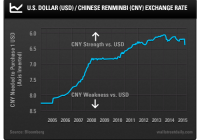
Alan Gula, CFA Earlier this week, two massive explosions rocked the Chinese port city of Tianjin. It’s said that the larger explosion was equivalent to over 20 tons of TNT being detonated. The blasts were so large that seismic activity was registered around 100 miles away. The exact cause of the explosions is unknown, but other shocks emanating from China have clearer triggers. On August 11, 2015, China devalued its currency, the renminbi (yuan), by 1.9%. It was the currency’s biggest one-day drop since 1994. It didn’t stop there, either. At one point the following day, the yuan had cumulatively lost as much as 3.9% of its value against the dollar. Policymakers in China seem to be following through on their promise to allow the market to play a bigger role in determining the exchange rate. “A fixed exchange rate looks stable, but it hides accumulated problems,” noted Yi Gang, Vice Governor of China’s central bank. China doesn’t have a fixed peg, but it does heavily manage the yuan’s level relative to the U.S. dollar. The chart below helps us put the devaluation into perspective. The y-axis has been inverted so that a rising line shows the yuan’s strength. As you can see, China allowed the yuan to significantly appreciate against the dollar from 2005 up until the credit crisis. The fixed peg was reinstituted from mid-2008 until mid-2010. Then, the yuan began a slower appreciation, which culminated in early 2014. So, the yuan’s relatively small recent devaluation has only given back a small portion of its longer-term appreciation. That said, we shouldn’t downplay what’s happening right now. The U.S. dollar bull market has really forced China’s hand. The dollar has been very strong over the past year against virtually all global currencies. Therefore, the yuan has been dragged higher. With a strong currency, China has lost some of its export competitiveness. China has also been burning through foreign exchange reserves to keep the yuan at a level above where it would naturally be. Given that China’s economy is slowing, its exports are flagging, and its speculative bubbles are collapsing, the move wasn’t completely unexpected. Plus, an increasingly market-driven exchange rate will pave the way for the yuan to enter the Special Drawing Rights (SDR) basket. Nonetheless, the market seemed to be surprised by the devaluation. Global equity markets dipped and the U.S. 10-year yield declined all the way to 2.05%. China’s move has sparked fears that a new wave of deflation will wash over the world. A weaker yuan will also help boost China’s exports at the expense of other nations. Koichi Hamada, an adviser to Japan’s Prime Minister, went so far as to say that Japan can offset the yuan devaluation with monetary easing. Indeed, it’s clear to see why there’s a risk of escalating competitive devaluations or “currency wars.” For individual investors, it’s important to keep everything in perspective. Just a little while ago, Greece and Europe were roiling the markets. Now, it’s China’s turn. Soon, there will be something else. If you’re getting spooked by these news-driven stock market plunges, only to buy higher after a fierce rally, you’re doing it wrong. Many traders and investors are simply getting whipsawed by the volatility. Meanwhile, the S&P 500 has effectively gone nowhere since the Fed’s latest quantitative easing (QE3) program ended. This is why everyone should hold globally diversified portfolios of stocks, preferred stocks, bonds, and real assets. There are going to be more (and much larger) disturbances down the road, and their timing is uncertain. By being properly diversified and intelligently taking on risk, you’ll protect yourself from the market shocks and volatility storms coming our way. Original Post

Is The Small Cap Stock Premium Disappearing?

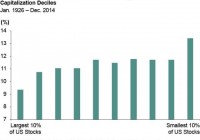
Summary The small cap size premium has shrunk from a 5% annualized return to 1% since Rolf Banz published a landmark paper demonstrating small stocks’ return premium in 1981. The shrinking of the small-cap premium can be explained by several reasons and is not unique in the investment world. A multi-factor investment strategy suggests keeping small-cap stocks, as several factor premiums, including momentum, asset growth and profitability, tend to be stronger among small-cap stocks. Small cap stocks are in a bit of a slump. For example, from January 1, 2014 to July 31, 2015, the Russell 2000 Index of small-company stocks returned just 8.6%, less than half of the 17.4% return of the Russell 1000 Index of large companies. Some market commentators ask whether the small cap premium (the historical phenomenon of small caps tending to outperform large caps) has disappeared; a number of academics even question whether the small cap premium ever existed. For a review of the continuing academic debate on this subject, I invite you to read our recently posted paper, ” Sizing Up the Size Premium .” In this article, I will discuss how we as investment practitioners who construct multi-asset class portfolios think about the small cap premium. The Small Cap Premium First, here’s some history. In 1981, Rolf Banz published a paper on the “small stock effect,” which demonstrated a return premium for small stocks over their larger counterparts.* For instance, from 1961-1980, the size premium earned an annualized return of 5%, which is very attractive. Exhibit 1 below, which divides the market into deciles, illustrates the historical returns from 1926 to 2014 of each market decile. Note the highly significant relationship between firm size and return, where smaller-cap stocks have earned higher returns. (click to enlarge) But since Banz published his paper, a funny thing has happened: the small-cap size premium has shrunk dramatically, from 5% to 1%. In Exhibit 2, which depicts a recent 20-year time period, the smallest decile of stocks is still the best performer, but this chart is much “noisier” than Exhibit 1, which is statistically what one might expect when examining a shorter time period in which data can be more idiosyncratic. Now look at Exhibit 3. Here we see that, during a recent 10-year period, the smallest-cap stocks significantly outperformed only the very largest stocks during the decade. (click to enlarge) (click to enlarge) How do we, as investment managers, explain and address the apparent shrinking of the size premium? I find it fascinating that a nearly identical phenomenon has occurred with value stocks-since Fama and French published their landmark paper on the value premium in 1992, that premium has also shrunk from 5% during the 1972-1991 period of study to just 1%, since 1991. In other words, it seems quite possible that once research on factor premiums (such as size and value) is out there in public, the investment world catches on and whittles away the premium. Since we have tilted portfolios to value and small caps for more than 20 years, I suppose we should plead guilty to aiding and abetting the shrinking premiums! The Case for Small Caps Despite the apparently declining size premium, we do not abandon small cap stocks for a number of reasons. For one thing, we think there is a strong underlying economic argument for why small companies should generate higher returns (though with higher volatility). Small firms do not have the same access to capital as large companies and typically have a higher cost of capital, thus requiring a higher rate of return. When we evaluate investment strategies, we consider economic and financial logic as well as study past patterns of returns. Note, also, that not all small caps are created equal. For instance, over time small-cap value stocks have dramatically outperformed small-cap growth ones (14.86% annualized vs. 8.81% from July 1, 1926 to June 30, 2015, according to Center for Research in Security Prices data), which appears to endorse a tilt to value. In addition, the small-cap growth “style box” has historically been a weak performer, but our research demonstrates that, by stripping out the “growthiest” stocks in this category, an investor will be much happier with returns (see ” Returns on Small Cap Growth Stocks, or Lack Thereof: What Risk Factor Exposures Can Tell Us “). Insights such as these are ones that we employ in building portfolios and, indeed, in constructing our own factor-based investment strategies. To this point, I should add that small cap’s dry spell (recall the 10-year cycle of Exhibit 3) is a good example of why we embrace multi-factor investing rather than single-factor investing (for a quick tutorial on our investing style, see ” What is a Multi-Factor Investment Approach? “). Different factors move in different cycles of different duration, which provides diversification. And importantly, several factor premiums (including momentum, asset growth and profitability) tend to be stronger among small-cap stocks, which is yet another reason why we continue to like investing in smaller companies despite the eroding premium. Conclusion The size premium, while weaker than in the past, is generally still positive. Even with a modest small cap premium, we still believe there is a benefit in holding small cap stocks as a distinct tilt in an equity strategy and as an important component of a multi-factor investment strategy. * Banz, Rolf W. “The Relationship Between Market Value and Return of Common Stocks,” Journal of Financial Economics, November 1981. Disclosure: I/we have no positions in any stocks mentioned, and no plans to initiate any positions within the next 72 hours. (More…) I wrote this article myself, and it expresses my own opinions. I am not receiving compensation for it. I have no business relationship with any company whose stock is mentioned in this article.