Tag Archives: seeking-alpha

Greek ETF Faces Volatility On ECB Move

After last month’s political instability, Greece received yet another blow from the European Central Bank (ECB). The ECB on Wednesday announced that it would no longer accept Greek government debt as collateral for regular central bank loans, cutting off access to a key source of funding for Greek banks. This is likely to put fresh pressure on the country’s new government to rewrite the terms of its €240 billion bailout from the troika of the European Central Bank, the International Monetary Fund (NYSE: IMF ) and the European Commission (EU). Greek bonds are presently junk rated and are thus below the ECB’s minimum threshold to qualify as collateral. The recent move by the ECB means that the Greek central bank will now have to provide its banks with Emergency Liquidity Assistance (NYSE: ELA ), putting Greek banks in a tight corner as these are already facing signs of capital flight. The banks had earlier used their holdings of Greek government bonds to borrow from the central bank at an interest rate of just 0.05%. However, Greek banks will still have access to funds through the ECB’s emergency lending program, though the loans will carry a higher interest rate. However, the credit risk of the loans stays on the books of the Greek central bank. The move by ECB is significant as it sends a clear signal to Greece’s new Prime Minister Alexis Tsipras that the lenders are determined to force Greece to reach a compromise about any new potential debt terms. Moreover, it implies that if the Greek central bank is unable to solve its funding issues, the nation’s cash strapped government would have to step in for rescue. Market Impact The recent move by the ECB to tighten the country’s banking system made investors nervous, who then dumped Greek shares. Investors feared that ECB’s latest announcement might lead Greece to exit from the Euro zone. The Greek stock market shed more than 9% in early trading on Thursday following ECB’s move. Moreover, the Global X FTSE Greece ETF (NYSEARCA: GREK ), which tracks the performance of Greek stocks, plunged more than 10% on Wednesday following ECB’s announcement. Though GREK managed to recover part of its losses on Thursday and gained 4.4%, investors should cautiously trade the product. Below we have highlighted some of the details about the product. GREK in Focus The product tracks the FTSE/ATHEX Custom Capped Index and is home to a basket of 22 stocks. The fund manages a small asset base of $150.7 million and trades in solid volumes of 560,000 shares per day. The product holds a small basket of 24 stocks and is heavily concentrated in the top five holdings that make up for a combined 43.4% of assets. Financials takes the top spot at 32.5% in terms of sector holdings, followed by consumer discretionary (14.4%), consumer staples (13.4%) and materials (9.8%). The fund charges a fee of 65 basis points on an annual basis. The fund is down 7.3% in the year-to-date frame and currently has a Zacks Rank #3 or Hold rating.

How To Increase The Dynamic Energy Of Your Portfolio

In physics, the dynamic energy of an object is a measure of how much energy the object can release under favorable conditions. In a similar way, a stock portfolio has higher dynamic energy when it consists of stocks with great upside potential thanks to a headwind and its resultant sell-off. The article suggests replacing some stalwarts, whose growth has stumbled but still trade at elevated P/E, with some oil stocks that have been extremely punished due to the oil plunge. In physics, the dynamic energy of an object is a measure of how much energy the object can release under favorable conditions. To clarify this through an example, two objects that are still, with the one at the sea level and the other one on the top of a hill, both have zero kinetic energy. However, the one on the top of the hill possesses much greater dynamic energy because a minimal push can make it start moving at an increasing speed, whereas the other one will remain still under any conditions. Given this definition, investors should try to build a portfolio that has high dynamic energy, i.e., its stocks will greatly appreciate under favorable conditions. Of course this does not involve purchasing extremely high-risk stocks that will return great profits under extremely specific conditions, which have minimal chance of prevailing. Instead this strategy involves purchasing stocks that have asymmetrical reward to risk, as they have been beaten to the extreme due to a temporary headwind despite their strong fundamentals. In the past, it was much easier to build a portfolio with high growth potential. More specifically, all an investor needed to do was to purchase some stalwarts, such as Coca-Cola (NYSE: KO ), PepsiCo (NYSE: PEP ), McDonald’s (NYSE: MCD ), Wal-Mart (NYSE: WMT ), General Mills (NYSE: GIS ), Philip Morris (NYSE: PM ) and Procter & Gamble (NYSE: PG ), and hold them forever without even checking on them. As these companies have historically grown their earnings per share [EPS] at a rate higher than 10%, they have historically offered excellent returns to their shareholders. However, as these stalwarts have now expanded to almost every country, further growth has become much harder to accomplish and hence their EPS growth has stumbled in the last 2 years, as shown in the table (data from morningstar.com for 2013-2014 and finance.yahoo.com for 2015): KO PEP MCD WMT GIS PM PG 2013 growth -4% 10% 4% -3% 19% 2% 6% 2014 growth -2% 5% -8% -2% 1% -5% 4% 2015 growth [Exp.] 0% 4% 5% 5% 0% -10% -2% P/E TTM 21 21 19 17 22 16 21 Given the low growth rate of the above stalwarts, their high market cap and their relatively high P/E, investors should realize that a portfolio consisting largely of such stocks possesses limited upside (fortunately it also has limited downside, as these stocks greatly outperform the market during a downturn). Therefore, investors should add some stocks that have been unfairly beaten to the extreme due to a temporary headwind. At the moment, there are some off-shore drillers and oilfield service companies that possess strong balance sheets and great managements but have been sold off to the extreme due to the sell-off of their entire sector. Investors should realize that oil is very cyclical in nature and hence it will not remain for many years at its current level, which is half of the level that prevailed in the last 4 years. To be sure, the number of oil rigs has consistently decreased in the last 10 weeks, reaching the level of March-2010, and will keep declining if oil remains pressured. Moreover, all oil companies have significantly curtailed their capital expenses for future growth, which will ultimately result in lower production levels in the future. Thus it is a question of time before oil returns to a more reasonable range, which will render more rigs profitable than the current price does. The table below includes some stocks with strong earnings and low amounts of debt, which will strongly recover when oil returns to a more reasonable level, around $70-$80. The table depicts the decline of these stocks off their peak in the summer, the upside from their current price to their peak and the upside from their current price to half way till their peak, which will correspond to an oil price within $70-$80. NOV HAL ESV NOV Decline off peak 41% 42% 46% 40% Upside to peak 69% 72% 85% 67% Upside if oil rises to $70-$80 35% 36% 43% 33% P/E TTM 9 11 5 6 Given the extremely low P/E of Ensco (NYSE: ESV ), its low debt and its high dividend yield (10%), it is the stock with the greatest upside potential if oil rises to $70-$80. Noble Energy (NYSE: NE ) has a very low current P/E but its forward P/E is higher, around 9, while the company also carries a much higher relative amount of net debt ($7 B) than Ensco, standing at about 9 years’ earnings. National Oilwell Varco (NYSE: NOV ) has a low P/E and high backlog, which can fully protect its profitability for at least one more year, while its balance sheet is essentially debt-free, as its net debt ($2 B) is worth only one year’s earnings. Halliburton (NYSE: HAL ) has a low P/E but its earnings are expected to plunge almost 50% this year so it is a riskier choice. To sum up, investors should always look for stocks that have strong fundamentals but have been punished due to a temporary headwind, thus possessing great upside potential. As the market always overreacts to headwinds and any factor of uncertainty, it is only natural that asymmetric reward to risk shows up whenever an unforeseen headwind emerges. Of course this does not mean that an entire portfolio should consist of such stocks, particularly in the case of defensive investors. Nevertheless, when a stock of a portfolio reaches an overvalued level that leaves very limited further upside, it is prudent for investors to exchange that stock with another one as shown above so that their portfolio maintains high dynamic energy. Disclosure: The author is long ESV, NOV. (More…) The author wrote this article themselves, and it expresses their own opinions. The author is not receiving compensation for it (other than from Seeking Alpha). The author has no business relationship with any company whose stock is mentioned in this article.

The Attractiveness Of Farmland And Other Alternative Asset Classes

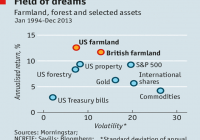
Summary Over the last ten years, the returns on more exotic alternative investments like farmland, rare coins and stamps comfortably beat the returns on the S&P 500 Index. Moreover, based on a risk-return trade off, exotic alternative asset classes also come out on top. This in contrast to more traditional alternative asset classes like commodities, hedge funds, and private equity, which have performed poorly over the last decade. Finally, although investing in exotic asset classes is much less straightforward than investing in equities and bonds, there are certainly opportunities available. Recently, The Economist published an insightful graph that showed that not equities or real estate, but farmland, was the best investment in the last few decades. And, while forestry also earned a spot in the graph, The Economist could have gone a little bit further by adding other, more exotic investment classes as well. (click to enlarge) Adding Coins, Stamps and Wine No worries, with a little help from Bloomberg, I constructed an ‘Economist-like’ chart that, next to farmland and forestry, also includes fine wine, stamps and rare coins as exotic investments. To put things into perspective, I also added ‘traditional’ alternative asset classes like commodities (NYSEARCA: DJP ), gold (NYSEARCA: GLD ), hedge funds and private equity (NYSEARCA: PSP ). Equities (NYSEARCA: SPY ) and bonds (NYSEARCA: BND ) are also included. I intended to add art as well, but art is a bit of an outlier. First, who can actually afford a Monet or Van Gogh? Second, only pieces that are actually sold get to enter the leading index (Moses MEI). This implies that the most traded (and most popular) art works are overrepresented in the index. Hence, the index comes with a classical example of ‘selection bias.’ Finally, most art investment funds are scheduled to retire in the coming years. Farmland tops the list Let’s focus on the alternatives that do make the cut. The graph below shows that, over the last ten years, farmland realized the best return with an average of 17% per year. While less exuberant than farmland, the realized returns on gold, rare coins and stamps (all roughly +10% per year) are also pretty impressive. All of these alternative investments comfortably beat the 8% annual return on the S&P 500 index over the last decade. The two remaining exotic alternatives, forestry and wine, realized an average return almost equal, but also just above, that of equities. (click to enlarge) The return data lead to the straightforward conclusion that, at least over the last 10 years, these exotic alternatives performed very well. This cannot be said of the more traditional alternative investments. While ‘smart’ investors were probably laughing at you if you didn’t add any commodities, hedge funds and/or private equity to your portfolio, these investments didn’t get you anywhere from a return perspective. Private equity performed the least worst, with an average annual return of just 2%, way less than government bonds, for example. Commodities actually yielded a negative return. Of the more ‘familiar’ alternatives, gold was the only one to keep up. Risk and Return Profile So far, I have focused on return data only. However, as risk and return often go hand in hand, a ranking based on the Sharpe ratio (return divided by standard deviation) gives a more complete overview of the relative attractiveness of assets. The graph below shows the Sharpe ratios of the different asset classes over the last ten years. (click to enlarge) As much as a ranking based on the Sharpe ratio is the sounder one, the results are not that different. Most exotic alternatives rank well on their risk-return profile. Farmland, forestry and stamps take three out of the four top spots. Government bonds move up the ranking due to their low volatility. And, as before, gold is the only one of the more traditional alternative investments to do well. Hedge funds, private equity and commodities remain far behind. Based on the risk and return data, investment classes like farmland, forestry, rare coins and stamps are very attractive alternatives. However, there are a few things to keep in mind. First, a period of ten year is not that long from an investment perspective. Things could be different for other time spans (data issues arise, however, for longer historical periods.) Second, most of these exotic alternatives suffer from sticky prices (valuation changes are artificially slow). This means volatility estimates are too low in most cases. That said, the Sharpe ratios suggest it would take a serious volatility increase to push the exotic alternatives down the ranking. Investment Opportunities Now I guess many investors will anticipate another, third factor to keep in mind when looking at these exotic investment alternatives. And that is, availability. Because, how do you invest in (a diversified basket of) farmland or forestry, for example? While this question is totally legit, getting exposure to these alternatives is nowhere near as straightforward as investments in equities and bonds, there are possibilities. Some of them are actually listed. Farmland Partners (NYSEMKT: FPI ) acquires high-quality primary row crop farmland located in agricultural markets throughout North America. Adecoagro (NYSE: AGRO ) from Brazil and Cresud (NASDAQ: CRESY ) from Argentina, invest in farmland and crop production activities in South America. And there are more of these companies around the globe. They are mostly located in emerging markets, as most of the arable land can be found here. On top of that, there are dozens of private investment companies like the Hancock Agricultural Investment Group or Duxton Asset Management from Australia that also offer investment opportunities in farmland or forestry. For other exotic alternatives there are opportunities as well. For example, Stanley Gibbons Investment is a leading company focused on investing in stamps and rare coins. For wine, there is a whole range of private investment funds available. Examples are the Wine Asset Managers, The Wine Investment Fund and Lunzer Wine Investments. But there are many, many more. These companies select, buy and store a variety of wines and save you the hassle of doing this all by yourself. Hence, some of these companies do not only invest in wine but also in whole vineyards as a means of diversification. Mind you, the companies mentioned above are just examples of possibilities to invest in more exotic investment classes like farmland, stamps and wine. You should conduct your own research to find out if these companies offer investment opportunities suitable for you. Investing in these alternatives will require some serious ‘due diligence.’ But, with the disappointing returns of traditional alternative investments in mind, that effort could turn out to be rewarding! Disclosure: The author has no positions in any stocks mentioned, and no plans to initiate any positions within the next 72 hours. (More…) The author wrote this article themselves, and it expresses their own opinions. The author is not receiving compensation for it (other than from Seeking Alpha). The author has no business relationship with any company whose stock is mentioned in this article.