Tag Archives: seeking-alpha

Stocks And ETFs To Reflect Top Sales Growth

The Q2 earnings season is now about to end with 83.1% of the S&P 500 companies having reported already. The overall picture was not quite bright as growth for both earnings and revenues was negative in the quarter. Earnings fell 2.4% year over year while weakness in revenues was more acute with a 4.1% annual rate of decline (as per the Zacks Earning Trends issued on August, 2015). Companies found it hard to even match the already conservative top-line estimates. When everything points toward utter sluggishness, investors must be looking for specific stocks or sectors that somehow managed to outperform, snapping the downing trend. Though the entire season is all about earnings, how about looking at sales more precisely? After all, sales are harder to influence in an income statement than earnings. A company can end up scoring decent earnings by adopting cost-cutting or refinancing its credit facility which in turn lowers interest expenses. But investors should note that these activities do not represent the companies’ prime purpose – sales generation. So, it appears more analytical to assess through a company’s sales per share rather than earnings per share. This is truer given the fact that it is harder for a company to shape up revenue figures by some other measure. MarketWatch recently highlighted 10 S&P 500 companies that exhibited the speediest sales growth in the last reported quarter. To do so, the author calculated sales per share of the latest quarter and then measured its rate of growth from the sales per share in the year-ago quarter. While this approach surely presents investors a set of stocks to keep a close eye on, they can also consider the ETF or basket approach for risk minimization purpose. For that, we highlight ETFs considerably invested in those stocks. Housing D.R. Horton (NYSE: DHI ) , one of the biggest and well-known homebuilders in the nation, topped the list provided by MarketWatch having recorded 37% growth in sales per share. This Zacks Rank #2 (Buy) stock has Growth and Momentum Style Score of ‘A’. On the other hand, Lennar Corporation (NYSE: LEN ) a Zacks Rank #1 (Strong Buy) firm in the Residential Construction space, recorded 30% sales per share growth in its most recent quarter and occupied the sixth spot. Both stocks have considerable exposure of at least 11% in the iShares U.S. Home Construction ETF (NYSEARCA: ITB ) . Another housing ETF SPDR Homebuilders ETF (NYSEARCA: XHB ) also invests over 3% in each stock. In any case, the housing sector shaped up well in recent months. The Key constituents’ sturdy sales performance makes these funds worth noting. Both funds have a Zacks ETF Rank #3 (Hold). Health Care Who does not know about the robust health of the health care stocks and funds? Merger and acquisition frenzy, encouraging industry fundamentals and promising new drugs sent the sector on cloud nine these days. Quite expectedly, stocks from health care sectors will hit the list of ‘fastest sales growth’. The Zacks Rank #1 Gilead Sciences (NASDAQ: GILD ) put up 36% sales growth. The stock, with Growth and Value Style Scores of ‘B’ has hefty shares in the Market Vectors Biotech ETF (NYSEARCA: BBH ) and the iShares Nasdaq Biotechnology ETF (NASDAQ: IBB ) with about 16% and 8%, respectively. Though biotech stocks and ETFs recently fell out of investors’ favor possibly on overvaluation concerns, the space should bounce back after the correction. BBH has a Zacks ETF Rank #1 while IBB carries a Zacks ETF Rank #2. Technology Though the tech sector was on a roller-coaster ride this earnings season and some major tech companies were badly beaten down post earnings, much of the downside was largely the result of lofty expectations. At least for the tech monster Apple (NASDAQ: AAPL ) , the scenario looked like this. The company had some issues with some of its key products and their sales momentum, but still saw sales per share growth of 36%. This Zacks Rank #2 (Buy) stock has compelling indicators of Growth and Value scores of ‘A’ and Momentum score of ‘B’. Investors can easily play this stock via the iShares Dow Jones US Technology ETF (NYSEARCA: IYW ) , the Technology Select Sector SPDR ETF (NYSEARCA: XLK ) and the Vanguard Information Technology ETF (NYSEARCA: VGT ) . All three are Buy rated. Link to the original post on Zacks.com
Berkshire Hathaway And The Importance Of Deferred Taxes

Summary As Charlie Munger says, a deferred tax liability is like an interest-free “loan” from the government. The magic of compounding is best illustrated with a high return investment held over a large number of years. Examples help illustrate the importance of the timing of tax payments. Introduction Tax laws in the U.S. are setup such that patient investors can be rewarded. Warren Buffett of Berkshire Hathaway (NYSE: BRK.A ) illustrates this in an example in his 1989 letter to shareholders. We’ve added a few more examples that show what happens when the number of years and the rate of return are different. Examples Warren Buffett uses an extreme example in the 1989 letter to shareholders to show how tax laws favor investors who hold for the long term as opposed to switching investments yearly: Imagine that Berkshire had only $1, which we put in a security that doubled by year-end and was then sold. Imagine further that we used the after-tax proceeds to repeat this process in each of the next 19 years, scoring a double each time. At the end of the 20 years, the 34% capital gains tax that we would have paid on the profits from each sale would have delivered about $13,000 to the government and we would be left with about $25,250. Not bad. If, however, we made a single fantastic investment that itself doubled 20 times during the 20 years, our dollar would grow to $1,048,576. Were we then to cash out, we would pay a 34% tax of roughly $356,500 and be left with about $692,000. Summing up, we have the following: Starting Investment: $1 Length: 20 years Return: 100% Tax Rate: 34% Yearly Switch Total: $25,250 No Switch Total: $692,000 This is a powerful example but it may not fully register with everyone. For one thing, most of us won’t find an investment that doubles every year for 20 years straight. If we do then we’ll put more than $1 into it. We’ll use this first example as a template for more examples where these 2 variables are more realistic. As for the 34% tax rate, we’ll leave that alone. It is fine for companies. When it comes to individuals, folks in some states pay less and folks in others pay a little more. Living in California, my cumulative tax rate is actually higher than 34% because it’s about 23.8% federal plus about 13.3% state. Long-term capital gains apply to assets held over a year so in these examples the “Yearly Switch” investor might actually have to switch after a year and 1 day. Like the first example above, we’ll ignore transaction costs. Over the years Berkshire let the timing of tax payments work to its advantage with big investments like American Express (NYSE: AXP ), Coca-Cola (NYSE: KO ) and Wells Fargo (NYSE: WFC ). However, showing the specifics here could get a bit messy. Looking at Coca-Cola for instance, the letters to shareholders show different share amounts in 1988, 1989 and 1994. The 1989 letter shows most of the position was in place by the end of that year (373.6 million out of today’s 400 million shares adjusted for splits) but showing the yearly switch and no switch differences isn’t as straightforward as other examples. Suppose an investor decided to buy 1 share of Berkshire Hathaway on June 30, 2005, and hold it for 10 years until June 30, 2015. It went from $83,500 to $204,850 per share during that time: Starting Investment: $83,500 Length: 10 years Return: 9.3893% Tax Rate: 34% Yearly Switch Total: $152,337 No Switch Total: $163,591 (204,850 – .34*(204,850-83,500)) Our investor made over $10,000 more after taxes with the patient No Switch strategy as opposed to the more frenzied Yearly Switch strategy. Let’s look at another example with a higher rate of return and a greater number of years than the last one. Suppose an investor decided to buy 1 share of Berkshire Hathaway on June 30, 1985, (technically just before the closing bell on June 28) and hold it for 30 years until June 30, 2015. It went from $2,150 to $204,850 per share during that time. Starting Investment: $2,150 Length: 30 years Return: 16.4036% Tax Rate: 34% Yearly Switch Total: $46,960 No Switch Total: $135,930 (204,850 – .34*(204,850-2,150)) This time the patient No Switch approach made a huge difference as it ends up with almost 3 times as much money after taxes as the more frenzied Yearly Switch approach. Closing Thoughts We see that being patient and not jumping from investment to investment has great rewards when the rate of return is high and the number of years is large. Those that bash Warren should note that the government makes more money as well in the long run when Berkshire defers taxes. Sources Berkshire Hathaway Letters to Shareholders MarketWatch Historical Stock Prices Yahoo Finance Historical Stock Prices Disclosure: I am/we are long BRK.A, BRK.B, KO, WFC. (More…) I wrote this article myself, and it expresses my own opinions. I am not receiving compensation for it (other than from Seeking Alpha). I have no business relationship with any company whose stock is mentioned in this article.

A Well Designed High Yield Bond Fund: HYG

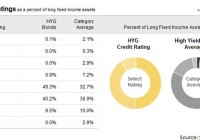
Summary The IShares iBoxx $ High Yield Corporate Bond ETF has the expected credit risk for a high yield fund, but the yield is worth it. The holdings show reasonable diversification in the debt securities in the portfolio. Maturities are scattered from 1 year through 10 years with the heaviest levels in the 5 to 7 year range. The correlation to SPY which causes the ETF to dip with the S&P 500 is a concern of investing in junk bond funds. The correlation issues should be less pronounced if investors include other (not junk, lower yield) bond funds in their portfolio. The iShares iBoxx $ High Yield Corporate Bond ETF (NYSEARCA: HYG ) is a solid bond fund for exposure to securities rated BB or B. As I’ve been searching for appealing bond funds, finding great ETFs for bonds of mediocre quality and higher yields has been difficult. After looking through the portfolio, I think the holdings are fairly reasonable for an investor wanting to regularly keep part of their portfolio in a bond fund. The holdings clearly don’t have impeccable credit ratings but they do offer investors a decent yield. The distribution yield is about 5.5% which means investors are actually getting some respectable income out a bond fund. Credit Quality When the name says “High Yield Corporate Bond”, investors should know that is going to mean that credit ratings won’t be very high. The allocation here seems within reason even if it is a little heavier on the specific ratings it targets than the category average. See the chart below: (click to enlarge) The concentration doesn’t bother me. If I’m going to invest in a credit sensitive bond portfolio I want the holdings to be diversified when considering the issuer of the debt, however having a heavy focus on the specific credit ratings is nice when an investor wants to build an entire portfolio and use multiple bond funds. Holdings I prepared the following chart showing the largest debt holdings of HYG. There were a couple equity holdings showing up but they were inconsequential to the overall portfolio as their combined value was significantly less than 1% of the portfolio. (click to enlarge) Maturities I grabbed another chart to show the maturity ranges across the portfolio: (click to enlarge) The maturity profile for the iShares iBoxx $ High Yield Corporate Bond ETF is fairly reasonable for an investor trying to get a solid diversification across the yield curve with a preference for shorter to medium length securities which should reduce the volatility of the portfolio. Of course, the credit risk on the portfolio could be an issue for some investors and may influence volatility in its own way. Regardless, the portfolio is showing almost no exposure beyond 10 years while having a solid yield. When it comes to maturities, I think this breakdown looks fairly solid. Risk HYG has been around since early 2007 which is wonderful for seeing how the fund did during that challenging period that followed. The shares did drop hard along with the market, which is not surprising given that they are investing in high yield (and thus higher risk) securities, however it did not fall even remotely as hard as the S&P 500. The biggest risk factor from a portfolio standpoint that came up for me was a 73.8% correlation in monthly returns with the S&P 500. Since one purpose of the bond portion of the portfolio is to provide diversification, it is a strike against junk bond funds that they tend to move with the market. That is a problem that should be impacting most junk bonds though, not a risk unique to HYG. Expense Ratio The one thing I really don’t care for is the expense ratio at .50%. I’m not going to say that this is terrible for a bond fund, but my expectations for low expense ratios are not met. Conclusion HYG is a fairly solid option for junk bond exposure. The portfolio appears to be designed well, the distribution of maturities works to help avoid excessive exposure to a single part of the yield curve and the portfolio produces a respectable amount of income. I could go for a lower expense ratio to really make this fund stand out, but that is the only weakness I see that is specific to the fund. If an investor is looking at the role of the bond fund in their portfolio, it would be wise to consider having multiple bond funds if the first one is going to be investing in junk bonds. This kind of fund can offer some diversification benefits to investors but it would be most productive in a portfolio that combines it with a few other bond funds with different duration exposures and higher credit ratings to enhance the diversification benefits that bonds bring to the investor’s portfolio. Disclosure: I/we have no positions in any stocks mentioned, and no plans to initiate any positions within the next 72 hours. (More…) I wrote this article myself, and it expresses my own opinions. I am not receiving compensation for it (other than from Seeking Alpha). I have no business relationship with any company whose stock is mentioned in this article. Additional disclosure: Information in this article represents the opinion of the analyst. All statements are represented as opinions, rather than facts, and should not be construed as advice to buy or sell a security. Ratings of “outperform” and “underperform” reflect the analyst’s estimation of a divergence between the market value for a security and the price that would be appropriate given the potential for risks and returns relative to other securities. The analyst does not know your particular objectives for returns or constraints upon investing. All investors are encouraged to do their own research before making any investment decision. Information is regularly obtained from Yahoo Finance, Google Finance, and SEC Database. If Yahoo, Google, or the SEC database contained faulty or old information it could be incorporated into my analysis.