Tag Archives: news

Short-Term Respite For Gold ETFs?

After being crushed in the last three months thanks to a stronger dollar and lower demand, gold saw some respite yesterday on a dovish Fed stance. Gold rallied the most in three months, suggesting strong sentiment in the space, at least for the short term. Gold started off 2015 on a strong note thanks to its safe-haven appeal as doubts over Greece’s fate in the Euro zone and the looming quantitative easing in that debt-ridden region were widespread. However, all returns soon turned into losses as the U.S. economy kept coming up with sturdy data especially on the jobs and housing front which made the case for a sooner-than-expected rate hike stronger. The SPDR Gold Trust ETF (NYSEARCA: GLD ) lost about 6.5% in the last three months while the Market Vectors Gold Miners ETF (NYSEARCA: GDX ) was off about 25%. However, yesterday, GLD added over 1.3% while GDX was up about 2.9%. GDX saw more gains as it often trades as a leveraged play on gold? What Brightens the Yellow Metal? Muted Prospect of September Fed Liftoff: Yesterday’s move was largely the result of speculations of no imminent rate hike decision by the Fed. Minutes from the U.S. Federal Reserve’s July meeting weakened the heightened prospect for Fed rate liftoff in mid September. Some market participants shifted the timeline of a lift-off to December. This in turn weighed on the greenback. The Fed now looks for further stabilization in the labor market and wants to wait for inflation to reach its target. While job data in the U.S. appears strong, apart from the wage gains, low inflation seems to be the real culprit. Inflation is still short of the Fed’s longer-term target due to the free fall in energy prices last year and declining prices of non-energy related imports, per the Fed minute. The Fed expects the price index to remain under pressure in the near term though it will perk up in the medium term. Notably, U.S. consumer prices grew 0.1% in July, down from 0.3% and 0.4% recorded in the prior two months. All these bolstered the appeal for gold. Fight to Safety on China Currency Issue: In early August, Chinese policymakers devalued the country’s currency by 2% against the greenback to boost its waning export profile. Global experts apprehended a currency war in the near future, especially among the Asian export-centric biggies. As s result, yuan devaluation instigated a rout across the global asset classes and spurred a flight to safety for a valid reason. Gold is long viewed as a safe asset and gained an edge over the other assets thanks to this currency issue. Compelling Valuation: Finally, the metal scored higher on a low valuation, compelling investors to trend back into this space, building positions in this otherwise risky metal. GLD is presently trading at a 15% lower level than its 52-week high price prompting many to take advantage of this sudden surge in gold. Bottom Line Having said this, we would like to note that the Fed is due for policy tightening sometime this year. In fact, a group of analysts is still voting for a September lift-off. Inflation will not be barrier for long, and will put pressure on gold yet again. So, this gain seems a short-lived one and will better suit investors with a short-term approach. After all, GLD has a negative weighted alpha of 11.57 , hinting at more pain. Link to the original article here .
Pampa Energía Is A Good Option For Normalization In Argentina

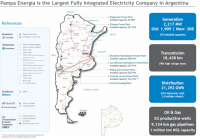
Summary Pampa Energía works in a highly distorted regulatory framework, where frozen tariffs have led to a critical situation for the utility companies. Even in this scenario Pampa Energía has managed to reach a price earning of 5 years. With a new government about to be elected, great improvements could be in the way. Pampa Energía S.A. (NYSE: PAM ) is the largest integrated electricity company in Argentina and through its subsidiaries participates in the generation, transmission and distribution of electricity, as well as natural gas transportation and production. (click to enlarge) Source: Pampa Energía. Pampa Energía owns indirectly: 84% of the generation assets. 26% of the transmission business (TRAN.BA). 52% of the distribution business with Edenor (EDN). 26% of the natural gas transportation business with Transportadora de Gas del Sur (NYSE: TGS )(pending government approval). 50% of the Oil and Gas exploration and production business with Petrolera Pampa (PETR.BA), associated with Yacimientos Petrolíferos Fiscales (YPF). As of August 17th, 2015 the market cap of the above mentioned: (click to enlarge) Source: Yahoo Finance Reminder: Transener and Petrolera Pampa stocks are only listed in the Merval Index, the market cap is expressed in Argentine Pesos -AR$-. Exchange rate as of August 17th: ARS/USD= 9.15. Updated quotes and market cap expressed in USD here . Scenario: Pampa Energía works in a highly distorted regulatory framework where frozen tariffs have led to a critical situation for the utility companies. From 2001 onwards the tariff was converted to AR$ and had practically no adjustments and no longer provides for a reasonable return on capital/assets. Full tariff reviews are pending. High inflation and regulated tariffs that took place since 2006 and 2001 respectively, have led to deep margin erosion for utility stocks. The Argentine utility stocks have underperformed their Latam and EM peers since 2001, these poor returns are explained by significant erosion in real electricity tariffs (frozen since 2001). Gross margin captured by utilities as a percentage of the GDP fall from 0.3% to 0.02%, setting the scope for a possible recovery in profits, if the upcoming political situation leads to a normalization of the current imbalances. For example, the comparison between the residential electricity cost in Argentina and regional peers shows clearly how distorted the public services tariffs are. (click to enlarge) Source: Pampa Energía. Subsidies for electricity and gas purchases cost the government around 4.5% of GDP, and the burden is growing. Some tariffs would need to triple or even be multiplied by seven times to reach market prices. With just a small correction, companies like PAM will perform better. A presidential election is coming in Argentina as of October 25, and the main contenders (Daniel Scioli, Mauricio Macri and Sergio Massa) have expressed its understanding about the need to lift some tariffs caps, in order to reduce the fiscal deficit, which is unsustainable at these levels. As the company’s aren’t capable of fulfilling the investment needs in electricity of the country, and several blackouts occur during the last quarters, the actual government is taking some measures to improve the situation. Two relevant facts take place during 2Q15 for Pampa Energía: 1) “SE Resolution No. 482/15: Increase in the Electricity Generation Remuneration Scheme On June 10, 2015, the Secretariat of Energy issued SE Resolution No. 482/15, in which it updates retroactively the remuneration for electricity generation as of February 2015 commercial transactions.” 2) “Gas Transportation Tariff Increase for Transportadora de Gas del Sur S.A. On June 8, 2015, the National Gas Regulatory Authority -ENARGAS- issued Resolution No. 3,347/15, which grants TGS a tariff increase for gas transportation and operation and maintenance fees of 44.3% and 73.1%, respectively, both retroactive to May 2015.” Source: Pampa Energía 2Q15. This and other measures have improved Pampa´s EBITDA and Profits. In the 2H15 : Consolidated sales revenues of AR$3,457.6 million ($378 million) for the six-month period ended on June 30, 2015, 18.4% higher than the AR$2,921.4 million ($319 million) for the same period of 2014. Adjusted consolidated EBITDA of AR$1,693.3 million ($185 million) for the six-month period ended on June 30, 2015, compared to AR$27.1 million ($9 million) for the same period of 2014. Consolidated profit of AR$1,365.1 million ($149 million) during the six-month period ended on June 30, 2015, of which a profit of AR$963.0 million ($105 million) is attributable to the owners of the company, compared to an AR$80.4 million loss (-$8.8 million) attributable to the owners of the company in the same period of 2014. With a market cap of $900 million, earnings per ADR in the 1H15 of $1.7, and foreseeable earnings of nearly $180 million a year, the forward P/E looks compelling. Just thinking about the replacement cost of its fixed assets, it´s easy to see how PAM is undervalued, and this is mostly caused by a regulatory environment which could improve soon. As a change in the government is approaching, it could be expected that some distortions will disappear, I´m not talking here about free market prices, as it´s “politically incorrect” to raise tariffs by 200% in a single move, but given the current situation, where PAM is trading at a forward P/E of 5, and making money under this difficult scenario, any improvement will boost earnings and improve the company´s situation. Risks: Currency risks are present since it’s widely expected that the new government will depreciate the local currency, but that depreciation will certainly include better tariffs for the utilities as the energy price is partly dollar linked as well as the importations of energy. Political risks are another factor to bear in mind, but as the current government deficit is unsustainable, some adjustments are needed. To conclude PAM is under the current conditions deeply undervalued, and that could increase if the pending integral tariff revision comes in place. If the Argentinean economy is going to improve, massive capex in the electricity sector would be needed, and PAM is in the better position to profit from that. Disclosure: I/we have no positions in any stocks mentioned, but may initiate a long position in PAM over the next 72 hours. (More…) I wrote this article myself, and it expresses my own opinions. I am not receiving compensation for it (other than from Seeking Alpha). I have no business relationship with any company whose stock is mentioned in this article.