Tag Archives: nasdaq

Market Lab Report – Pocket Pivot and BGU Weekly Review for 11/15/15
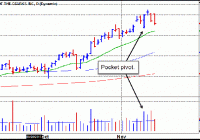
Trading Journal notes from Gil Morales and Chris Kacher regarding recent pocket pivots and buyable gap-ups for the week of 11/9 – 11/15/15: General comments : GM – Most of the recent pocket pivots and buyable gap-ups we have seen have either gone nowhere or declined since early October, even as the general market indexes have been in a strong rally since late September. In fact, the rally has been led by big-cap NASDAQ names, and over the past three days. Here’s a simple breakdown of pocket pivots since early October, just after the general market lows of late September: Down: OZRK, CDW, CTSH, DHI, PLAY, ELLI, NCLH, ORLY, PFGC, SHOP, SBUX, TTWO, TYL, ULTA Flat: STZ, EEFT, HELE, TREE. Up: AYI, DY, FB, GDDY, IDTI, LXFT, MANH, ULTI. While this is not necessarily terrible, we can still conclude that most pocket pivots and buyable gap-ups have not led to significant upside gains. AYI, FB (on the pocket pivot breakout at 97), and MANH have probably performed the best, but keep in mind also that FB most recently failed on a buyable gap-up around the 108 price area.  The main issue for most of these names is whether they are representative of the type of dynamic new leadership that tends to lead robust market rallies. A lot of this just strikes me as rotational in a market where making big money is a difficult proposition.   DRK – Continuing that thought, the best way to make money the last 2 years has been to be quick about taking profits in context with the chart and general market as we have discussed each week in our webinars. Developing one’s chart eye is essential so one can see when a stock gets ahead of itself in price in proper context.  The actionable stocks for this week (OZRK, DHI, STZ) pulled back along with the market on Thursday and Friday, some to support points. LXFT put in the strongest showing as it was up on Thursday and only down a bit on Friday. Its buyable gap up on Wednesday perhaps gave it more strength to buck the weakness in the general market.   GM – OZRK is a financial name, and financials are expected to benefit from higher interest rates. However, this is dependent on what the Fed does in December, and in my view this is not conclusive. One could just as easily buy the Financial Select Sector SPDR Fund (XLF) to play any rising interest rate scenario. Objectively OZRK sold off hard on Wednesday and is now coming into the 20-day moving average. The main issue I would have with this recent pocket pivot is that it is occurring within a reasonably strong and extended prior uptrend. In this market gains like that don’t necessarily have much in the way of sustaining power. DRK – CME FedWatch shows a 70% chance of a rate hike when the Fed meets in December, far from a sure thing. OZRK’s mini-gap lower on Thursday closed near its low on the highest volume in a few weeks, a negative, though the S&P 500 was sharply lower on higher volume both Thursday and Friday, yet OZRK managed to get support at its 10dma. If you own this one, keep your stops tight, perhaps at an undercut of Friday’s low. With the Paris and Beirut news, markets could gap lower at Monday’s open.  GM – STZ is a beverage stock, hence is considered a defensive consumer staple type of name. Tuesday’s pocket pivot has led to little more than a pullback into the 50-day moving average as volume dries up. Theoretically, this would present a lower-risk entry point following the pocket pivot, assuming the stock is able to hold the 50-day line. DRK – Again, keep your stops tight if you own this or plan to buy it near its closing price at the 50dma. If it pierces the 50dma, in a weak market, it can slice right through so be quick to sell should it pierce its 50dma support.  GM – DHI pocket pivoted after beating earnings estimates by a penny on Tuesday, while guiding lower on revenues. The company also raised their stock dividend. Despite the strong earnings report, DHI was not able to break out of its current base, and has slipped back towards the 50-day line as volume dries up, which objectively brings it back into a low-risk buy position after the prior pocket pivot. DRK – This is a lower risk entry but only if you sell should it pierce its 50dma. Your risk would then be less than 1% assuming you buy it near its Friday’s closing price. Notice how the pattern has been a bit wide and loose, thus could easily fall to the bottom of its base should it pierce support at its 50dma.  GM – I think its helpful to review FB since it has had two buy signals over the past month. The first was a pocket pivot breakout back in mid-October, and the latest was a buyable gap-up move following earnings. While FB was able to make reasonable progress (more than 10%) from its pocket pivot breakout around the 97 price area, the more recent BGU has now failed. FB was hit with some above-average selling volume on Friday as the stock broke down through the 10-day line and met up with the 20-day line. This could fail altogether here if it cannot hold the 20-day line, perhaps bringing the stock into play as a short-sale target. DRK – In context with the chart and general market, a stock’s BGU can be held if it does not break below the low of the gap up day by more than 2-3%. A 3% undercut would be 104.7 which FB blew through on Friday on higher volume. It sits at its 20dma. If you own this, your stop should be tight such as a piercing of its 20dma or roughly a sell stop around 103.5. Of course, if markets open lower on Monday and FB gaps lower along with other stocks, that is no excuse to hold onto it hoping it will bounce. 

Cleco: The Closing Of A Stable Growth Story

Cleco Corporation has had a good run, generating investors substantial returns in the form of dividends and capital appreciation. But now, the story is closing, with a potential acquisition granting investors an automatic 10% upside. Invest in Cleco now for the high probability of receiving this upside. Even if the deal falls through, this well-run company can still deliver more upside over a longer time frame. As investors know, small cap companies provide investors with overall better-than-expected returns than mid caps or large caps, and as a whole, they definitely provide a better return than the S&P 500. Small caps are an excellent way for investors to add some more growth potential to their portfolios if they are willing to also pump in more risk as well. However, most investors who are looking for stable returns are unwilling to pump in more risk-these investors like the idea of the company handing them a steady quarterly paycheck, and they are willing to sacrifice the potential large capital gains in exchange for peace of mind and a good night’s sleep. But what if investors want the best of both worlds? Is it possible to get both growth and stability in one investment? Some industries with highly inelastic consumer demands such as the utilities industry or large diversified business segments such as the industrials industry can provide investors with stability, but not growth. But what if investors combined the small cap size of a company with industry stability? That would lead to the small cap utilities company. Enter Cleco Corp. (NYSE: CNL ), a small cap utilities company that serves customers in Louisiana. Cleco is a holding company composed of both Cleco Power, which is the actual regulated electric utilities firm that serves customers in Louisiana, and Cleco Midstream Resources, which is an energy services company. The two different functions that Cleco’s business segments have enable Cleco to vertically diversify some of its operations and offer investors greater stability in the form of supply chain protection and/or stabilization. While the Company has done an excellent job serving its customers over the years and would be an excellent investment in and of itself, there is something going on with the Company that would enable investors to profit without staying invested for too long, as we’ll see later. As investors can clearly see, just from the stock chart, the Company has done investors well over the past five years. Capital invested at the onset of calendar year 2011 would have generated a total return on investment of about 100%, which is excellent given the fact that this is a utilities company we are talking about. In the recent year, the stock price has been stagnating; volatility from normal market fluctuations is clearly visible in the years leading up to 2015, but since then, the stock price has barely budged at all from about $54. Only recently has the stock dipped to about $50.50. This drastic drop in volatility is due to an event we will go more into later on. From a technical perspective, the 50-day moving average has been dancing above the 200-day moving average for quite some time, with occasional dips back down but never staying below the 200-day moving average for long. Recently, the two indicators have converged on each other due to the decreased volatility in share price. (click to enlarge) Source: Stockcharts.com In terms of fundamentals, the Company’s two business segments, Cleco Power and Cleco Midstream Resources, generate a substantial amount of free cash flow for investors to feast on. While free cash flow was mostly negative in prior years, for the past five years, the Company has generated positive free cash flow, which signals a better handling on the businesses’ operations. Dividends have seen increases in the past five years from a constant $0.90 per share up to $1.60 per share TTM; these dividends have been increasing on a non-stop basis since the 2008 financial crisis. Margins have also seen improvement through the Company’s earlier 2005-06 years, and liquidity ratios have mostly held steady. But what’s more important to investors is the potential deal to acquire the Company that could close very soon . This deal would essentially allow Cleco’s shares to be acquired for $55.37 per share, which represents about a 9.3% premium over the current market price within this week. This deal was announced last year and is expected to close in the 2nd half of 2015, although investors are waiting to see whether this deal will get approved by regulators. The most important regulator in this deal is the Louisiana Public Service Commission, and without the approval of this regulatory body, this deal will fall through. Some members of the commission are leaning against the passing of the deal , but members are keeping an open mind. Should the deal close, an automatic almost 10% return on investment would be cherry on top of an already great investment that has generated investors substantial capital appreciation and dividends. While the latter has passed already, an investment in Cleco now will yield a good chance of a 10% return given the high probability of the deal passing through.

The V20 Portfolio Week #6: Shift In Portfolio Weights

Summary The V20 Portfolio declined 7.3% against S&P 500’s decline of 3.6%. The biggest position has been trimmed. No purchases were made for Conn’s as the stock has rebounded from its previous lows. Dex Media could be nearing the final verdict. The V20 portfolio is an actively managed portfolio that seeks to achieve annualized return of 20% over the long term. If you are a long-term investor, then this portfolio may be for you. You can read more about how the portfolio works and the associated risks here . Always do your own research before making an investment. Read last week’s update here ! The market has become bearish again. This week was one of the worst weeks for the averages in months, with the S&P 500 slipping 3.6%. Unfortunately, the V20 Portfolio followed suit with a decline of 7.3%. However, due to the strong performance in the previous week, the V20 Portfolio is still positive for the month while the index is down 2.6%. Portfolio Update As I mentioned in last week’s update, this week the V20 Portfolio had to endure its biggest test. Our largest position, MagicJack (NASDAQ: CALL ), reported earnings on Monday. Although initial reactions were positive, the stock has since declined 10% to $10.30. I have been talking about trimming the MagicJack position for a couple of weeks now. Third quarter results were the push that I needed. You can read my analysis of MagicJack’s current situation here . The bottom line is that the company has transitioned into a growth stock. Although I don’t like to admit it, core operation has deteriorated (i.e. lower renewal revenue), and if the trend continues, a significant amount of value will have to come from growth. Because third quarter results were not a “smash hit,” there was no reason to maintain a large position in MagicJack. After Q3 earnings, 50% of the position was sold, lowering the portfolio’s exposure from 39% to 19%. Although I trimmed the position, the company is still around 50% cash, so relatively speaking, the downside is limited. Furthermore, new developments (Hoteligent, Movistar partnership) added significant option value to the stock. If executed well, both partnerships could be highly profitable as there is minimal capital requirement. For that reason, I believe that a 19% weight on MagicJack is justified. Moving on to our now largest position, Conn’s (NASDAQ: CONN ). While I would be happy to add to the position if the stock was trading around $19 (as was the case two weeks ago), the fact that Conn’s has rebounded from its lows means that the stock has now become more expensive than before. For that reason, I’ve decided to stay put for now and wait for a better entry point. Although it is my hope that Conn’s will decline in the near future so I can pick up more shares at a cheaper price, the management is currently executing a share repurchase program, exerting upward pressure on the stock. This is probably the reason why the stock didn’t move much in comparison to its typical volatility (only declined by 4% this week). Looking Forward With earnings season now over, there won’t be as many decisions that we have to make in relation to our holdings’ fundamentals. Nevertheless, the stock market will continue to gyrate in absence of any news, so I will continue to monitor the portfolio and seek opportunities to trim or add as I have done with MagicJack this week. There is one thing that we can look forward to however. I haven’t talked too much about Dex Media (NASDAQ: DXM ) since the position is so small (0.4%). You can find a brief overview of the company in the portfolio introduction. The initial investment rationale was that there was a chance that restructuring could provide a favorable outcome for shareholders (e.g. extending maturity). Currently, the sentiment is very negative. Although there were no official news, the stock was down 50% on Friday on rumor that the company will be pushed into bankruptcy. I invested in Dex Media with the knowledge that there was a high risk of bankruptcy, hence I sized the position carefully, so I am not too concerned. Given current prices, it is clear that the market believes that equity holders will be completely wiped out in the resulting restructuring. Of course, if equity holders do get a stake or if maturities are extended, shares could appreciate significantly. With official filing expected in December (according to the rumor), this is definitely something that we should look out for. Given the portfolio’s current weight on Dex Media, this is really a situation where it’s heads I win, tails I lose very little. Editor’s Note: This article covers one or more stocks trading at less than $1 per share and/or with less than a $100 million market cap. Please be aware of the risks associated with these stocks.