Tag Archives: nasdaq

Market Lab Report – Pocket Pivot Review for the Week of 11/16-11/20 2015

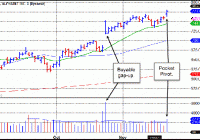
Trading Journal notes from Dr. K and Gil regarding this past week’s pocket pivot reports.  Pocket Pivots: Alphabet (GOOGL) DRK – supercap technology stocks have been leading the market as shown in the performance of the NASDAQ-100 which is comprised of the larger cap tech stocks. GOOGL gapped higher on its prior earnings report and has since moved higher. In a risk-on environment, the largest cap leading names tend to outperform the smaller cap names as the Russell 2000 has been severely lagging. GM – this pocket pivot is coming off the 10-day line in continuation fashion following a buyable gap-up after the company announced earnings in late October. In a case like this my preference would be to buy the supporting day at the 20-day moving average five days ago on the chart while looking for some sort of low-volume pullback into the 10-day line as a lower-risk entry.  Luxoft Holdings (LXFT) DRK – stock gapped higher on its prior earnings report, and since has traded sideways in constructive fashion. Its pocket pivot if still within the sideways consolidation so could have been bought. Since 5 days have passed since the gap higher, should the stock break below the low of the gap up day, it should be sold. A 2-3% allowance under the low of the gap up day is allowed if it occurs within 5 days after the gap up day. GM – company is a small player in outsourced IT services and relatively thinly traded at about 229,000 shares a day. I’ve noticed that the spread on this puppy can get as much as 40-50 cents wide during certain times of the day, which makes it a little difficult to buy or sell at times. But it may be “revving up” to move higher with a number of pocket pivots and a buyable gap-up in the pattern. ServiceNow (NOW) DRK – breaking out to new highs so is extended. It could be bought on a pullback to its 10dma. GM – This is probably best bought on low-volume pullbacks into the 10-day line. Notice how trying to chase Wednesday’s pocket pivot as the stock moved higher on Thursday or Friday was probably late as the stock stalled out and closed at the lows of its trading range on both of those days. INC Research Holdings (INCR) DRK – just broke above its double bottom midpoint. The right side of double bottoms should have stronger upside thrust especially in an uptrending market. This is a sign of weakness in the pattern. On the other hand, earnings have been soaring over the last several quarters, but keep in mind that future earnings surprises are more important than what everyone already knows. GM – this stock is actually trying to break out through the mid-point of a double-bottom type of base. The middle peak of the “W” in the double-bottom is the peak at the right of the chart, and you can see how the stock broke out through that high on above-average volume on Friday. Of course, buying as close to the 10-day line as possible following the pocket pivot on Tuesday gets you in earlier.  Integrated Device Technology (IDTI) DRK – this gapped higher on its prior earnings report, then undercut the low of the gap up day by -2.6% so could have been held. It is now extended as it breaks out to new highs. GM – this has been one of the strongest semiconductor names in the market since early October, and we have reported on this several times on the way up as it has flashed pocket pivots along the 10-day line. Tuesday’s pocket pivot led to a breakout later in the week, so from here you’d want to wait for a low-volume pullback back into the 10-day line.  

Restaurant Investing: What Early Investors Should Look For In An IPO Opportunity

Summary What are the telltale signs that a company’s stock is worth its post-IPO price? Do investors need to look beyond mere hype to make such a crucial decision as putting their money into a business? What are the metrics that an investor needs to closely review before making that investment decision? Photo Courtesy: Value in Wall Street Investing in a company that’s going to IPO is a difficult decision to make. With all the hype surrounding restaurant IPOs these past five years, the abundance of “noise” made by early investors and even the companies themselves drowns out the “right noises” that should be heard by anyone interested in getting in. Introduction The first point to remember is that it is never too late to invest in a stock as long as the company has a solid foundation of financial and operational management. In that respect, the CEO and CFO are the most important people to get to know because they carry the bulk of the responsibility for managing operations and finances. The second point – a deeper one – is how they’ve been performing in the years preceding the IPO. Very often, investors will merely look at the current revenues or average sales volume or unit growth published in the IPO prospectus, read a few articles from expert financial analysts and then jump headlong into the investment. More often than not – and this is because the vast majority of investors can’t actually get in at the IPO price – they are forced to buy at prices much higher than the actual performance of the company warrants. To help investors make better decisions, we’ve studied one of the best performing companies of this decade and showcased their metrics to elucidate what we mean when we say that management and margins should be the factors driving investor sentiment – and not the “campaigning” surrounding an initial public offering. Background For the purpose of this showcase, we’ll be looking at Chipotle (NYSE: CMG ), which is one of the top performers in the fast casual segment. In an earlier article, we discussed how this burrito maker crushed 3 prevalent myths about restaurant investing. In this article, we’ll see something entirely different: what were those early signs that told us that this was going to be a good company to invest in? The end objective here is to allow investors a deeper and broader insight into the decision-making process that should necessarily precede an IPO investment. With close to 1,800 restaurants efficiently serving burritos and other Mexican fare since the 90s, CMG is a fast casual restaurant that boasts one of the highest AUVs in the segment – $2.47 million over the last full fiscal (2014). Consider that its AUV growth for the three years preceding the IPO stood at above 6%, and you’ll know that comp sales growth contributed to a large part of that – growing an average of 16% in the three years before going public – as did aggressive but well-planned unit growth, which saw units go from 229 at the beginning of 2003 to 481 at the end of 2005 – a growth of 210%. When all these factors work together, they produce a solid foundation on which to base an investment decision. Of course, not all companies can boast stellar numbers before their IPO year, but the fact remains that these indications must necessarily be there in part. Anything less would likely miss the whole point of investing – to acquire, hold on to and benefit from a share of a consistently profitable public company. Analysis If you had delved into Chipotle’s margins reports for the five years preceding the IPO, this is what you would have seen: Strong cost control action on several fronts like occupancy, labor, food and pre-opening costs. An operating cost that went from 118% of revenue to 95% of revenue in 5 years. A net income percentage that grew from -18% to over 6% during that time. Five Years Pre-IPO Fiscal year 2005 2004 2003 2002 2001 Total revenue 100.00% 100.00% 100.00% 100.00% 100.00% Food, beverage and packaging costs 32.23% 32.75% 33.25% 33.07% 34.37% Labor costs 28.47% 29.63% 29.80% 32.50% 34.99% Occupancy costs 7.59% 7.69% 8.10% 9.15% 8.92% Other operating costs 13.22% 13.65% 13.80% 14.56% 16.38% General and administrative expenses 8.28% 9.53% 10.84% 12.61% 15.72% Depreciation and amortization 4.46% 4.63% 4.78% 5.50% 6.63% Pre-opening costs 0.31% 0.47% 0.52% 0.50% 1.71% Loss on disposal of assets 0.50% 0.36% 1.43% 0.73% 0.06% Total costs and expenses 95.06% 98.70% 102.51% 108.62% 118.79% Income (loss) from operations 4.94% 1.30% -2.51% -8.62% -18.79% Income (loss) before income taxes 4.82% 1.30% -2.44% -8.45% -18.24% Net income (loss) 6.01% 1.30% -2.44% -8.45% -18.24% If that data weren’t sufficient, you could have taken a look at its comparable store sales and average unit volumes, which were equally impressive: 6% growth in average unit volume for the three years preceding the IPO. 16% comp sales growth average for the period. Fiscal Year 2005 2004 2003 Average Restaurant Sales $1,440 $1,361 $1,274 Comparable Store Sales 10.20% 13.30% 24.40% If you still weren’t convinced, you could have looked into how fast it was growing its stores: A jump of 270% in the number of stores – all company-owned – between the beginning of 2001 and the end of 2005. Fiscal Year 2005 2004 2003 2002 2001 Units 481 401 298 229 177 Conclusion From what you would have seen of its Margins, Comp Sales, AUVs and Unit Growth in the 3-5 year period before it went IPO, you would have realized that this is a company with strong management and bright prospects for the future. So what about companies that are going IPO now or in the near future? Well, take a look at their metrics – just like we did for Chipotle for the years leading up to the IPO. Do they show strong or improving margins? Or both? Are they steadily growing their stores while keeping their pre-opening costs, occupancy and other current liabilities in check? Is their AUV improving or at least holding while they add more units? Are they going overboard on G&A using unit growth as the reason? Are their prime costs (food and labor) within reasonable bounds for the segment? These are questions that every investor in an IPO must necessarily ask. While this is no guarantee that a company that shows these positive indicators will make you money in the future, it gives you as educated a perspective to make your decision from as possible. Over the next week, we’ll be covering several recently-gone IPOs in the restaurant industry to try and arrive at some common denominators that underline strong performance and stability in a company. If you enjoyed this article, we’d be pleased as punch if you would do us the honor of reviewing our extensive coverage of major and minor players in the restaurant industry, and commenting candidly on what you think about them. Click here to see all other articles in our profile page. Some of the companies where investors were affected by “IPO-itis”: Potbelly (NASDAQ: PBPB ) PBPB data by YCharts Wingstop (NASDAQ: WING ) WING data by YCharts The Habit Restaurants (NASDAQ: HABT ) HABT data by YCharts El Pollo Loco (NASDAQ: LOCO ) LOCO data by YCharts Bojangles’ (NASDAQ: BOJA ) BOJA data by YCharts

25% Allocation To Apple – Too Much Risk?

Summary Apple remains my largest position at 25.9%. The portfolio risk factor is not necessarily increased with position size. Reflect your knowledge or confidence in a company with your position size. After releasing the details of my Young and Cautious portfolio , one of the most frequently presented criticisms is of the very high allocation to Apple (NASDAQ: AAPL ). My current allocation is just north of 25%. Company Current p/e Current yield Annual dividends ($) Portfolio weighting (%) Apple 13 1.75 110.2 25.9 Aberdeen Asset Management ( OTCPK:ABDNF ) 10.53 5.21 130 9.6 Bank of America (NYSE: BAC ) 13.07 1.13 5.8 2 Coca-Cola (NYSE: KO ) 27.47 3.08 36.96 5 DaVita HealthCare (NYSE: DVA ) 33.16 0 0 11.6 General Motors (NYSE: GM ) 13.24 4 72 7.5 Gilead Sciences (NASDAQ: GILD ) 9.78 1.61 46.44 11.9 McDonald’s (NYSE: MCD ) 24.64 3.12 27.2 3.7 Rolls Royce ( OTCPK:RYCEY ) 8.28 4.18 62.42 7.5 Transocean (NYSE: RIG ) n/a 4 100.8 11 Wells Fargo (NYSE: WFC ) 13.51 2.7 27 4 Note: Average Yield = 2.6% The following comments sum up the main criticisms of the portfolio, which can be found in Young and Cautious – One month on and First Portfolio review – Young and Cautious , respectively. (click to enlarge) (click to enlarge) Although I respect the views of many commentators and contributors, I do not accept that the best strategy for an active investor is to just divide your capital equally among a list of companies that you think might perform well, regardless of their individual valuations and business circumstances. I will set out below why a higher allocation in a common stock does not necessarily lead to higher overall risk for your portfolio, and specifically, why I have allocated such a large percentage to Apple. Risk Risk can be split up into systematic risk and company specific risk, or non-systematic risk. However, for the purposes of this article, only company-specific risk will be analyzed. When talking solely about stocks, it is undeniable that non-systemic risk can be mitigated through splitting your capital among a variety of common stocks. This leads many investors to argue that the best way to reduce risk is to evenly distribute your capital over all your holdings. For example, 10 stocks with 10% weighting, or 20 stocks with 5% weighting. Many writers disagree on the ‘perfect number’ that provides the best risk/reward scenario for an active investor. Arguments generally range from 10 at the low end, to around 40 at the high end of the scale. Anything higher than this leads to a significant amount of money spent through transaction costs, which will impact significantly depending on how frequently positions are bought and sold. A higher number of stocks in a portfolio would most likely warrant the need to just take on a more passive approach through using a cheap index fund, such as provided by Vanguard. The risk that is not mentioned when talking about diversification Apart from individual company risk and systematic risk, one of the most prominent risks inherent in over-diversification is yourself. Your knowledge and time has to be spread over a higher number of companies, undeniably leading to the risk of gaps in your knowledge. This could be not having enough time to go through each company’s quarterly reports and individual valuations. This inefficient manner of investing has the potential to lead to sub-par returns. In addressing this view, investment icon Warren Buffett has stated: Once you decide that you are in the business of evaluating businesses, diversification is a terrible mistake to a certain degree. His reasoning is based on the idea of the mistake of omission in investing: Big opportunities in life have to be seized … Doing it on a small scale is almost as big a mistake as not doing it at all. This is not a scarcely held belief of prominent investors around the world. Below you see how frequently a large position plays a role in those investors’ portfolios: Warren Buffett Wells Fargo 19% Kraft Heinz (NASDAQ: KHC ) 18% David Einhorn Apple 20.5% Carl Icahn Icahn Enterprises (NASDAQ: IEP ) 27.5% Apple 21% Bill Ackman Valeant Pharmaceuticals (NYSE: VRX ) 25% Air Products & Chemicals (NYSE: APD ) 18.8% Chase Coleman Netflix (NASDAQ: NFLX ) 22.9% Amazon (NASDAQ: AMZN ) 20.1% Although not all of the companies have performed well over the past year, most notably Valeant Pharmaceuticals, most of them have. This high allocation in a company would classify as a ‘conviction buy’, exemplifying each investor’s confidence in these respective companies. It is what separates them from the rest of the market, allowing them the opportunity to beat the market returns. Know your strengths Every investor has their own strengths. This is down to the fact that whatever their profession is, or if they have a strong passion for something, they will generally have a deeper knowledge of it. This gives them an advantage over the general public and can give them the edge when it comes to putting their capital to work. This can be reflected in your portfolio. For example being a student has its perks. Many trends over what is popular originate from this age group. This could be said with regards to Apple, Facebook (NASDAQ: FB ) and Nike (NYSE: NKE ). What is popular with this age group has a tendency to spread to other age groups to create the norm. Looking back at Facebook, I grew up alongside the likes of Bebo, MSN Messenger and MySpace. My age group saw a shift from these social networking sites to Facebook, because we were causing the shift. Examples such as this give investors of certain age groups, professions, or hobbies that advantage in the market. This is one of the reasons why I am still so bullish on Apple. Regardless of what some financial news websites publish about Apple losing it’s ‘shine’ or ‘cool factor’, it is evident that Apple still has the backing of its supporters. It only takes a trip to any university library to see the momentous number of Apple products being used by students, who are in effect the future. For example, the Mac lineup has been of great popularity. Many students are making use of their university discounts and either upgrading from the previous model or other brand laptops. Growing up, these students will see Apple as the norm and are more likely to continue using their products. On the contrary, there are many areas where my knowledge lacks. This could come down to being young, lack of interest in the subject matter, or just plain ignorance. This is absolutely fine. It just means I don’t invest in these areas. If I invested in these areas for the sole reason of ‘achieving diversification’, I would be opening myself up to a great deal of risk. This is just not necessary. When opportunities are present, grab them by the horns The second part of investing in your strengths is investing at the right price. There are many companies I see doing well. Nike and Starbucks (NASDAQ: SBUX ) are both companies I want to own, just not at these prices. There is too much optimism built into the stocks. On the other hand, Apple is a company I understand well. I have a strong insight into how my generation sees their products and services over their competitors, and most importantly, the valuation is cheap. Valuation The company stands at a huge discount to the overall market. Apple’s trailing P/E ratio stands at just under 13 while the forward P/E is 11. This represents a 41% discount to the current ratio of the wider market, currently standing at 22. Apple is priced for a deceleration in earnings, while it is posting ever-growing earnings. The last earnings report showed EPS growth of 38% over the previous year, with guidance showing further record earnings for the near future. An earnings growth that surpasses the wider market. In addition to this, I believe Apple has in recent years been paving the way to become a future dividend champion. It is managing to consecutively increase dividend payments to shareholders year over year, while maintaining a low payout ratio. Currently, the dividends to shareholders represent only 21% of total earnings. This gives the company a great deal of room to increase payments several years from now. On top of this, Apple stated in April of this year that the share repurchase program would be increased to $140 billion. What are my risks? Having over a quarter of my capital in one stock does mean that if the share price drops significantly, this will drag down the portfolio significantly. Bill Ackman has recently been a victim of this, as Valeant has dropped like a rock after allegations of price gouging surfaced. This has led to him suffering a severe loss of capital and significant underperformance to the market. To compare this to Apple would be unfair. Apple has many factors that give it a large margin of safety to prevent this. First of all, almost a third of the entire market capitalization is made up of cash and equivalents, and this continues to grow. This allows Apple to raise cheap cash in corporate bonds to facilitate large share repurchases. Secondly, Apple’s great P/E discount to the wider market and higher growth rate provides a safety buffer, as it is already priced for no growth. The only time I will reduce this high allocation is if either of two things happen: Earnings begin to fall, or the share price rises resulting in a P/E ratio similar to the wider market. Conclusion Everyone has their strengths in investing. This means having a high allocation of your capital in one company will carry different risks depending on who owns that particular company. When you have the opportunity to own a good company trading at a cheap valuation that you have a deep understanding of, allocate more capital to this to increase your chances of outperforming the rest of the market. Thank you for reading. If you have enjoyed reading this article, or want to follow the progress of the ‘Young and Cautious’ portfolio please hit ‘follow’ at the top of the page. Editor’s Note: This article discusses one or more securities that do not trade on a major U.S. exchange. Please be aware of the risks associated with these stocks.