Tag Archives: nasdaq

Sector Investing: Why It Matters

This was originally published on December 29, 2015 Within the S&P 500, there are 10 sectors that comprise the key benchmark, and it remains my preferred way of dissecting the market for clients, and giving clients an orderly structure or framework to think about the giant morass that is the capital markets. The primary tool for analyzing sectors for clients remains the excellent sector earnings work done by Thomson Reuters and FactSet, as well as Howard Silverblatt of Standard & Poor’s, and Estimize (although Estimize has a narrower focus than the other firms) which is shared every week on this blog for readers. (Sam Stovall of Standard & Poor’s wrote a book on sector investing that was published in 1996. I just found the book on Amazon and bought it for some holiday reading this weekend.) Why worry about sectors? Well, give this a little thought: The bull market in the S&P 500 that ran from August 1982 to March of 2000 was dominated by two sectors: Technology and Financials. A lot of the old market pundits and the so-called gurus from the 1990s used to say that “The Financials are the market generals” and there was real truth to this. The Financials were the S&P 500’s primary market leader in the 1980s and 1990s. The S&P 500’s decade-long bear market from 2000 through 2009, the decade with the lowest average return for the S&P 500 since the 1930s, was a result of brutal bear markets in two sectors (guess which sectors): yes, Financials and Technology. Technology came first, with the Nasdaq correcting 80% from March 2000 through October 2002, and then the mother-of-all sector corrections with Financial stocks correcting (looking at the Financial Select Sector SPDR ETF (NYSEARCA: XLF )) from $38 to the $6 area from mid-2007, though late 2008, early 2009. Technology as a percentage of the S&P 500’s total market cap hit a peak of 33% in the first quarter of 2000 (really unbelievable when you think about it) and Financials hit their peak in mid-2007. I thought that Financials had gotten close to 30% as a percentage of the S&P 500’s market cap, but from looking at historical data, maybe Financials’ peak total of the S&P 500 was closer to 25% rather than 30%. The reason the Energy bear market hasn’t really impacted the S&P 500 like the Technology and the Financials’ collapse is that when crude oil started to fall from $110 to today’s $35-$37 per barrel, Energy as a percentage of the market cap of the S&P 500 was just 10%. It is now roughly 6.5% today. As the above implies, “Size (in terms of market cap) Matters”. Three bear markets: Technology, Financial and Energy – all sector-driven. Here is our latest spreadsheet where we updated sector weightings ( FC – marketcapvsearningswt ). As readers can see from this spreadsheet, Technology and Financials remain the two largest sectors within the S&P 500 at 37% of the S&P 500, and since they had their absolutely crushing bear markets in the last decade, what are the odds (in your opinion) that Technology repeats 2000-2002 or Financials’ 2007-2009? 20% corrections can happen at any time for a variety of reasons, but would a reader think that Financials and Technology could correct 30% or 40%? Here are the sector weightings for the S&P 500 as of late December 2015 (courtesy of Bespoke, rounded to the nearest 1%): Technology: 21% Financials: 16% Health Care: 15% Consumer Discretionary: 13% Industrials: 10% Consumer Staples: 10% Energy: 6%-7% Utilities, Materials, Telecom: 3% each The top 5 sectors of the S&P 500 are 75% of the market cap of the S&P 500. The top sectors which we’ve discussed at length are 37%. Consumer Discretionary’s 10% return year to date is heavily influenced by Amazon (NASDAQ: AMZN ) since the stock is a member of the Consumer Discretionary sector. Bespoke has noted that without Amazon’s 140% return year to date, Consumer Discretionary would be up just 2%-3% in 2015. Conclusions about 2016: Given the above, and the Technology and Financials’ weights, I just don’t think there is a sustained bear market in our future. Technology and Financials remain the largest sector overweights for clients coming into 2016. I’m leery of Health Care in a Presidential election year. I do like Industrials in 2016 IF the dollar can remain right where it is, or weaken a little. The biggest change to client accounts in the last 4 months has been adding the Energy Select Sector SPDR ETF (NYSEARCA: XLE ), and the iShares U.S. Energy ETF (NYSEARCA: IYE ) to client accounts with the market correction in August-September. We haven’t had any Energy exposure for years. There is more owned now than at any time in the last 5 years. Also bought in September, early October were the Vanguard FTSE Emerging Markets ETF (NYSEARCA: VWO ), and the iShares MSCI Emerging Markets ETF (NYSEARCA: EEM ), or the Emerging Markets ETFs. The underperformance of emerging markets relative to the S&P 500 the last 7-8 years has been remarkable. We have never owned Emerging Markets for clients before these positions. Finally, I took a shot at some Brazil (NYSEARCA: EWZ ), the last month. Brazil is the confluence of Energy risk, commodity risk, socialism, and inept incompetence, in one ETF. There is an approximate weighting of 5% in Energy, Emerging markets and Brazil in client accounts, depending on a number of other factors.
Market Lab Report – 2015 Year-End Review and Summary

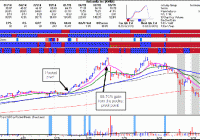
2015 has been one of the most challenging, trendless yet choppy years seen in decades. As a consequence, hedge funds have had one of their worst performing years, and some media souces have cited 2015 as the “most difficult” market in 78 years. Even the performance-tracked trend-following wizards, a collection of top traders who have been interviewed in “Market Wizard” type books and who have been running hedge funds for at least several years if not longer, have once again collectively lost money as of November 30, 2015. They will post final results in early January 2016. Indeed, each year seems worse than the last so we have had to create new strategies to keep profits alive. Finding early entry points within bases rather than buying into obvious O’Neil-style base breakouts through the use of pocket pivots and “voodoo” pullbacks within base structures has been critical. Once an advantage is gained by implementing some of our early-entry buying methods, selling into strength in context with a stock’s chart and keeping stops extra tight such as we illustrated in some of our weekly pocket pivot/buyable gap up reports has been essential to making any kind of progress in this market. By doing so, a gain of 10% or more can easily offset a few small losses of 1-2%. That said, earlier this year, profits came more easily.  Profits in individual stocks well beyond 20-25% were achievable. In the first half of the year, a number of high quality names (SUPN, AMBA, SKX, etc) hit our screens resulting in profitable summary reports such as the one we emailed in June: http://www.virtueofselfishinvesting.com/reports/view/market-lab-report-stocktalk-sunday-edition-6-14-15 Ambarella (AMBA) illustrates the treacherous action that often characterized even the best-performing names. In mid-May, we issued a pocket pivot alert for the stock as it was still in its base, and this led to a sizzling 68.7%, five-week upside move to the peak in mid-June. However, if one had held the stock two days too long after the peak day, over half of those rapid upside gains dissolved instantaneously. The key sell signal came on 6/19, one day after the stock peaked on 6/18. Downside volume was the highest in the history of the stock. Further, the stock was clearly getting ahead of itself such that one could sell at least half of one’s position on 6/19. It closed at 119.35. Then the next trading day, on 6/22, the stock gapped lower, opening at 112.61, which would be the “sell all” signal if you still held any shares. The stock then moved a lot lower that day, closing at 94.36. But since June, profiting in stocks has been a major challenge. In a nutshell, the pickings have been slim. The fall in junk bonds accelerated in June of this year which put pressure on the stock market much as it did in 2007-2008 before the big crash. As we mentioned, when junk bonds plummet, the stock market corrects along with junk bonds. The correlation is quite high, as can be seen in the comparison chart of the iShares High-Yield Bond Fund (HYG) and the NASDAQ Composite Index, below. Meanwhile, oil and other commodities continue their slide which also pressures stock markets, as can be seen in the comparison chart of the Powershares Commodity Index ETF (DBC), below. Quantitative easing (QE) has been unable to resuscitate global demand as a growing number of countries sink into recession. Despite these troubling times, governments continue to raise taxes which is often the final nail in the economic coffin. In fact, major world governments with the exception of China are doing everything they can to extract as much tax as possible from their citizens. For example, the US has pressured the Swiss government to hand over all its private records of those who keep valuables in Swiss warehouses. The Chinese, for example, buy works of art worth millions of dollars, then store them in these warehouses. They do it to move money out of China as the Chinese government prohibits any Chinese citizen from moving more than the equivalent of roughly $50,000 out of the country. Crippling their respective economies by attempting to extract as much tax as possible, governments delay any true global economic recovery.  The silver lining is that the Federal Reserve has hiked rates for the first time in a decade, thus the U.S. markets may no longer be on the QE bandwagon. If we assume that the Fed’s dot plot proves somewhat accurate, they should hike rates a few times in 2016. This may restore some normality to stock markets. That said, the repercussions for low grade loans may be dire. Many such loans have been made due to historically low rates as individuals, businesses, and governments have levered up again as they did in 2007-2008. This in itself is a potential bubble waiting to burst. The pin that pops the bubble could be an additional rate hike or two. The best cure would likely be a proper bear market or crash that is long overdue. Perhaps this would be the equivalent of hitting the reset button. Since the dot-com bubble burst in the early 2000s, stock markets have behaved differently. Base breakouts and CAN SLIM type names no longer worked well compared to the 1980s and 1990s. Thus, the pocket pivot and buyable gap up concepts were born in 2004 then put to the test in 2005. Then when QE market manipulations began in late 2008, markets behaved in a manner that was even more at odds with many decades of market history. Most tried-and-true indicators stopped working. Thus investors lost money by trying to hang onto market history.  The latest challenge has been 2015 which has been choppy and trendless. Much as the pocket pivot and buyable gap up strategies were born from the post-dot-com bubble market wherein most base breakouts stopped working, the VIX Volatility Model was born from this year’s trendless market. The model especially enjoys volatility, trendless markets such as the one in 2015, as well as low volatile, uptrending markets. Testing has shown profits far exceed the small losses. The fail-safes make a big difference to the strategy’s risk/reward profile, so the beta phase has been worthwhile. We thank you for your patience.  As one can see from the model’s last few signals, losses are typically contained to within 0-1.5% while gains are typically 3% or more as the current signal sits on a 8.2% gain using 2x ETF UVXY. For record keeping purposes, UVXY will be used as the benchmark as prior testing shows this to be the optimum instrument on BUY signals which over any given cycle tends to well outperform in back tests.  So as for the New Year, stay tuned for new developments at home and abroad which may be fraught with shock and surprise as 2016 may well prove to be one of the more volatile years on record given that central banks around the world continue to paint themselves into a corner. Volatile markets such as 2000-2002, 2008, and 2011 often bring great market-timing profit opportunities. VoSI members should not let a difficult market year as we saw in 2015 cause them to freeze up. It is critical that investors maintain optimistic vigilance, since the greatest market opportunities tend to occur when we least expect them. In our first book, “Trade Like an O’Neil Disciple,” we discussed how bleak the market was looking on October 23, 1999. At that time, William J. O’Neil, for whom we were both running money back then, declared that “This market is through.” Four days later the market followed-through in an historic parabolic rally that carried into the peak of March 2000. It was literally a life-changing event for both of us as our double-digit performance up until October 1999 ballooned to over +500 to +1,000% in just a couple of months. The lesson here is that even the greatest traders on the planet can’t see the future and can’t be aware of when the market’s most fantastically profitable and historic opportunities will present themselves ahead of time. They can only move in sync and in tune with the available real-time market evidence and thereby put themselves in the position of “getting lucky.” Market pundits and commentators make a living writing and prognosticating about what a new investment year will bring, but ultimately it is merely blather and bloviation.   Had we relied on some sort of macro-prediction or “outlook” for the market in October of 1999, we might have missed the follow-through day on October 27th and the start of one of the most amazing year-end stock market runs in history. Thus our message for 2016 is simple: Predictions are useless. Keep an open mind and let the market tell you what it is doing in real-time, and be prepared to put yourself in the position of being able to “get lucky.” Dr. Chris Kacher & Gil Morales

Does Low Growth Mean Lower Investment Returns?

Why U.S. potential GDP has declined. Investors should lower their expectations of future returns. Low growth comes with both higher opportunity and higher risk too. With little fanfare, the Federal Reserve recently reduced their estimate of the U.S. economy’s long-term potential growth rate. To be sure, the Federal Reserve has a less than enviable record forecasting GDP, or inflation for that matter. In fact, the Fed has systematically overestimated growth for many years now. In six of the past seven years, actual GDP growth has been outside the Fed’s central tendency or forecasted range. For 2015, real GDP is on track to increase at an annual rate of 2%, which is at the lower bound of the Fed’s initial estimate. This should not be a surprise to anyone. After all, forecasting is a tough science and there are few people that can boast of consistent success. We are all left to wonder whether the Fed’s reduction of potential GDP from a range of 2.0% to 2.3% to 1.8% to 2.2% is at all relevant. The cynics can rightfully be excused for believing that Fed’s action to trim potential GDP growth is a cherished signal that real growth is set to break out on the upside. It may be helpful to recall that GDP is simply a function of changes in two key variables: the employment participation rate and employee productivity. If we accept this premise, then the prospects for future GDP growth are indeed worrying. The civilian labor force participation rate, rather than increasing, has been decreasing at a rate of about 1% since 2008. Similarly, trend productivity, as measured by the Nonfarm Business Sector: Real Output per Hour of All Persons, is downward sloping as shown in the following chart: With both the employee participation rate and productivity declining, it is hard to see real GDP growth returning to the 3.5% to 4.0% range we enjoyed in decades past. Slow growth is now the new normal, which, if realized, has broad implications for investment returns over the medium to longer term. First, it should be no surprise that the iShares S&P 500 Growth Index ETF (NYSEARCA: IVW ) handily outperformed the iShares S&P 500 Value ETF (NYSEARCA: IVE ) by 9.24%. In a low growth environment, investors are sure to pay up for growth. Next, in a slow growth environment, companies will increasingly find it difficult to increase dividends, although they should be able to maintain current payouts, unless we face an earnings recession. However, as interest rates rise, as is currently the case, dividend payers will lose their luster relative to less risky alternatives like U.S. Treasury Notes. The two most popular dividend ETFs, the iShares Select Dividend ETF (NYSEARCA: DVY ) and the Vanguard Dividend Appreciation ETF (NYSEARCA: VIG ) , both sport small total return losses for the year. It is interesting to note that according to FactSet, “shareholder distributions for companies in the S&P 500 amounted to $259.8 billion in Q3 (October), which was the highest quarterly total in at least ten years.” Companies are paying out record amounts of cash via dividends or buybacks, yet investors are marking down theses shares’ prices due to lower expected future growth prospects. A dividend yield of 5% is not advantageous if the company’s stock price drops by 5% too. Reader of Thomas Piketty’s Capital in the Twenty First Century can take comfort in the fact that slow growth, circa 1.0% to 1.5%, is a much more the normal rate of growth over long periods of time dating back to the 1700s. Elevated GDP growth rates of say, 3% to 4%, are much more an aberration than the norm. The good news is that even at a growth rate of 1.5%, stock market returns should compound up to at least 45% over a generation, defined here by a period of thirty years. The bad news is that most investors are impatient and are unwilling to let the wonders of compounding work in their favor. So they are forced to take on an inordinate amount of risk to generate acceptable returns. That’s OK in my mind, as long as these investors have both the ability and willingness to take on such risk. Problems arise when investors possess a lot of willingness to take on risk but their ability is curtailed due their financial condition. In other words, most investors simply cannot afford to face big drawdowns that come along with upping the risk profile. What is to be done? The solution for many investors is to simply lower your expectations of returns, defer consumption in favor of savings and maintain a well-balanced disciplined portfolio approach. Granted nothing worked in 2015 – a traditional 60/40 portfolio using the Vanguard S&P 500 ETF (NYSEARCA: VOO ) and the iShares Core Total U.S. Bond Market ETF (NYSEARCA: AGG ) barely returned 1% after dividends. Alternative, higher risk portfolios fared much worse and may bounce back – which is fine unless you cannot afford to lose a large amount of money now, which few people can. Of course, higher returns are available with higher risk. The PowerShares QQQ Trust ETF (NASDAQ: QQQ ) had a 9.45% total return in 2015 and both European and Japanese equities had high single-digit returns, at least in local currency terms. All three alternatives experienced higher volatility (risk) than the S&P 500. Certain financial institutions, with powerhouse investment banking franchises, should benefit in a low growth environment. It’s no wonder that investment bankers feast on low growth. After all, mature companies with muted growth prospects focus on industry consolidation (M&A), capital structure (buybacks financed with debt) and tax management (inversions). Well-heeled bankers are ideally placed to lend a helping hand and the Financial Select Sector SPDR ETF (NYSEARCA: XLF ) is likely to outperform the broader market in 2016. Slow GDP growth is likely to be an enduring feature of the investment landscape for many years to come. It is not realistic to expect eight to ten percent annual returns when interest rates remain at extraordinarily low levels. Low or negative interest rates are the result of low growth expectations and intense risk aversion, not as popularly believed, an exclusive consequence of muted inflation. Setting accurate investment return goals, based upon current conditions rather than on historical precedent, is the surest way to avoid nagging disappointments.