Tag Archives: nasdaq

Covered Call ETFs Sidestep Market Volatility

Many investors have now transitioned to a lower stock allocation during the midst of this early 2016 decline. In fact, it has likely created a new sense of reality that it may be time to transition to a structure of low volatility to wait out the storm. A conventional and highly touted method has been to own stocks with lower historical price fluctuations than their peers like the iShares MSCI USA Minimum Volatility ETF (NYSEARCA: USMV ). However, there is also another way for ETF investors to own a basket of stocks with built-in options to collect income and potentially reduce price volatility. Covered call ETFs are also often referred to as a “buy-write” options strategy. This process involves owning a group of publicly traded stocks and selling call options on the underlying securities to collect the premium. This can be done by sophisticated investors on individual positions or you can effectively own an ETF or two that will do it for you on a diversified basket of stocks. The end goal is to collect income from the options contracts, which will ultimately reduce the effectiveness of these ETFs during a sustained uptrend in the market. Nevertheless, they have shown far less relative drawdown than their fully loaded index peers during the last two recent corrections. The oldest and most established fund in this group is the PowerShares S&P 500 BuyWrite Portfolio (NYSEARCA: PBP ). This ETF debuted in 2007 and has accumulated $312 million in assets. As you can see on the chart below, PBP has been able to sidestep a great deal of the decline versus the broad-market SPDR S&P 500 ETF (NYSEARCA: SPY ). It was also able to accomplish that same feat in the summer 2015 swoon as well. It’s worth noting that over longer periods of time, the PBP performance story falls short of the stock-only SPY. This is primarily due to the drag of the options buy-write strategy on 3, 5, and 10-year time horizons. In addition, PDP charges a premium expense ratio of 0.75% for the implementation of its unique approach. The income from PBP is interesting because it often experiences big changes over time. Distributions are paid on a quarterly basis to shareholders and over the last 12-months the trailing yield is 5.40%. Some of those distributions have included short and long-term capital gains as well. Another worthy contender in this space is the Recon Capital NASDAQ 100 Covered Call ETF (NASDAQ: QYLD ). This ETF implements a similar strategy based on the NASDAQ-100 Index. The end result is a more concentrated mix of stocks with concentrations in technology and consumer discretionary sectors. This ETF has been able to achieve a similar pattern of reduced draw down relative to the PowerShares QQQ (NASDAQ: QQQ ) during periods of market stress. QYLD charges an expense ratio of 0.60% and income is distributed on a monthly basis to shareholders. This may be a more attractive feature for income investors who are searching for a more regular dividend stream . The trailing 12-month distributions indicate a yield of 10.49% based on the current share price of QYLD. These buy-write strategies have traditionally been a more obscure way to generate income while reducing draw down during sideways or falling markets. This likely means that they are going to be more of a tactical opportunity in the context of a diversified portfolio rather than a dedicated core position. Investors considering these funds should closely research the underlying mechanics of how the income is generated and compare against other potential low volatility alternatives as well. Disclosure: I am/we are long USMV. I wrote this article myself, and it expresses my own opinions. I am not receiving compensation for it. I have no business relationship with any company whose stock is mentioned in this article. Additional disclosure: David Fabian, FMD Capital Management, and/or clients may hold positions in the ETFs and mutual funds mentioned above. The commentary does not constitute individualized investment advice. The opinions offered herein are not personalized recommendations to buy, sell, or hold securities.
Market Lab Report – Review of Pocket Pivots for the Week of 2/29 thru 3/4/16

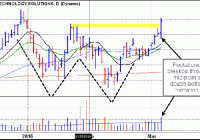
M/A-Com Technology Solutions (MTSI) GM – Nice pocket pivot breakout through the mid-point of the “W” in a double-bottom formation. I actually notice a pocket pivot off the 50-day line four days earlier, so we could say we were late on this one. Would prefer to buy this on a pullback towards the rising 10-day line, now at 38.76. Dr.K – Its industry group, semiconductors, has made a strong comeback along with the small cap Russell 2000 as capital flows into risk-on type stocks.  SolarEdge (SEDG) GM – Big-volume pocket pivot runs into resistance near the top of the two-month range and we see a pullback to the 50-day line as volume declines. This brings the stock into a lower-risk entry point with the idea that it should hold the 50-day line with maybe 2-3% porosity allowed for on the downside. Dr. K – The stock closed at its 50-day line thus risk in buying at this level is minimal provided one keep their stops tight as should the current bounce in the general market back-and-fill or roll over, volatile stocks such as SEDG could fall faster.  Alaska Airlines (ALK) GM – A nice pocket pivot off the 50-day moving average in a “roundabout” type of position where the stock is coming up the right side of a potential new base. Notice how the bottom of the base sets up as a double-bottom shakeout. Would look to buy this on pullbacks into the 10-day line at 75.24. Dr. K – Airlines have shown renewed strength over the last few weeks. ALK has skated along its 10-day line since it bottomed. Buying as close as possible to its 10-day will keep risk to a minimum.  Silicon Motion (SIMO) GM – SIMO has flashed two pocket pivots this past week, one on Monday and one on Friday. The stock remains in a buyable position here along the 10-day line. I would use the 20-day exponential moving average at 32.65 as a maximum selling guide. Dr. K – Another semiconductor stock showing strength as it enjoyed a big move when it reported earnings after the close on 1/28. Semiconductor stocks tend to be more volatile so giving it a little more wiggle room is an option such as a stop under the low set on 2/25.  Super Micro Computer (SMCI) GM – SMCI had some nice follow-through after Monday’s pocket pivot, but it gave up most of that three-day move on Friday when it came in sharply on light volume. This of course brings it into a lower-risk buy position based on the “voodoo” pullback to the 10-day line. I would use the 20-day exponential moving average at 31.69 as a maximum selling guide. Dr. K – The right side of its base has experienced two gaps higher with the most recent gap due to a strong earnings report. This stock can be choppy as it challenges former resistance points so using the 20-day exponential line will keep losses in check.  O’Reilly Automotive (ORLY) GM – ORLY has shown a lot of buying volume support at its January and February lows, and so it keeps making runs back up towards its prior highs each time. The stock looked strong on Tuesday but sent the next three days pulling into the 10-day line. Friday’s above-average volume came as the stock was able to hold the 10-day line, which could be interpreted as supporting action at a lower-risk entry point. I would use the 20-day exponential moving average at 259.62 as a maximum downside selling guide.  Dr. K – ORLY has pulled back for 3 days with the last 2 days on above average volume, closing roughly midbar each time. Overall, ORLY has displayed considerably more strength than the NASDAQ Composite as it is just 4% from hitting new highs. The weekly chart shows it trades in a tight, constructive fashion. It breaches its 50-day line only when the general market undergoes a steep correction then quickly recovers.  Fabrinet (FN) GM – This is a bit of a disappointment as the stock looked strong posting a supporting type of pocket pivot off the 20-day exponential moving average on Tuesday, but then rolled over on Thursday as volume picked up sharply. It has, however, been able to hold above the intraday low of the early February buyable gap-up. This would bring it into a possible buy position using the BGU intraday low at 27.34 as a very tight stop. Dr. K – Risk here is very low were one to initiate a position as since the stock has traded above the low of its BGU for more than 5 days, so no porosity is needed when setting the stop. An undercut below the low of its low on its BGU day would trigger a sell.  Â