Tag Archives: nasdaq

Avoiding Cigarette Butts

Too many investors hang their hat on investments that seem “cheap”. Unfortunately, too often something that looks like a bargain turns out to be a cigarette butt from which investors are hoping to take a last puff. As the old adage states, “you get what you pay for,” and that certainly applies to the world of investments. There are endless examples of cheap stocks getting cheaper, or in other words, stocks with low price/earnings ratios going lower. Stocks that appear cheap today, in many cases turn out to be expensive tomorrow because of deteriorating or collapsing profitability. For instance, take Haliburton Company (NYSE: HAL ), an energy services company. Wall Street analysts are forecasting the Houston, Texas based oil services company to achieve 2016 EPS (earnings per share) of $0.32, down -79%. The share price currently stands at $37, so this translates into an eye-popping valuation of 128x P/E ratio, based on 2016 earnings estimates. What has effectively occurred in the HAL example is earnings have declined faster than the share price, which has caused the P/E to go higher. If you were to look at the energy sector overall, the same phenomenon is occurring with the P/E ratio standing at a whopping 97x (at the end of Q1). These inflated P/E ratios are obviously not sustainable, so two scenarios are likely to occur: The price of the P/E (numerator) will decline faster than earnings (denominator) The earnings of the P/E (denominator) will rise faster than the price (numerator) Under either scenario, the current nose-bleed P/E ratio should moderate. Energy companies are doing their best to preserve profitability by cutting expenses as fast as possible, but when the product you are selling plummets about -70% in 18 months (from $100 per barrel to $30), producing profits can be challenging. The Importance of Price (or Lack Thereof) Similarly to the variables an investor would consider in purchasing an apartment building, “price” is supreme. With that said, “price” is not the only important variable. As famed investor Warren Buffett shrewdly notes, the quality of a company can be even more important than the price paid, especially if you are a long-term investor. “It’s far better to buy a wonderful company at a fair price than a fair company at a wonderful price.” The advantage of identifying and owning a “wonderful company” is the long-term stream of growing earnings. The trajectory of future earnings growth, more than current price, is the key driver of long-term stock performance. Growth investor extraordinaire Peter Lynch summed it up well when he stated, ” People Concentrate too much on the P, but the E really makes the difference.” Albert Einstein identified the power of “compounding” as the 8th Wonder of the World, which when applied to earnings growth of a stock can create phenomenal outperformance – if held long enough. Warren Buffett emphasized the point here: “If you aren’t willing to own a stock for ten years, don’t even think about owning it for ten minutes. Put together a portfolio of companies whose aggregate earnings march upward over the years, and so also will the portfolio’s market value.” Throw Away Cigarette Butts I have acknowledged the importance of aforementioned price, but your investment portfolio will perform much better, if you throw away the cigarette butts and focus on identifying market leading franchise that can sustain earnings growth. The lower the growth potential, the more important price becomes in the investment question. (see also Magic Quadrant ) Here are the key factors in identifying wining stocks: Market Share Leaders : If you pay peanuts, you usually get monkeys. Paying a premium for the #1 or #2 player in an industry is usually the way to go. Certainly, there is plenty of money to be made by smaller innovative companies that disrupt an industry, so for these exceptions, focus should be placed on share gains – not absolute market share numbers. Proven Management Team : It’s nice to own a great horse (i.e., company), but you need a good jockey as well. There have been plenty of great companies that have been run into the ground by inept managers. Evaluating management’s financial track record along with a history of their strategic decisions will give you an idea what you’re working with. Performance doesn’t happen in a vacuum, so results should be judged relative to the industry and their competitors. There are plenty of incredible managers in the energy sector, even if the falling tide is sinking all ships. Large and/or Growing Markets : Spotting great companies in niche markets may be a fun hobby, but with limited potential for growth, playing in small market sandboxes can be hazardous for your investment health. On the other hand, priority #1, #2, and #3 should be finding market leaders in growth markets or locating disruptive share gainers in large markets. Finding fertile ground on long runways of growth is how investors benefit from the power of compound earnings. Capital Allocation Prowess: Learning the capital allocation skillset can be demanding for executives who climb the corporate ladder from areas like marketing, operations, or engineering. Regrettably, these experiences don’t prepare them for the ultimate responsibility of distributing millions/billions of dollars. In the current low/negative interest rate environment, allocating capital to the highest return areas is more imperative than ever. Cash sitting on the balance sheet earning 0% and losing value to inflation is pure financial destruction. Conservatism is prudent, however, excessive piles of cash and overpaying for acquisitions are big red flags. Managers with a track record of organically investing in their businesses by creating moats for long-term competitive advantage are the leaders we invest in. Many so-called “value” investors solely use price as a crutch. Anyone can print out a list of cheap stocks based on Price-to-Earnings, Enterprise Value/EBITDA, or Price/Cash Flow, but much of the heavy lifting occurs in determining the future trajectory of earnings and cash flows. Taking that last puff from that cheap, value stock cigarette butt may seem temporarily satisfying, but investing into too many value traps may lead you gasping for air and force you to change your stock analysis habits. DISCLOSURE: Sidoxia Capital Management (SCM) and some of its clients hold positions in certain exchange traded funds (ETFs), but at the time of publishing had no direct position in HAL or any security referenced in this article. No information accessed through the Investing Caffeine (IC) website constitutes investment, financial, legal, tax or other advice nor is to be relied on in making an investment or other decision. Please read disclosure language on IC Contact page.
Estimating Future Stock Returns

Click to enlarge Idea Credit: Philosophical Economics , but I estimated and designed the graphs There are many alternative models for attempting to estimate how undervalued or overvalued the stock market is. Among them are: Price/Book P/Retained Earnings Q-ratio (Market Capitalization of the entire market / replacement cost) Market Capitalization of the entire market / GDP Shiller’s CAPE10 (and all modified versions) Typically these explain 60-70% of the variation in stock returns. Today I can tell you there is a better model, which is not mine, I found it at the blog Philosophical Economics. The basic idea of the model is this: look at the proportion of US wealth held by private investors in stocks using the Fed’s Z.1 report. The higher the proportion, the lower future returns will be. There are two aspects of the intuition here, as I see it: the simple one is that when ordinary people are scared and have run from stocks, future returns tend to be higher (buy panic). When ordinary people are buying stocks with both hands, it is time to sell stocks to them, or even do IPOs to feed them catchy new overpriced stocks (sell greed). The second intuitive way to view it is that it is analogous to Modiglani and Miller’s capital structure theory, where assets return the same regardless of how they are financed with equity and debt. When equity is a small component as a percentage of market value, equities will return better than when it is a big component. What it Means Now Now, if you look at the graph at the top of my blog, which was estimated back in mid-March off of year-end data, you can notice a few things: The formula explains more than 90% of the variation in return over a ten-year period. Back in March of 2009, it estimated returns of 16%/year over the next ten years. Back in March of 1999, it estimated returns of -2%/year over the next ten years. At present, it forecasts returns of 6%/year, bouncing back from an estimate of around 4.7% one year ago. I have two more graphs to show on this. The first one below is showing the curve as I tried to fit it to the level of the S&P 500. You will note that it fits better at the end. The reason for that it is not a total return index and so the difference going backward in time are the accumulated dividends. That said, I can make the statement that the S&P 500 should be near 3000 at the end of 2025, give or take several hundred points. You might say, “Wait, the graph looks higher than that.” You’re right, but I had to take out the anticipated dividends. Click to enlarge The next graph shows the fit using a homemade total return index. Note the close fit. Click to enlarge Implications If total returns from stocks are only likely to be 6.1%/year (w/ dividends @ 2.2%) for the next 10 years, what does that do to: Pension funding / Retirement Variable annuities Convertible bonds Employee Stock Options Anything that relies on the returns from stocks? Defined benefit pension funds are expecting a lot higher returns out of stocks than 6%. Expect funding gaps to widen further unless contributions increase. Defined contributions face the same problem, at the time that the tail end of the Baby Boom needs returns. (Sorry, they *don’t* come when you need them.) Variable annuities and high-load mutual funds take a big bite out of scant future returns – people will be disappointed with the returns. With convertible bonds, many will not go “into the money.” They will remain bonds, and not stock substitutes. Many employee stock options and stock ownership plan will deliver meager value unless the company is hot stuff. The entire capital structure is consistent with low-ish corporate bond yields, and low-ish volatility. It’s a low-yielding environment for capital almost everywhere. This is partially due to the machinations of the world’s central banks, which have tried to stimulate the economy by lowering rates, rather than letting recessions clear away low-yielding projects that are unworthy of the capital that they employ. Reset Your Expectations and Save More If you want more at retirement, you will have to set more aside. You could take a chance, and wait to see if the market will sell off, but valuations today are near the 70th percentile. That’s high, but not nosebleed high. If this measure got to levels 3%/year returns, I would hedge my positions, but that would imply the S&P 500 at around 2500. As for now, I continue my ordinary investing posture. If you want, you can do the same. Disclosure: None

Growth And Surging Popularity Of Unconstrained Bond Funds

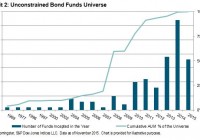
By Hong Xie In the aftermath of the global financial crisis of 2007-2008, one noticeable trend in fixed income investment is the growth and popularity of unconstrained bond funds. They have generated strong interest in the investment industry due to the flexibility they offer in duration management and the broader investment universe. Because they are not managed against a specific benchmark, unconstrained bond funds may also pose challenges for investors in understanding and measuring their performance. The global financial crisis of 2007-2008 and the economic recession that followed prompted unprecedented quantitative easing monetary policies across many countries. Not only were short-term interest rates lowered to either zero or close to zero, but quantitative easing was also adopted in places such as the U.S., the U.K., the eurozone, and Japan to flatten the yield curve and keep long-term interest rates low. As the U.S. economy continues to recover and the Fed starts to increase interest rates, many investors have concerns about holding core fixed income products with high interest-rate risk in a rising-rate environment. It is this widespread market sentiment that has driven the surging popularity of unconstrained bond funds, which offer wide latitude to fund managers on duration management and investment selection. We use fund data from Morningstar to gauge the size and growth of unconstrained bond funds. In particular, we screen for funds categorized as “U.S. OE Nontraditional Bonds” by Morningstar, while excluding those with mandates in specific sectors or with duration constraints. As of November 2015, there were 122 open-ended mutual funds with total assets under management (AUM) of USD 140 billion in our data set, in comparison with 19 funds with AUM of USD 9 billion at the end of 2008 (see Exhibit 1). Even though the first fund started in 1969, it wasn’t until after the global financial crisis of 2007-2008 that unconstrained bond funds started gaining traction among investors. Exhibits 1 and 2 show the rapid growth of unconstrained bond funds since 2008 in terms of both AUM and number of funds. Disclosure: © S&P Dow Jones Indices LLC 2015. Indexology® is a trademark of S&P Dow Jones Indices LLC (SPDJI). S&P® is a trademark of Standard & Poor’s Financial Services LLC and Dow Jones® is a trademark of Dow Jones Trademark Holdings LLC, and those marks have been licensed to S&P DJI. This material is reproduced with the prior written consent of S&P DJI. For more information on S&P DJI and to see our full disclaimer, visit www.spdji.com/terms-of-use .