Tag Archives: georgia

Why Equity Outperforms Credit
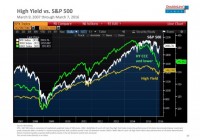
In my new paper on asset allocation I go into quite a bit of detail about why certain asset classes generate the returns they do. Understanding this is useful when thinking in a macro sense and trying to gauge why financial assets perform in certain ways in both the short-term and the long-term. It’s important to understand the fundamental drivers of these returns in order to avoid falling into the trap that these assets generate returns due to the way they’re traded in the markets. One of the more common misconceptions I see in the financial space is that credit traders are smarter than equity traders. This is usually presented with charts showing how credit “leads” equity performance or something like that. One of the more egregious offenders of this is a chart that has been going around in the last few days from Jeffrey Gundlach’s presentation showing credit relative to equity: One might look at this and conclude that these lines should necessarily converge at some point. As if the credit markets know something that the equity markets don’t. This is usually bandied about by bond traders who are convinced that stock traders are a bunch of dopes.¹ But this is silly when you think of things in aggregates because, in the long-run, the credit markets generate whatever the return is on the instruments that have been issued and not because bond traders are smarter or dumber than other people.² For instance, XYZ Corporate Bond paying 10% per year for 10 years doesn’t generate 10% for 10 years because bond traders are smart or stupid. It generates a 10% annualized return because the issuing entity pays that amount of income over the life of the bond. In fact, the more traders trade this bond the lower their real, real return will be. Trying to be overly clever about trading the bond, in the aggregate, only reduces the average return earned by its holders as taxes and fees chew into that 10% return. The “bond traders are smarter than stock traders” myth is hardly the most egregious myth at work here though. The bigger myth is the idea that equity must necessarily converge with credit over time. For instance, let’s change the time frame on our chart for a bit better perspective: If you’d bought into this notion that credit and equity converge starting in 1985 you would still be waiting for this great convergence. The reason for this is quite fundamental though. Corporate bonds only give owners access to a fixed rate of income expense paid by the issuing entity. Common stock, however, gives the owner access to the full potential profit in the long-term. If we think of common stock as a bond then common stock has essentially paid a 12% average annual coupon over the last 30 years while high yield bonds have only paid about a 8% coupon. In the most basic sense, credit and equity are different types of legal instruments giving the owner access to different potential streams of income. Equity, being the higher risk form of financing, will tend to reward its owners with higher returns over long periods of time. Why equity outperforms credit is hotly debated, but it makes sense that equity outperforms because the return on financing via equity must be higher than the potential return an investor will earn on otherwise safe assets. That is, if I am an entrepreneur who can earn 5% from a low risk bond it does not make sense for me to invest my capital in an instrument or entity that might not generate a greater return. In this sense, equity generates greater returns than credit because it’s not worth the extra risk to issue equity if the alternative is a relatively safe form of credit. Of course, it doesn’t always play out like this in the short-term, but if you think of equity as a sufficiently long-term instrument then it will tend to be true over the long-term because it’s the only rational reason for equity to be issued in the first place.³ ¹ – As an advocate of diversified indexing I can rightly be included as a “dope” about both asset classes. ² – This return could actually be lower due to defaults, callability, etc. ³ – “Long-term” in this instance has been calculated as at least a 25 year duration for equity. This is a sufficiently long period during which we should expect to see equity consistently earn a risk premium over credit.

7 Year Bull Market? It May Only Be 6 Years And 2 Months After All

What do these 10 companies – Wal-Mart (NYSE: WMT ), Macy’s (NYSE: M ), Kohl’s (NYSE: KSS ), Sears (NASDAQ: SHLD ), Target (NYSE: TGT ), Best Buy (NYSE: BBY ), Office Depot (NASDAQ: ODP ), K-Mart, J.C Penney (NYSE: JCP ), Gap (NYSE: GPS ) – all have in common? Each one of them is closing down a slew of retail storefronts. The “talking heads” on CNBC want you to believe that brick-and-mortar woes are merely a reflection of the consumer’s preference to shop online. Maybe. Or perhaps shuttering the doors will help boost the bottom-line profitability of retail company shareholders. After all, the SPDR S&P Retail ETF (NYSEARCA: XRT ) has bounced an astonishing 17.5% off its bear market lows. On the other hand, a 24.5% bearish descent for the retail segment does not reflect positively on the well-being of American business. In fact, many influential sectors of the U.S. economy have already descended more than a bearish 20%. There have been peak-to-trough declines ranging from 20%-40% in energy, materials, transporters, biotechnology as well as financial institutions. The bear market rally in the Financial Select Sector SPDR ETF (NYSEARCA: XLF ) still leaves the influential sector in correction territory, roughly 12% beneath its July pinnacle. Perhaps ironically, the business media excitedly embraced the 7th birthday of the bull market yesterday (3/9/16). What was missing from the exuberance? The S&P 500 traded at 1989 back in July of 2014. That’s 20 months ago. More critically, 42% of S&P 500 components remain mired in bear market territory, even after the 10% bounce off of the February lows. And what if the S&P 500 should ultimately drop 20% prior to reclaiming its May 2015 record high of 2130? In that case, the bull market would have ended ten months ago at an age of six years, two months. Not surprisingly, the very same folks who believed the bear market was unstoppable at the February lows – S&P 500 at 1829 – shifted back to the bull camp the minute the S&P 500 closed above 2000. Did the fundamental backdrop on three consecutive quarters of declining earnings per share (EPS) change to justify the bullishness? Hardly. Hadn’t they ever seen how bear market rallies work? Where broad market gauges could jump 10%, 15%, even 18% in the middle of a bearish downtrend? Apparently not. In spite of the bullish refrain that you have to invest in stocks because there is no alternative (T.I.N.A.), investor preference for intermediate-term treasury bonds demonstrates otherwise. The Federal Reserve is raising its overnight lending rate; committee members express a desire for gradual stimulus removal. Yet that guidance has done little to dissuade the investment community from embracing low yielding investment grade debt – the kind of capital preservation one might get by selecting the iShares 7-10 Year Treasury Bond ETF (NYSEARCA: IEF ). The result? The yield curve continues to flatten. The spread between “10s” and “2s” has fallen to a meager 1%. In fact, you’d have to go back to the start of the Great Recession to witness a similar phenomenon. “But Gary,” there is not going to be a recession. “The Federal Reserve won’t make the mistake that it made in 2008 by waiting an entire calendar year before coming to the rescue with asset purchases via electronic money creation (a.k.a. QE).” How is that working out for Europe? This morning, Mario Draghi of the European Central Bank (ECB) hoped to kick-start its moribund regional economy by announcing a foray into deeper negative interest rate waters (-0.4%) and committing to $87 billion per month in asset purchases. Not only did global investors sell the news – not only did the SPDR EURO STOXX 50 ETF (NYSEARCA: FEZ ) give up nearly all of its 2% intra-day gains – but the European economy has yet to show genuine improvement from the stimulus policies of the ECB. Consequently, the bear market rallies in Europe have consistently registered “lower highs” and “lower lows.” Meanwhile, each of the respective BRIC nations (i.e., Brazil, Russia, India, China) are still suffering. There are cracks in Australia’s housing market. And the entire Canadian economy? It has been falling apart on numerous measures. The hope, then, is that the resilient U.S. consumer will buck the trend of global stagnation. Unfortunately, U.S. corporate profits cannot escape a worldwide demand strike , particularly when 50% of profits come from overseas operations. It seems the resilient U.S. consumer is being asked to carry a whole lot more weight on his/her shoulders than is feasible. With Markit’s U.S. Services PMI hitting a recessionary 49.8 in February – a data point that is at the lowest level in nearly two-and-a-half years – maybe the consumer is getting closer to “tapping out.” Disclosure: Gary Gordon, MS, CFP is the president of Pacific Park Financial, Inc., a Registered Investment Adviser with the SEC. Gary Gordon, Pacific Park Financial, Inc, and/or its clients may hold positions in the ETFs, mutual funds, and/or any investment asset mentioned above. The commentary does not constitute individualized investment advice. The opinions offered herein are not personalized recommendations to buy, sell or hold securities. At times, issuers of exchange-traded products compensate Pacific Park Financial, Inc. or its subsidiaries for advertising at the ETF Expert web site. ETF Expert content is created independently of any advertising relationships.

Four Top-Ranked Municipal Bond Mutual Funds For Stable Returns

The debt securities category will always be the first choice for risk-averse investors, because this class of instruments provides a regular income flow at low levels of risk. Income from regular dividends helps to ease the pain caused by plunging stock prices. When considering the safety of capital invested, municipal bond mutual funds are second only to those investing in government securities. In addition, the interest income earned from these securities is exempt from federal taxes, and in many cases, from state taxes as well. Below, we will share with you four top-rated municipal bond mutual funds. Each has earned a Zacks #1 Rank (Strong Buy) and is expected to outperform its peers in the future. To view the Zacks Rank and past performance of all municipal bond mutual funds, investors can click here . Federated Municipal High Yield Advantage Fund (MUTF: FHTFX ) invests in securities that are believed to provide federal tax-free interest income. It normally invests in long-term securities, but may also invest in securities of medium quality and that are rated below investment grade. The Federated Municipal High Yield Advantage F fund is non-diversified and has a three-year annualized return of 4.4%. Lee R. Cunningham II is one of the fund managers of FHTFX since 2009. American Century California High Yield Municipal Fund Investor (MUTF: BCHYX ) seeks a tax-exempted high level of current income. It invests a major share of its assets in municipal securities that are expected to provide income exempted from federal and California income taxes. The fund mainly invests in California municipal debt securities that are rated below investment grade and are expected to provide high yield. BCHYX may also invest in unrated securities. The fund is non-diversified and has a three-year annualized return of 5.1%. BCHYX has an expense ratio of 0.50%, as compared to the category average of 0.9%. PIMCO New York Municipal Fund A (MUTF: PNYAX ) invests a large portion of its assets in debt securities whose interest is exempted from regular federal income tax and New York income tax. It may invest in “private activity” bonds having interest, which is a tax-preference item for the purpose of the federal alternative minimum tax. The fund is non-diversified and has a three-year annualized return of 3.2%. Joe Deane is one of the executive vice presidents and has managed PNYAX since July 2011. Dreyfus High Yield Municipal Bond Fund (MUTF: DHMBX ) seeks a tax-exempted high level of current income. It invests the majority of its assets in municipal securities that are expected to provide return free from federal income tax. The fund is generally expected to maintain a dollar-weighted average maturity of more than 10 years. It is non-diversified and has a three-year annualized return of 3.6%. As of January 2016, DHMBX held 91 issues, with 3.71% of its assets invested in Tobacco Settlement Financing Corp N Asset 5%. Original Post