Tag Archives: financial

The Market Doesn’t Matter: Vanguard Dividend Appreciation ETF
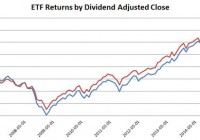
Summary Investors need to avoid decision risk. While many individual stocks can be attractive, I’ve seen to many people feel handcuffed (or married) to particular companies. Investors that held VIG and didn’t watch TV could have ignored the financial crisis. If there is one thing investors often struggle with, it is being able to pick a winner and stick with it. While picking winners in the stock market can be very difficult, I believe picking winners in the ETF market is easier. Rather than understanding every business, the fundamentals of the ETF can be used to determine the risk level and risk factors. In my opinion, there are a few ETFs that are simply born winners. It isn’t a case of looking at their performance of an arbitrary time period; it is a matter of some ETFs being designed to serve investors while other ETFs are designed to serve managers. In my opinion, the Vanguard Dividend Appreciation ETF (NYSEARCA: VIG ) is one of those born winners. The very nature of the Vanguard Dividend Appreciation ETF is what makes it such a solid choice. I’ve been asked on occasion: “If you could only invest in one ticker and had to hold it for 50 years, which ticker would you buy?” While I haven’t nailed down the answer to that question, because the premise is mildly absurd, I do believe it is important for investors to know their long term goals and to find investments that match those goals. VIG is an ETF that matches my long term goals, so it would be an extremely strong contender for that question. What does VIG do? VIG attempts to track the investment results of the NASDAQ US Dividend Achievers Select Index. The general methodology is to focus on stocks that have a history of increasing dividends over time. The ETF falls under the category of “Large Blend” and has a very high correlation with the SPDR S&P 500 Trust ETF (NYSEARCA: SPY ). Overall the ETF has been slightly less volatile than SPY and performed slightly better during the last crash as demonstrated in the following chart: (click to enlarge) Getting married I often cover Freeport-McMoRan (NYSE: FCX ) and one of the common themes I hear from investors is that they don’t like the company anymore but after holding it while it fell so far, they feel “married” to it. They resent the investment in which they lost so much money, but they don’t want to just walk away either. That isn’t the way I like to think of marriage, but I can understand how they feel. As investors we may become attached to the investments we have selected and that emotional attachment can complicate our decision making. Since it is very difficult to mitigate emotional biases through training clients, I would rather see people select an investment that will work to protect them. While I am long FCX, I certainly don’t think that it belongs in every investor’s portfolio. On the other hand, there are very few investors that wouldn’t be well served to hold VIG over the next several decades. The risk VIG solves for investors One of the major issues investors face is decision risk. While there are plenty of other kinds of risk in the market, decision risk is one of the nastiest ones. One reason that the S&P 500 regularly beats out most investors (and even money managers) is that a comparison of SPY to actual performance is that money simply stays in SPY while people trade at the wrong time, pay more commissions because of the trading, and cross the bid-ask spread. These issues all add up and stack the deck against many investors. VIG solves a substantial portion of the decision risk problem by offering investors a different way to look at part of their portfolio. Instead of deciding what they should do with their holdings in VIG, investors need simply to turn off dividend reinvestment when they are ready for an income stream. After that, there is no need to touch the investment again. My suggestion on this would be to hold VIG in a different brokerage from other holdings. Hold VIG in an account you never log into, that way there is no temptation to kill the goose that lays the golden egg. If you were holding VIG during the financial crisis As all readers should know, we had a bit of an issue in the financial markets. We saw the economy tank, stock prices plummet, and interest rates go to 0%. On the other hand, if an investor was simply holding VIG and enjoying a nice beach, they had no need to know or care. Their dividends didn’t go away. They still had a similar payment to live on. Just look at the chart below: Investors should know about a couple issues I came across preparing the chart. The fund inception date was in April of 2006, so there are only 3 dividends included for the year. It is only may of 2015, there is only one dividend included for 2015. Yahoo Finance has incorrect information on dividend history. I verified the dividend payouts through Google and Schwab. Yahoo was missing the December 2014 payout. Holdings I put together the following chart showing the top 10 holdings in VIG: (click to enlarge) Conclusion If an investor was only picking one investment, VIG should be a strong contender. If the investor wants to build a more diversified portfolio, it makes sense to put VIG in a separate account and just leave it alone. While rebalancing accounts is very useful in maintaining the optimal risk exposures, the decision risk of accessing the golden goose offsets the benefits of rebalancing. I’m not currently holding any VIG, but my long term plan will have me buying into VIG or the very similar Schwab U.S. Dividend Equity ETF (NYSEARCA: SCHD ). I’ll probably start acquiring the position later this year or early next year. Disclosure: The author has no positions in any stocks mentioned, and no plans to initiate any positions within the next 72 hours. (More…) The author wrote this article themselves, and it expresses their own opinions. The author is not receiving compensation for it (other than from Seeking Alpha). The author has no business relationship with any company whose stock is mentioned in this article. Additional disclosure: Information in this article represents the opinion of the analyst. All statements are represented as opinions, rather than facts, and should not be construed as advice to buy or sell a security. Ratings of “outperform” and “underperform” reflect the analyst’s estimation of a divergence between the market value for a security and the price that would be appropriate given the potential for risks and returns relative to other securities. The analyst does not know your particular objectives for returns or constraints upon investing. All investors are encouraged to do their own research before making any investment decision. Information is regularly obtained from Yahoo Finance, Google Finance, and SEC Database. If Yahoo, Google, or the SEC database contained faulty or old information it could be incorporated into my analysis.
3 Other Ways To Play Defense

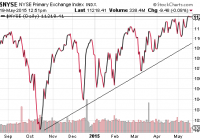
If one has the confidence in the sector’s ability to weather cyclical storms in the economy, one might be compensated for recognizing why defense/aerospace contractors are likely to prosper for years to come. XAR tracks a modified equal weight index such that market cap giants like LMT and UTX do not steal the entire limelight. SPY sports an astronomical P/S ratio of 1.8 whereas ITA boasts a more fundamentally sound P/S of 1.3. The broader stock market (as measured by the NYSE Composite) may be making marginal progress. A 2.5% appreciation in price over the last nine months is mildly positive. Similarly, higher lows are typically indicative of ongoing strength. It would be reasonable, however, to discuss whether the risk of participation is worthy of the potential reward. Retail sales in the warm weather month of April were flat; clearly, consumers have not been spending their windfalls from the gasoline pump since 2015 began. Moreover, views on the U.S. economy in Bloomberg’s Consumer Comfort Index sank to a five-month low. If the trend towards saving over consumption continues, exports and investment by businesses would need to pick up the slack. Unfortunately, the strong U.S. dollar has crucified exports in recent months and durable goods sales excluding aircraft/defense have been tepid. These are trends that do no bode well for corporate revenue growth . Another way to look at the discrepancy between the broader market and revenue winners is through the use of price ratios. For example the i Shares U.S. Aerospace & Defense ETF (NYSEARCA: ITA ):the SPDR S&P 500 Trust ETF (NYSEARCA: SPY ) price ratio demonstrates the momentum that has been building for defense/aerospace contractors for the better part of nine months. In addition, SPY sports an astronomical P/S ratio of 1.8 whereas ITA boasts a more fundamentally sound P/S of 1.3. Granted, rising bond yields and a slow growth economy produce less tax dollars for government authorities to spend on the defense of the country; more tax dollars will go to paying the interest on treasury debt obligations, leaving Democrats and Republicans to wrangle over where remaining funds should be allocated. Yet the recent military conquests by the Islamic State in Iraq and Syria suggest to me that dollars will be found or created to finance operations that would undercut advances by radical elements in the Middle East. There are three ETFs that cover the Defense/Aerospace arena. Both ITA and the longer-running PowerShares Aerospace & Defense Portfolio ETF (NYSEARCA: PPA ) tend to track one another fairly closely. Over the past 3 years, each has posted annualized gains of approximately 23.5%. The SPDR S&P Aerospace & Defense ETF (NYSEARCA: XAR ) tracks a modified equal weight index such that market cap giants like Lockheed Martin (NYSE: LMT ) and United Technologies (NYSE: UTX ) do not steal the entire limelight. The fact that XAR has a number of smaller companies with higher weight in the fund performance contributes to a bit more risk, though the reward has been commensurate with a 3-year trailing result of 25.5%. Three Ways To Play Defense With ETFs Price YTD% XAR SPDR S&P Aerospace & Defense ETF $118.77 9.10% ITA iShares U.S. Aerospace & Defense ETF $124.07 8.62% PPA Aerospace & Defense $36.85 6.20% Purchasing any stock asset near all-time record highs can be tricky. It may be even trickier when any additional economic downgrade would likely be accompanied by more earnings and revenue warnings; any economic uptick would give the Fed reason to hike borrowing costs. In essence, buying before a pullback may not be advisable. Nevertheless, if one has the confidence in the sector’s ability to weather cyclical storms in the economy, one might be compensated for recognizing why defense/aerospace contractors are likely to prosper for years to come. Disclosure: Gary Gordon, MS, CFP is the president of Pacific Park Financial, Inc., a Registered Investment Adviser with the SEC. Gary Gordon, Pacific Park Financial, Inc, and/or its clients may hold positions in the ETFs, mutual funds, and/or any investment asset mentioned above. The commentary does not constitute individualized investment advice. The opinions offered herein are not personalized recommendations to buy, sell or hold securities. At times, issuers of exchange-traded products compensate Pacific Park Financial, Inc. or its subsidiaries for advertising at the ETF Expert web site. ETF Expert content is created independently of any advertising relationships.

Downside Protection: The Changing Methods And Mindset Of Investment Research

The analysis of intelligence shortcomings from the events of 9/11 reveals some important lessons for investment research. Trends in technology are vastly increasing the amount of information that is publicly available which is decreasing the value of “secrets”. At the same time, sharing information and “connecting the dots” is proving to be of more value in understanding the landscape. While times of low volatility can increase complacency, a primary goal of research should always be to protect against catastrophic losses. Conducting the best research is an ongoing challenge for even the most organized investment firms with the most resources. For individuals and small institutions, however, it can be frustrating and outright overwhelming. Fortunately, there is a useful analogue with the intelligence community that provides instructive lessons on how to approach the task. Certainly parallels exist. In both investment research and intelligence efforts, masses of information flooding in need to evaluated. In both efforts, information and themes need to be prioritized such that the most important receive the most attention. In both efforts, the possibilities of very significant, non-linear events also exist. One silver lining resulting from the events of 9/11 was that we also learned a lot about what not to do when conducting research – and these lessons apply to the financial crashes of 2000 and 2008. In the New York Times Magazine article, “Open-Source Spying” [here], Clive Thompson quickly identifies the paradox of U.S intelligence systems. According to the chief information officer for the office of the director of national intelligence at the time, “The 16 intelligence organizations of the U.S. are without peer. They are the best in the world.” The question he raises, however, is “Are they collectively the best?” In hindsight, they quite clearly were not. Closer inspection revealed all kinds of obstacles that emerged from the interrelationships of the various intelligence agencies and that prevented useful insights from being made. Unfortunately, “None of the agents knew about the existence of the other evidence. The report concluded that the agencies failed to ‘connect the dots’.” Further, some of the obstacles were structural: “If an analyst requested information from another agency, that request traveled through elaborate formal channels.” Worse, “In the past, each agency chose its own outside contractor to build customized software – creating proprietary systems, each of which stored data in totally different file formats.” While ideally any effort to increase knowledge ought to revolve around sharing information, in practice, the intelligence agencies kept information in silos. For those involved in investment research many of these issues will sound familiar. Individual excellence is lauded for many participants such as industry analysts and subject matter experts such as economists. While much of the information gathered by such experts may be very good, too often structures and incentives prevent the complete assimilation of insights. For one, the aggregation of narrowly focused expertise creates many “cracks” through which important information can fall. The bigger problem, however, is often cultural. When the ethos of “need to know” is more important than the mandate of “need to share”, assimilation will suffer. These are not the only costs of siloed and proprietary information though. In such a system, holders of unique knowledge also often hold the power to create a narrative around that knowledge. Not surprisingly, that narrative can be created partly or wholly out of self-interest and it can be extremely difficult to effectively challenge that narrative or to detect potential flaws. Indeed this is increasingly recognized as a problem at the highest levels of corporate decision making. As Ann Mule and Charles Elson point out in “A new kind of captured board” [ here ], having sufficient representation by independent directors with industry expertise is essential in preventing the board from being “captured” by the knowledge of management. While it became increasingly clear what didn’t work, it still wasn’t clear how best to resolve the primary challenge: “What the agencies needed was a way to take the thousands of disparate, unorganized pieces of intel they generate every day and somehow divine which are the most important.” To this end, the success of the internet in helping people find information proved a guiding insight. The hypothesis that, “the real power of the Internet comes from the boom in self-publishing: everyday people surging online to impart their thoughts and views,” further focused where improvements could be made. Whereas the boom in self-publishing has certainly opened a window to the world that didn’t exist before, the near ubiquity of smartphones and other connected devices has pushed that window even much further open. The consequences for research are quite meaningful. On one hand, “Top-secret information is becoming less useful than it used to be,” because so many people now have good access to what is going on all over the world. On the other, “more value can be generated by analysts sharing bits of ‘open source’ information – the nonclassified material in the broad world, like foreign newspapers, newsletters, and blogs.” One key lesson from the analysis is that the nexus of value for research is evolving and this has very significant implications for investors and investment committees. As technology is gradually eroding the value of “secrets,” it is also increasing the value of assimilating, curating, and synthesizing information. As a result, it is no longer sufficient to have individually excellent, but collectively deficient research sources and research organizations will need to adapt to this reality. A more dramatic lesson is that for many the entire mindset towards research will need to change. The overarching purpose of any research effort is to understand what is going on such that you can benefit from the landscape. In times of low volatility and complacency, it’s not surprising that many focus on incremental gains. As the events of 9/11 reveal all too clearly, however, the avoidance of catastrophic losses is also an important “benefit” of truly understanding one’s environment. Further, the avoidance of losses requires a constant and ongoing effort, regardless of whether those losses materialize or not. This applies to investment portfolios just as much as it does in real life. Many of the lessons from 9/11 have been learned and applied in the intelligence community; it’s not so clear the same has happened in regards to the financial crashes of 2000 and 2008. Disclosure: The author has no positions in any stocks mentioned, and no plans to initiate any positions within the next 72 hours. (More…) The author wrote this article themselves, and it expresses their own opinions. The author is not receiving compensation for it. The author has no business relationship with any company whose stock is mentioned in this article.