Tag Archives: financial
SCHH: Finally The REIT Indexes Are Going Back On Sale; Limit Order Placed
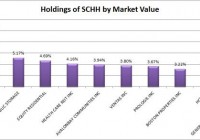
Summary SCHH is trading lower at the same time as treasury yields are falling. When SCHH falls under $38.00 per share, I become interested in buying more. As of my writing I have a buy limit order in place for my personal accounts. I would like to see less SPG in the portfolio to improve diversification, however the rest of the portfolio is beautifully diversified. The Schwab U.S. REIT ETF (NYSEARCA: SCHH ), also known as “Schwab Strategic Trust” on Google, fell today (August 6th, 2015) in early trading and was down by .78% within the first couple hours. The drop in SCHH is interesting because it came while treasury yields were falling. When treasury yields are weak, income investors are more inclined to take on the risks of investing in an equity REIT index to achieve higher yields. As an investor, I love equity REIT indexes and I am long SCHH and the Vanguard REIT Index ETF (NYSEARCA: VNQ ) in my retirement accounts. Why Both? The first equity REIT index that really attracted me was VNQ and I began buying into it. Since then I began the process of moving my brokerage over to Charles Schwab and have free trading on SCHH which makes it more desirable for new allocations. Buying Strategy If I were to simplify my views on SCHH as far as possible it would be like this: Under $38.00 SCHH is a solid deal. The lower it goes, the better the deal. Seeing SCHH fall under $38.00 I decided to place some limit buy orders on SCHH. Since the ETF is so thoroughly diversified (within equity REITs), I’m confident about the underlying fundamentals of the fund. Even though I’m already heavily invested in SCHH and VNQ, I view price drops as favorable because I’m holding some cash and looking to buy more every time the price falls. I got lucky enough to buy in late June when prices were hitting at least a temporary bottom. I would love to say it was pure skill in timing the recovery, but that is absurd. I got home from a vacation, saw cheap shares, and put in a limit buy order. Holdings The holdings are shown in the chart below: (click to enlarge) There is only one meaningful concern I have about buying into SCHH. I feel that their allocation to Simon Property Group (NYSE: SPG ) is simply too large. It hurts the diversification of the portfolio to have 10% invested into a single equity REIT. Regardless of how the portfolio managers feel about this allocation, I don’t like it. I would rather see this allocation dropped to around 5%. Retail REITs The largest sector holding for SCHH is the retail REIT sector. My preferred part of the equity REIT market is the residential REITs, but when it comes down to building a portfolio the diversification into the different parts of the REIT market offer superior risk adjusted returns over the long haul. Simon Property Group I have no current business relationships with Simon Property Group. However, quite a while ago I ended a business relationship with one of their properties. I ended that relationship for two reasons. One is that I was moving farther away from the location and the other is that their system was not friendly to those leasing property. When I was dealing with one of their leasing managers they were too focused on establishing rental rates and sales expectations on a “per square foot” metric. That was a problem because they were offering breaks on expectations for leasing larger amounts of space which turned into breaks for customers were willing to play the game by adjusting square foot usage through building taller displays. The spaces I was leasing were adjacent to customer traffic pathways and were otherwise nearly useless due to how small they were. Of course, my experience is only that of one customer dealing with the leasing manager for one mall. However, getting a feel for the way the leasing business was structured left me feeling concerned that the strategy was less than optimal. Dividend Yield The dividend yield on SCHH is only 2.27% which is incredibly low for an equity REIT index. With reasonably similar holdings VNQ is offering a 3.89% dividend yield. Because the holdings are very similar, I consider SCHH and VNQ to be very comparable when placed inside a tax advantaged retirement account with no plans to withdraw in the next couple decades. On the other hand, if an investor was living off the dividends they would have a solid reason for preferring VNQ over SCHH. If Prices Fall Further The more prices fall, the more limit buy orders I plan to place. My retirement accounts right now contain a meaningful allocation of cash. The return on cash and equivalents is terrible, but I’m holding the cash so I can look for some bargain prices on my favorite investments. If prices fell as low as $36 or $35 my cash position would be mostly gone as I would keep going back to get more shares. Max Allocation Many investors appear to think (judging from comments on my articles) that allocating more than 20% of a portfolio to domestic equity REITs is too heavy. I’m willing to see my allocations go as high as around 40% on domestic equity REIT indexes. The volatility on a diversified REIT index like SCHH is fairly reasonable when compared to other major investments like total stock market indexes or the S&P 500. Due to moderate levels of correlation, the total risk level on the equity portion of the portfolio can often improve as allocations move up towards 40% to 50%. Note that this is referring only to allocation within the equity portion of the portfolio. Clearly replacing cash or high quality short duration bond funds with SCHH or VNQ will result in more portfolio risk. Conclusion I love SCHH as an investment vehicle. I’m long both SCHH and VNQ and I have a buy limit order on SCHH at $37.85. Disclosure: I am/we are long SCHH. (More…) I wrote this article myself, and it expresses my own opinions. I am not receiving compensation for it (other than from Seeking Alpha). I have no business relationship with any company whose stock is mentioned in this article. Additional disclosure: Information in this article represents the opinion of the analyst. All statements are represented as opinions, rather than facts, and should not be construed as advice to buy or sell a security. Ratings of “outperform” and “underperform” reflect the analyst’s estimation of a divergence between the market value for a security and the price that would be appropriate given the potential for risks and returns relative to other securities. The analyst does not know your particular objectives for returns or constraints upon investing. All investors are encouraged to do their own research before making any investment decision. Information is regularly obtained from Yahoo Finance, Google Finance, and SEC Database. If Yahoo, Google, or the SEC database contained faulty or old information it could be incorporated into my analysis.
Warren Buffett And The Art Of Focus Investing
Summary Buffett (BRK.B) stated he would have a portfolio of 4-5 securities if he were managing smaller sums of money ($50 million, $100 million, or $200 million). Most value investors who use a focused approach significantly outperform the market. The secret to this approach is the Kelly Growth Formula for portfolio allocation. “If I were running $50, $100, $200 million, I would have 80 percent in five positions, with 25 percent for the largest. In 1964 I found a position I was willing to go heavier into, up to 40 percent. I told investors they could pull their money out. None did. The position was American Express after the salad oil scandal. ” -Warren Buffett; 2008 Berkshire Hathaway (NYSE: BRK.A ) Annual Meeting Source: Dang Le, “Notes from Buffett meeting 2/15/2008,” Underground value blog , February 23, 2008; also cited in The Kelly Capital Growth Investment Criterion by Edward Thorpe, William Ziemba, Leonard Maclean ” Back in the 1960s I actually took a compound interest rate table and I made various assumptions about what kind of edge I might have in reference to the behavior of common stocks generally. I knew from being a poker player that you have to be heavily when you’ve got huge odds in your favor (he concluded as long as he could handle price volatility, owning as few as three stocks would be plenty). I knew I could handle the bumps psychologically because I was raised by people who believed in handling bumps. So I was an ideal person to adopt my own methodology.” –Charlie Munger; D*mn Right! By Janet Lowe Introduction Today I briefly wanted to illustrate the concept of a focused investing approach. I remember when I started investing nobody ever seemed to have a methodology as to how many stocks to have in their portfolio or how to decide which amount/percentage to place of each stock in a given portfolio. Obviously there was the academic theory of diversification taught in most finance classes that advocated 50-100 stocks, but it continued to puzzle me that it was so difficult to find information on a more focused approach. In this article I’ll attempt to outline the parameters of a focused strategy that I use, and also list several resources on focus investing to hopefully save everyone time as finding all of this research was quite time consuming for me. Academic Theory, Diversification, and Value Investing Focus “The Berkshire-style investors tend to be less diversified than other people. The academics have done a terrible disservice to intelligent investors by glorifying the idea of diversification. Because I just think the whole concept is literally almost insane. It emphasizes feeling good about not having your investment results depart very much from average investment results. But why would you get on the bandwagon like that if somebody didn’t make you with a whip and a gun?” — Charlie Munger, 2005 There are no winners in the short-term, relative performance derby. Attempting to outperform the market in the short term is futile…The effort only distracts a money manager from finding and acting on sound long-term opportunities…As a result the clients experience mediocre performance…Only brokers benefit from the high level of activity. – Seth Klarman; quote taken from James Montier’s Value Investing Most universities and institutions teach that a diversified approach to investing is the best way to minimize risk and still obtain good results in the market. The majority of the investment community believes this, and most mutual funds own anywhere from 50-100 stocks with few exceptions. This approach typically leads to a return that is equal to or less than the S&P 500 and also causes most mutual fund performance to fall in a very narrow range. There is no incentive for the average fund manager to deviate from the norm as even one year of performance that is significantly less than his or her peers would probably result in the mutual fund manager being fired or severely reprimanded. Investment management companies reinforce this behavior as investment companies performing in-line with their peers don’t suffer significant losses of assets under management even if their long run performance is abysmal. A study by Randy Cohen et al. (2009; quoted in Montier’s Value Investing) the obsession with relative performance is one of the key sources of underperformance among active fund managers. Although 80-90% of fund managers underperform the S&P 500 averages in a given year, it is interesting to note how much the performance of fund managers top picks deviate from the average. Cohen’s study focused on the top 25% of “best ideas” among active managers and noted active fund managers “best ideas have a long-term average return of 19% per year vs. a market return of 12% over the same period. Best ideas were determined by portfolio allocation and looking at manager’s most significant holdings in size, especially those differing from weights in a typical index fund. If active managers followed a more focused approach and invested a larger percentage of their investable funds in their “best ideas,” both the managers and their clients would be a lot wealthier. In contrast to the diversified approach I described above that is praised by most academics and mutual fund managers there is a school of thought in the value investing community labeled “Focus Investing” by Robert Hagstrom of Legg Mason . This approach advocates putting your investable funds into a few securities and is based on a formula known as the Kelly Growth Criterion. As noted above, Warren Buffett advocates holding four to five securities using this approach and his partner Charlie Munger advocated an even more extreme approach, holding just three securities. This approach is often misunderstood, and there were a few questions on this topic at the Berkshire annual meeting this year. The main question was generally why Berkshire held so many securities and wasn’t “more focused.” Although at first glance this may appear to be true, let’s dig a little deeper to see just how focused the portfolios are. Despite holding roughly 50 stocks, Berkshire’s portfolio is still very focused with 63% of the portfolio invested in four securities (AXP, KO, IBM, WFC), and 82.10% invested in the top ten holdings (in addition to the four previously mentioned, positions five through ten are: WMT, PG, USB, DVA, MCO, GS) as of 3/31/2015. Although at first glance this focused investing approach may seem very risky, Joel Greenblatt tells a different story in his book You Too Can Be a Stock Market Genius noting that, “owning just two stocks eliminates 46 percent of the nonmarket risk of owning just one stock. This type of risk is supposedly reduced to 72 percent with a four stock portfolio, by 81 percent with eight stocks, 93 percent with 16 stocks, 96 percent with just 32 stocks, and 99 percent with 500 stocks.” Greenblatt seemed perplexed at why an investor would add hundreds of stocks to his portfolio to reduce risk by 3 percent. ROBERT HAGSTROM’S STUDY: DOES THE TYPICAL FOCUSED PORTFOLIO OUTPERFORM? ” The deleterious effects of such improbable events can best be mitigated through prudent diversification. The number of securities that should be owned to reduce portfolio risk to an acceptable level is not great, as few as ten to fifteen different holdings usually suffices.” — Seth Klarman, Margin of Safety In their study “Focus Investing: An Optimal Portfolio Strategy Alternative to Active versus Passive Management, ” Joan Lamm-Tennant, Phd., and Robert Hagstrom concluded that while a portfolio consisting of 15 stocks gives an investor a 1-in-4 chance of beating the market (S&P 500 index); a 250 stock portfolio reduces those odds to 1-in-50. Their study was based on 12,000 randomly assembled portfolios constructed with the following parameters: 3,000 portfolios with 250 stocks 3,000 portfolios with 100 stocks 3,000 portfolios with 50 stocks 3,000 portfolios with 15 stocks When sorting the ten year data, they found that 63 portfolios from group #1 (250 stocks) beat the market returns, 337 from group 2 (100 stocks) beat the market, 549 from group #3 (50 stocks) beat the market returns, and 808 from group #4 (15 stocks) beat the market’s return over the time period studied (1987-1996). Although the data below will show that the average portfolio returned less than the S&P 500 over that period (a particularly well performing period for large cap stocks), it also shows that as you reduce the number of stocks in a given portfolio, the probability of beating the returns of the S&P 500 increases. KELLY GROWTH CRITERION AND PORTFOLIO ALLOCATION “It is known that the great investor Warren Buffett’s Berkshire Hathaway actually has had a growth path similar to full Kelly betting.” – Scenarios for Risk Management and Global Investment Strategies; Rachel and William Ziemba “Discussion of Buffett’s concentrated bets gives considerable evidence that Buffett thinks like a Kelly Investor, citing Buffett bets of 25% to 40% of his net worth on single situations. — The Kelly Capital Growth Investment Growth Criterion: Theory and Practice, ” World Scientific Publishing Company, 2011; written by Thorpe, Maclean, and Ziemba. When I first started investing the most difficult topic for me was deciding how much of my portfolio to invest in a given position. This changed when I stumbled upon the Kelly Growth Criterion while reading through Ed Thorpe’s classic book on blackjack Beat the Dealer , after it was mentioned in Ben Mezrich’s book Bringing Down the House , which was later turned into a movie called “21.” The Kelly Growth Criterion is a probability based model that teaches one how much of his bankroll he should wager in a given situation, whether it’s gambling at a casino or investing in the stock market. Ed Thorpe mentions the Kelly Growth Formula in his classic book on Blackjack, “Beat the Dealer,” which became the foundation for the MIT Blackjack team as shown in the book Bringing Down the House: The Inside Story of Six MIT Students Who Took Vegas for Millions by Ben Mezrich. Interestingly enough the Kelly formula was not developed by J.L. Kelly (who it is named after) but rather by the incredible genius Claude Shannon as detailed in the excellent , Fortune’s Formula: The Untold Story of the Scientific Betting System that Beat the Casinos and Wall Street , by William Poundstone. After the formula was developed and published by Shannon another Mathematician, J.L. Kelly realized the formula could be applied to gambling, and the Kelly Growth Formula for gambling/investing was born. The formula is simply expressed as: 2p – 1 = X, where 2 times the probability of winning minus 1 equals the percentage of one’s bankroll that should be bet. For example, if the probability of beating the house is 55 percent, you should bet 10 percent of your bankroll to maximize profit. If the probability of beating the house is 70 percent you should bet 40 percent, etc. Kelly Growth: Application “We might invest up to 40% of our net worth in a single security under conditions coupling an extremely high probability that our facts and reasoning are correct with a very low probability that anything could change the underlying value of the investment.” – Warren Buffett; Letters to Investment Partners In his excellent book The Dhando Investor, Mohnish Pabrai outlines the application of the Kelly Growth Formula to Buffett’s 1964-67 investment in American Express (40% of partnership assets). Pabrai estimates the odds of this bet in a conservative case would be: Odds of 200% or greater return in three years – 90 percent. Odds of breakeven return in three years – 5 percent. Odds of a loss of up to 10 percent in three years – 4 percent. Odds of a total loss on the investment – 1 percent. Using the above odds, the Kelly formula would advocate betting 98.3 percent of assets on American Express according to Pabrai. Buffett invested an amount (40%) under the maximum suggested and placed a few other bets with the remaining 60% of assets. Pabrai gives several examples of ideal portfolio allocation in Dhando Investor, and also notes that several other famous value investors (Joel Greenblatt and Eddie Lampert) seem to be using a Kelly Approach. As noted above, Buffett’s ideal portfolio allocation places 25 percent of assets into the best idea, with the remainder allocated to four investments. Although Buffett has never advocated the Kelly formula, it seems that he uses it or some variation in his portfolio allocation. Kelly Growth: Target Investments “Good jockeys will do well on good horses, but not on broken down nags.” — Warren Buffett In a recent presentation for the website Singular Diligence , Tobias Carlisle did an excellent job describing and summarizing the ideal investment targets under a Kelly approach. On a side note, if you haven’t read Tobias Carlisle’s books Deep Value , and Quantitative Value , you are missing out — they are two of my all-time favorites. Carlisle suggested that the Kelly approach favors investments with the following characteristics: Stable, low risk targets. Reasonable valuation (free cash flow yield 8-10%) Growing bigger in the next 3-5 years. High Quality businesses High Quality Management. To summarize, one should focus on buying companies with wide economic moats at affordable prices. In addition placing large bets when pessimism is at a maximum (See Buffett’s 1964 AXP Investment) is also advantageous. Conclusion “If you are a professional and have confidence, then I would advocate lots of concentration. For everyone else, if it’s not your game, participate in total diversification. If it’s your game, diversification doesn’t make sense. It’s crazy to put money in your twentieth choice rather than your first choice.” — Warren Buffett (NYSE: BRK.B ); The Kelly Capital Growth Investment Criterion by Edward Thorpe, William Ziemba, Leonard Maclean “Of course, Charlie and I can identify only a few Inevitables, even after a lifetime of looking for them… Considering what it takes to be an Inevitable, Charlie and I recognize that we will never be able to come up with a Nifty Fifty or even a Twinkling Twenty. To the Inevitables in our portfolio, therefore, we add a few “Highly Probables.” – Warren Buffett; 1996 Berkshire Hathaway Letter to Shareholders In conclusion, if one has the time and resources a focused approach to portfolio management is ideal. Since I started my investment partnership I’ve consistently had 40-50% of AUM in 4 companies: Directv (NASDAQ: DTV ), Markel (NYSE: MKL ), Express Scripts (NASDAQ: ESRX ), and Davita (NYSE: DVA ); the only time the top 4 changed (added MasterCard (NYSE: MA ) to replace DTV) was when DTV was acquired by ATT. This approach can be frightening at times as your portfolio is exposed to any volatility driven by the largest positions, but in the long run the results are incredible. Appendix Examples of Modern Day Focus Investing in Practice Allan Mecham; Arlington Value Management Nelson Peltz; Trian Capital Chuck Akre; Akre Focus Fund (MUTF: AKREX ) Hennessy Focus Fund (MUTF: HFCSX ) Lou Simpson; SQ Advisors, LLC Tom Bancroft; Makaira Partners Resources: Recommended Reading Fortune’s Formula: The Untold Story of the Scientific Betting System that Beat the Casinos and Wall Street , by William Poundstone Probabilistic Reasoning by Amos Tversky and Daniel Kahneman Skin in the Game Heuristic as Protection Against Tail Events by Nassim Taleb and Constantantine Sandis Understanding Uncertainty by Dennis V. Lindley Scenarios for Risk Management and Global Investment Strategies by Rachel and Bill Ziemba The Kelly Capital Growth Investment Criterion by Edward Thorpe, William Ziemba, Leonard Maclean An Introduction to Probability Theory and Its Applications, Volumes 1-2 , by William Feller The Mathematics of Gambling by Edward O. Thorpe The Unfinished Game: Pascal, Fermat, and the Seventeenth-Century Letter that Made the World Modern by Keith Devlin The Dhando Investor by Mohnish Pabrai The Warren Buffett Portfolio by Robert Hagstrom More Than You Know: Finding Financial Wisdom in Unconventional Places by Michael Maubossin In an Uncertain World: Tough Choices from the Brink by Robert Rubin Judgment Under Uncertainty: Heuristics and Biases (Edited by Daniel Kahnemann, Paul) Value Investing by James Montier Margin of Safety by Seth Klarman Quantitative Value by Wesley Gray and Tobias Carlisle Deep Value by Tobias Carlisle Theory of Gambling by Richard Epstein Theory of Poker by David Sklansky Singular Diligence website ( singulardiligence.com ); Tobias Carlisle Kelly Criterion in Blackjack, Sports Betting, and the Stock Market by Edward Thorpe (available at edwardothorpe.com ) Beat the Dealer : A Winning Strategy for the Game of Twenty-One Bringing Down the House: The Inside Story of Six MIT Students Who Took Vegas for Millions by Ben Mezrich. Against the Gods The Remarkable Story of Risk by Peter L. Bernstein Winning Decision: Getting it Right the First Time by Paul Shoemaker and Edward Russo Disclosure: I am/we are long MKL, BRK.B, DVA, MA, ESRX. (More…) I wrote this article myself, and it expresses my own opinions. I am not receiving compensation for it (other than from Seeking Alpha). I have no business relationship with any company whose stock is mentioned in this article.