Tag Archives: financial

GLDI: A Safer Way To Invest In Gold
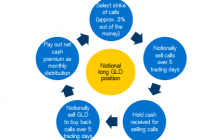
Summary GLDI is the gold variant of Credit Suisse’s covered call strategy ETNs. GLDI is an ETN issued by Credit Suisse, benchmarked to the Credit Suisse NASDAQ Gold FLOWS 103 Index, a proprietary index designed to track a covered call strategy. The Credit Suisse NASDAQ Gold FLOWS TM 103 Index notionally sells approximately 3% out of the money notional calls each month while maintaining a notional long position in GLD shares. The exchange traded note can potentially lower the downside risk over owning GLD shares or gold bullion outright with the approximately 11% distribution representing the covered call premiums. A few days ago I wrote about the silver sister product of this ETN offered by Credit Suisse. While the products are very similar in nature, there are a few differences as it relates to both the income generating strategy, and the resulting performance of the product. You can read the article about the Credit Suisse Silver Shares Covered Call ETN (NASDAQ: SLVO ) here. Before diving into the specifics of Credit Suisse X-Links Gold Shares Covered Call ETN (NASDAQ: GLDI ), let’s quickly review who this product is for and for whom it is not. I am going to quote myself from the previous article as it will sum it up quite well. Unlike in the world of stock and bond investors, the precious metals world has a wide variety of investors, ranging from individuals and institutions who just want to have precious metals exposures, to bullion purists who believe the only “real” way to invest in precious metals is to buy bullion that you hold in your hands, in your safe. This investment… is not for them. Source: SLVO: A Safer Way to Invest In Silver? GLDI is for someone who is not opposed to owning exposure to gold, either through exchange traded funds that invest in gold bullion such as the SPDR Gold Trust ETF (NYSEARCA: GLD ), the Sprott Physical Gold Trust (NYSEARCA: PHYS ) or the iShares Gold Trust ETF (NYSEARCA: IAU ), gold derivatives and indexes such as the PowerShares DB Gold ETF (NYSEARCA: DGL ), or gold mining stocks via ETFs or individual names and wants incremental income and lower volatility. What is the Credit Suisse X-Links Gold Shares Covered Call ETN ? GLDI is an exchange traded note benchmarked to the Credit Suisse NASDAQ Gold FLOWS 103 Index. The index is designed to replicate a strategy where you would write short term options against shares of GLD, the gold ETF. Specifically, Credit Suisse describes the index and strategy as follows: In a covered call (or “overwrite”) strategy, an investor holds a long position in an asset and sells call options on that same asset. Call options provide the seller with an up front premium payment, but require the seller to deliver to the buyer any upside an asset experiences beyond a set level (the “strike price”). The Gold FLOWSTM 103 Index sells approximately 3% out-of-the-money notional calls each month while maintaining a notional long position in shares. The notional net premiums received (if any) for selling the calls are paid out at the end of each monthly period. The strategy is designed to generate monthly cash flow in exchange for giving up any gains beyond the strike price. The strategy provides no protection from losses resulting from a decline in the value of the shares beyond the notional call premium. Source: Credit Suisse Below is a graphical representation of the Index Strategy: Source: Credit Suisse Performance For anyone who invested in Gold over the last 5 years, it would be tough to find a person who is happy with their investment, especially amongst those who purchased gold anywhere between $1,500 and $1,900 an ounce. With Gold currently at around $1,100 an ounce and trading within a fairly well established multi year, long term downtrend, it is not unreasonable to start thinking about what you could have done differently. While many gold bugs would justify any drop in price by diverting attention to the amount of ounces saved. Most investors though, particularly those investing in gold within their investment accounts are going to be forced to look at the value on the statement. A covered call strategy employed by this ETN would potentially lower a bit of the downside volatility and generate income by monetizing the risk you are taking for holding an inherently risky investment. Theoretically, a covered call strategy will be able to generate more income and outperform a simple buy and hold strategy in falling and flat markets. In order to generate the incremental income, you are giving up your upside over the strike price of the call options. In more volatile markets, writing call options generally makes sense as you are able to monetize the risk you are already taking by holding the underlying investment. Where you end up losing is during rising markets and your investments are called. Source: : A Safer Way to Invest In Silver? GLDI has performed exactly as expected over 1 year, 2 years, and since inception time periods. Below you can see the results of what a $10,000 investment in each of GLDI and GLD would net you. While a $10,000 investment in GLD would be worth approximately $8,504, representing a loss of nearly 15%, an investment in GLDI would be worth approximately $8,904, or a loss of approximately 11%. This hypothetical included a reinvestment of distributions. (click to enlarge) Since inception this trend stands true. A $10,000 investment from January 2013 in GLD would yield $6,518, whereas an investment in GLDI would be worth approximately $6,990. (click to enlarge) Is GLDI right for you? Perhaps. Even though GLDI has handily outperformed an outright investment in GLD, there are a number of downsides. The first risk is the strategy risk. In rising markets, writing covered calls will cap your upside on the investment. If for any reason gold spot price will rally over a sustained period of time, your upside will be limited typically to the 3% over spot price at the time the covered call was written, plus the premium received for writing the call. So for example if you purchased GLD today, for $106.26, a 3% over market price would imply $109.44, so let’s look at a $110.00 strike price, approximately 40 days out, in which case we would look at the September 18th, 2015 expiring option. The $110 strike is trading for approximately $.64, which you would receive. As we get closer to September 18th, that time premium would eradicate, and the only thing left over would be any intrinsic value. Since you are writing $110 options, and GLD is currently $106.26, there is only time value, and no intrinsic value in those options. If at expiration GLD is under $110, those options would expire worthless and you keep your $.64, in which case it is all profit. If GLD is over $110, let’s say $112, that option would be worth somewhere close to $2.00, the “intrinsic value.” At expiration, you would have the choice, either buy the option back for the $2.00, or let the shares of GLD get called away, where you would get the $110, plus the $.64 you received for writing the calls. Yes, you are making money, but you capped your upside. Because the benchmark has clear rules over what happens, the ETN index will buy back those calls approximately 5 days before expiration. The second risk here is the product structure. In this case, you must absolutely be aware that this is not an ETF, an exchange traded fund with underlying investments. This is an ETN, an exchange traded note. Unlike an ETF, ETNs are not shares of the actual underlying funds, ETNs are credit obligations, like bonds of the underlying issuer, whose value tracks a specified index. In the event of a default, owners of the ETN would be lining up for the settlement in the liquidation of the issuer. In order to invest in this ETN, you should be absolutely comfortable with Credit Suisse’s credit risk. While Credit Suisse is a seemingly sound institution, your investment in this ETN is not backed or invested in any underlying shares of gold. This is an additional risk that you should take into account. If you are not comfortable with taking on that credit risk, the alternative is to purchase your own shares of GLD and write the covered call options by yourself, to replicate this strategy. Note that you may incur additional trading fees, by both buying and selling the individual securities as well as writing and buying back any options. For smaller accounts, GLDI’s annual expense of .65% will likely be cheaper over the long term, however by owning your own shares of GLD, you will have more flexibility as to what options you will want to write. Other products that you may want to consider are the GAMCO Global Gold, Natural Resources & Income Trust (NYSEMKT: GGN ) and the BlackRock Resources & Commodities Strategy Trust (NYSE: BCX ). Both are Closed End Funds, which do carry annual fees, however there is an underlying portfolio of investments in case of liquidation. For more discussion about risk faced with ETN investing, feel free to read my previous ETN articles such as RBS ETNS: When A Good Idea Alone is Not Enough , as well as SLVO, linked above. Disclosure: I/we have no positions in any stocks mentioned, and no plans to initiate any positions within the next 72 hours. (More…) I wrote this article myself, and it expresses my own opinions. I am not receiving compensation for it (other than from Seeking Alpha). I have no business relationship with any company whose stock is mentioned in this article. Additional disclosure: None of the information discussed should be considered investment advice or a solicitation to buy or sell any securities. Please consult your investment advisor for specific recommendations.
Is The Small Cap Stock Premium Disappearing?

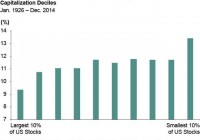
Summary The small cap size premium has shrunk from a 5% annualized return to 1% since Rolf Banz published a landmark paper demonstrating small stocks’ return premium in 1981. The shrinking of the small-cap premium can be explained by several reasons and is not unique in the investment world. A multi-factor investment strategy suggests keeping small-cap stocks, as several factor premiums, including momentum, asset growth and profitability, tend to be stronger among small-cap stocks. Small cap stocks are in a bit of a slump. For example, from January 1, 2014 to July 31, 2015, the Russell 2000 Index of small-company stocks returned just 8.6%, less than half of the 17.4% return of the Russell 1000 Index of large companies. Some market commentators ask whether the small cap premium (the historical phenomenon of small caps tending to outperform large caps) has disappeared; a number of academics even question whether the small cap premium ever existed. For a review of the continuing academic debate on this subject, I invite you to read our recently posted paper, ” Sizing Up the Size Premium .” In this article, I will discuss how we as investment practitioners who construct multi-asset class portfolios think about the small cap premium. The Small Cap Premium First, here’s some history. In 1981, Rolf Banz published a paper on the “small stock effect,” which demonstrated a return premium for small stocks over their larger counterparts.* For instance, from 1961-1980, the size premium earned an annualized return of 5%, which is very attractive. Exhibit 1 below, which divides the market into deciles, illustrates the historical returns from 1926 to 2014 of each market decile. Note the highly significant relationship between firm size and return, where smaller-cap stocks have earned higher returns. (click to enlarge) But since Banz published his paper, a funny thing has happened: the small-cap size premium has shrunk dramatically, from 5% to 1%. In Exhibit 2, which depicts a recent 20-year time period, the smallest decile of stocks is still the best performer, but this chart is much “noisier” than Exhibit 1, which is statistically what one might expect when examining a shorter time period in which data can be more idiosyncratic. Now look at Exhibit 3. Here we see that, during a recent 10-year period, the smallest-cap stocks significantly outperformed only the very largest stocks during the decade. (click to enlarge) (click to enlarge) How do we, as investment managers, explain and address the apparent shrinking of the size premium? I find it fascinating that a nearly identical phenomenon has occurred with value stocks-since Fama and French published their landmark paper on the value premium in 1992, that premium has also shrunk from 5% during the 1972-1991 period of study to just 1%, since 1991. In other words, it seems quite possible that once research on factor premiums (such as size and value) is out there in public, the investment world catches on and whittles away the premium. Since we have tilted portfolios to value and small caps for more than 20 years, I suppose we should plead guilty to aiding and abetting the shrinking premiums! The Case for Small Caps Despite the apparently declining size premium, we do not abandon small cap stocks for a number of reasons. For one thing, we think there is a strong underlying economic argument for why small companies should generate higher returns (though with higher volatility). Small firms do not have the same access to capital as large companies and typically have a higher cost of capital, thus requiring a higher rate of return. When we evaluate investment strategies, we consider economic and financial logic as well as study past patterns of returns. Note, also, that not all small caps are created equal. For instance, over time small-cap value stocks have dramatically outperformed small-cap growth ones (14.86% annualized vs. 8.81% from July 1, 1926 to June 30, 2015, according to Center for Research in Security Prices data), which appears to endorse a tilt to value. In addition, the small-cap growth “style box” has historically been a weak performer, but our research demonstrates that, by stripping out the “growthiest” stocks in this category, an investor will be much happier with returns (see ” Returns on Small Cap Growth Stocks, or Lack Thereof: What Risk Factor Exposures Can Tell Us “). Insights such as these are ones that we employ in building portfolios and, indeed, in constructing our own factor-based investment strategies. To this point, I should add that small cap’s dry spell (recall the 10-year cycle of Exhibit 3) is a good example of why we embrace multi-factor investing rather than single-factor investing (for a quick tutorial on our investing style, see ” What is a Multi-Factor Investment Approach? “). Different factors move in different cycles of different duration, which provides diversification. And importantly, several factor premiums (including momentum, asset growth and profitability) tend to be stronger among small-cap stocks, which is yet another reason why we continue to like investing in smaller companies despite the eroding premium. Conclusion The size premium, while weaker than in the past, is generally still positive. Even with a modest small cap premium, we still believe there is a benefit in holding small cap stocks as a distinct tilt in an equity strategy and as an important component of a multi-factor investment strategy. * Banz, Rolf W. “The Relationship Between Market Value and Return of Common Stocks,” Journal of Financial Economics, November 1981. Disclosure: I/we have no positions in any stocks mentioned, and no plans to initiate any positions within the next 72 hours. (More…) I wrote this article myself, and it expresses my own opinions. I am not receiving compensation for it. I have no business relationship with any company whose stock is mentioned in this article.

Spark Energy’s (SPKE) CEO Nathan Kroeker on Q2 2015 Results – Earnings Call Transcript

Spark Energy (NASDAQ: SPKE ) Q2 2015 Earnings Conference Call August 13, 2015, 11:00 AM ET Executives Andy Davis – Head of Investor Relations Nathan Kroeker – Director, President and Chief Executive Officer Georganne Hodges – Chief Financial Officer Analysts Selman Akyol – Stifel Operator Good morning, ladies and gentlemen. Welcome to the Spark Energy, Inc.’s second quarter 2015 earnings conference call. My name is Shannon, and I’ll be your operator for today. [Operator Instructions] I would now like to turn the conference over to Mr. Andy Davis, Head of Investor Relations for Spark Energy, Inc. Please go ahead. Andy Davis Good morning and welcome to Spark Energy, Inc. second quarter 2015 earnings call. This morning’s call is being broadcast live over the phone and via webcast, which can be located under Events and Presentations in the Investor Relations section of our website at www.sparkenergy.com. With us today from management is our President and CEO, Nathan Kroeker; and our CFO, Georganne Hodges. Please note that today’s discussion may contain forward-looking statements, which are based on assumptions that we believe to be reasonable as of this date. Management may make forward-looking statements concerning future expectations, projections of our operations, economic performance and financial condition. These statements are subject to risks and uncertainties that could cause actual results to differ materially from these statements. Although we believe that the expectations reflected in such forward-looking statements are reasonable, we give no assurance that such expectations will be realized. We urge everyone to review the Safe Harbor statement provided in yesterday’s earnings release as well as the risk factors contained in our SEC filings. We undertake no obligation to publicly update or revise any forward-looking statements whether as a result of new information, future events or otherwise except as required by law. During this morning’s call, we will refer to both GAAP and non-GAAP financial measures of the company’s operating and financial results. For information regarding our non-GAAP financial measures and reconciliations to the most directly comparable GAAP measures, please refer to yesterday’s earnings release. With that, I’ll turn the call over to Nathan Kroeker, our President and Chief Executive Officer. Nathan Kroeker Thank you, Andy. I’d like to welcome our shareholders and analysts to Spark’s second quarter 2015 conference call. I will make a few opening remarks about our operating results and the two acquisitions we closed recently. And then our Chief Financial Officer, Georganne Hodges, will provide some detail on the financial results. We will then conclude with questions from analysts. Georganne will give you the financial details of our second quarter results in a moment, but I will tell you that we are very pleased with these results. We saw enhanced unit margins in both our Retail Natural Gas and Retail Electricity segments during the second quarter. This was a result of margin expansion, coupled with declining wholesale prices and our ability to capture higher margins on our variable book. In terms of customer count, we saw organic growth of 4% in the second quarter, driven by strong success with our electric sales campaigns in PPL and NSTAR as well as consumers in PG&E on the natural gas side and dual fuel offerings in [indiscernible]. I will discuss our two recent acquisitions in a moment, but I will say that I’m very excited about the addition of 20 new markets from these acquisitions. In the first few weeks, we have launched several dual fuel products where, for example, we are now selling Oasis electricity combined with Spark gas in the same customer sales experience. In addition, we are in the process of broadening our broker relationships, providing brokers new electric and gas markets, leveraging our suite of brand. As we signaled last quarter, we continued to see the heightened level of attrition in Southern California, as a result of our more aggressive collection efforts in that market. In line with our expectations with the closing of the Entrust acquisition, we saw higher attrition as a result of required customer communications, as those customers came on flow in the second quarter. We have taken a series of steps, aimed at reducing attrition, and we are already seeing success. If you dig into the second quarter, attrition was at its highest point in April, and has been trending down through June, and we’re seeing this trend continue in the early part of the third quarter. While I expect our attrition to continue to improve over the next few quarters, I don’t expect it to return to the levels of a few years ago, as the composition of our business has shifted overtime at higher-margin lower-volume customers that tend to experience higher attrition levels. All of this attrition is factored into our pricing strategies and our customer likes on value analysis. On July 8, we acquired CenStar Energy, a retail energy company with approximately 75,000 RCEs across 20 utilities in New York, New Jersey and Ohio. CenStar provides us with the access to 13 new utilities service territories as well as several new products to support our continued organic growth efforts. Censtar has a strong brand as well as a number of broker infinity relationships that we intend to leverage, as we grow this business. On July 31, we completed our Oasis Energy acquisition. Oasis operates in six states across 18 utilities and has approximately 40,000 natural gas and electricity customers. Oasis provides the seven new utilities, providing additional organic growth opportunities for Spark. As discussed on the last call, we intend to maintain the Oasis brand in sales and marketing operations, given their ability to add customers at a competitive cost, and realize electricity unit margin that are significantly higher than our historical margins, while only experiencing slightly higher attrition rates. We expect both businesses to be accretive through adjusted EBITDA in 2015, inclusive of integration costs expected in the third and fourth quarters. On June 15, we paid a quarterly cash dividend for the first quarter of $0.3625 per share. More recently, on July 23, we announced that our second quarter dividend of $0.3625 per share will be paid on September 14. We expect to pay this quarterly dividend on a go-forward basis. And as we have previously communicated, we expect 2015 adjusted EBITDA to exceed our planned 2015 dividends and all required distributions and tax payments. And now with our two recent acquisitions, our adjusted EBITDA should be further increased by a meaningful amount. And I want to reiterate that management does not anticipate any changes to the dividend policy in 2015. Thanks for your attention. And with that, I will now turn the call over to Georganne Hodges, our Chief Financial Officer, for more financial review. Georganne? Georganne Hodges Thank you, Nathan. Strong unit margins underpinned by lower supply costs across several of our market led to an adjusted EBITDA of $4.6 million for the second quarter. This compared to $1.4 million for the second quarter of 2014. Retail gross margin was $23.1 million compared to $17.9 million in 2014. This increase was driven by increased unit margins across both our retail natural gas and electricity segments. Although, customer account was 17% higher in the second quarter of 2015 as compared to 2014, our gas volumes were slightly lower reflecting a shift in our overall geographic mix. G&A expenses for the quarter were $13 million compared to $9.7 million in 2014. This increase is primarily due to increased billing and other variable costs associated with customer account growth and increased costs associated with being a public company. Customer acquisition spending for the quarter was $6.2 million compared to $6.4 million spent in the second quarter of ’14. Approximately, 82,000 new customers came on flow in the quarter, which includes approximately 25,000 from our Entrust acquisition, which we closed in the first quarter. Our net income for the quarter was $4.6 million compared to $200,000 in 2014. Our EPS for the quarter was $0.23, which was positively impacted $0.02 by an unrealized gain on our hedges of future supply positions. In the second quarter, we paid down our working capital facility by $11 million, ending the quarter with a loan balance of $9 million. On July 8, we amended and restated our senior credit facility to include a $25 million secured revolving line of credit to be used specifically for the financing of permitted acquisitions, along with our revolving working capital facility of $60 million. As of today, the loan balance on the revolving acquisition tranche is $21.2 million, while the balance on the working capital facility is $20.3 million. I would point out that the balance on the working capital facility reflects the purchase of working capital for both CenStar and the Oasis acquisitions. Additionally, on July 8 and July 31, in conjunction with the closing of these acquisitions, we executed a total of $7.1 million of convertible subordinated debt with an affiliate of our founder. That concludes my prepared remarks. I’ll now turn the call back over to Nathan. Nathan Kroeker Thanks, Georganne. In summary, we are very pleased with the strong adjusted EBITDA and retail gross margin we realized in the second quarter. As we move through the third quarter, we are very focused on the integration of our two new acquisitions, taking advantage of the new market opportunities for organic customer acquisitions. We will now open up the line for questions from our analysts. Operator? Question-and-Answer Session Operator [Operator Instructions] Our first question comes from Selman Akyol with Stifel. Selman Akyol As we sit there and look at the gross margin, and I know represented in your early comments that you had, I guess, favorable supply contracts on as well. How long do those — is the gross margin due to the acquisitions, higher selling prices? Is it due more to the favorable acquisition prices of energy? And if so, how long do those contracts run for? Just trying to get a feel for how durable those margins are? Nathan Kroeker Let me make sure I understand your question, Selman. So you’re asking how much of it is due to us increasing revenue and how much of it is due to us having lower costs and how long can we expect that to continue for? Selman Akyol That’s a very good summary of it, yes. Nathan Kroeker It’s really a combination of both. So on the supply side, we saw commodity prices coming down through the quarter. And when we see commodity prices coming down like that, it gives us the opportunity to expand our unit margins in that period of time. Similarly, we do have a pretty significant portion of our book that’s on variable price contracts. With milder weather in the quarters, smaller builds for consumers, we were able to have slightly higher variable margins, raise the revenue on those customers. So it’s really a combination of both. I don’t think it has much to do with the supply hedges out into the future as it is the situation in the quarter. That said, I mean I think we’ve proven that we can achieve higher unit margins than what we had last year, and we expect to continue to manage the business in a similar way going forward. So I definitely think you’re going to see higher unit margins even through the balance of the year than we had last year. Selman Akyol And then, can you talk about attrition within the quarter? Georganne Hodges We saw attrition numbers — you saw attrition numbers, they were higher than we would like. Within that, it has been trending down throughout the second quarter. And as I said a moment ago, I mean also trend it down even in the first part of the third quarter. Full quarter number was 7.7. Our June attrition, on a standalone basis for the month of June, was actually 6.8, and we see that trend continuing in July. I don’t necessarily see attrition getting all the way back down to the historical levels that we had a couple of years ago, because the makeup of our customer book has changed, really shifted a lot of our focus to higher margin, lower volume customers. And those customers tend to have inherently higher attrition. But as I also said a moment ago, I mean all of that attrition is factored into our pricing decisions, our pricing models and our lifetime value strategies. So I think we have done a pretty good job of managing it. Selman Akyol And then last one from me, just on sort of the acquisition outlook. So are you seeing lot of opportunities out there? Nathan Kroeker Absolutely, I mean I will say the management team is very focused on integrating the two deals we just did in July. But we do have a founder that’s very committed to helping us grow through M&A, willing to continue to leverage his balance sheet in order to do that. So we’re absolutely continuing to look at additional opportunities. Whether there would be something we do directly in Spark or whether it’s something that we do with the parent company and then leverage subordinated debt in order to drop those down at a later date, but we’re willing to look at pretty much anything that we think is on strategy for us. Operator We have no further questions at this time. I would now like to turn the call back over to Nathan Kroeker for closing remarks. End of Q&A Nathan Kroeker Thanks everybody for participating in today’s call. And we look forward to talking to you soon. Operator Ladies and gentlemen, this concludes today’s conference. Thanks for your participation and have a wonderful day. Copyright policy: All transcripts on this site are the copyright of Seeking Alpha. However, we view them as an important resource for bloggers and journalists, and are excited to contribute to the democratization of financial information on the Internet. (Until now investors have had to pay thousands of dollars in subscription fees for transcripts.) So our reproduction policy is as follows: You may quote up to 400 words of any transcript on the condition that you attribute the transcript to Seeking Alpha and either link to the original transcript or to www.SeekingAlpha.com. All other use is prohibited. THE INFORMATION CONTAINED HERE IS A TEXTUAL REPRESENTATION OF THE APPLICABLE COMPANY’S CONFERENCE CALL, CONFERENCE PRESENTATION OR OTHER AUDIO PRESENTATION, AND WHILE EFFORTS ARE MADE TO PROVIDE AN ACCURATE TRANSCRIPTION, THERE MAY BE MATERIAL ERRORS, OMISSIONS, OR INACCURACIES IN THE REPORTING OF THE SUBSTANCE OF THE AUDIO PRESENTATIONS. IN NO WAY DOES SEEKING ALPHA ASSUME ANY RESPONSIBILITY FOR ANY INVESTMENT OR OTHER DECISIONS MADE BASED UPON THE INFORMATION PROVIDED ON THIS WEB SITE OR IN ANY TRANSCRIPT. USERS ARE ADVISED TO REVIEW THE APPLICABLE COMPANY’S AUDIO PRESENTATION ITSELF AND THE APPLICABLE COMPANY’S SEC FILINGS BEFORE MAKING ANY INVESTMENT OR OTHER DECISIONS. If you have any additional questions about our online transcripts, please contact us at: transcripts@seekingalpha.com . Thank you!