Tag Archives: feeds

Goldman Sachs Files For 2 New ETFs

In the last couple of years, ETFs have witnessed surging popularity as they continue to grow and evolve. With a number of products being launched and fees being slashed, ETFs have grown more competitive over time, forcing issuers to foray into spaces where none has gone before. Goldman Sachs (NYSE: GS ), which has recently filed two new ETFs, Goldman Sachs Hedge Fund VIP ETF and Goldman Sachs High Sharpe Ratio ETF , will use the bank’s own research reports, Hedge Fund Trend Monitor and U.S. Weekly Kickstart strategy report, respectively, as the basis of selection. Let’s dig a little deeper. Proposed Funds in Detail As per the SEC filing, the proposed Goldman Sachs Hedge Fund VIP ETF will track the performance of the Goldman Sachs Hedge Fund VIP Index. The Index provides exposure to equity stocks, which are expected to influence the long portfolios of hedge funds. These equity securities generally appear most frequently among the top ten equity holdings of U.S. hedge funds that select their positions based on fundamental analysis. The index comprises 50 securities with a market capitalization of approximately $2.5 billion to $715.6 billion, as per the filing. Meanwhile, Goldman Sachs High Sharpe Ratio ETF will track the performance of the Goldman Sachs High Sharpe Ratio Index, thereby providing exposure to large-cap U.S. stocks with the highest projected Sharpe ratio – a widely used measure of risk-adjusted return. The index comprises 50 securities with a market capitalization of approximately $4.2 billion to $212.3 billion, as per the filing. The constituents of the index are equal-weighted with a 2% basket weight each. This is the first ETF to be constructed around the Sharpe ratio. Both the funds are expected to be listed on the NYSE Arca. The expense ratio and the ticker code of the funds are yet to be disclosed. How Does it Fit in a Portfolio? The proposed Goldman Sachs Hedge Fund VIP ETF will be a good option for investors seeking high returns and who possess a healthy risk appetite. As per an Investopedia report, The Goldman Sachs Hedge Fund VIP Index has appreciated approximately 80% since mid-2012 while the S&P 500 was up approximately 51% in the period. Thus, the Hedge Fund VIP Index outperformed the S&P 500 even during a raging bull period. However, given the current bearish environment led by global growth worries, China turmoil and slump in oil prices, investors should be cautious (read: Best ETF Strategies to Survive Market Turmoil ). Goldman Sachs High Sharpe Ratio ETF will be an innovative product providing risk-adjusted return with low concentration risk. The Sharpe ratio can be defined as excess return i.e. difference between asset return and risk free return for per unit of risk dominated by standard deviation. However, the Sharpe ratio is sometimes criticized as it does not differentiate between upside and downside deviation. Thus, it penalizes stocks for its potential to gain. Although the filing did not state the fees the new ETFs will charge, it is expected that they will not be very high, considering Goldman’s strategy of charging below-average fees for a number of ETFs including smart-beta ETFs. The Goldman Sachs ActiveBeta U.S. Large Cap Equity ETF (NYSEARCA: GSLC ) launched in September 2015 has accumulated $300.8 million in its asset base and has an expense ratio of 0.09% (read: Can Goldman Dominate the Smart Beta ETF Industry? ). ETF Competition These new funds, if approved, could be interesting options for investors seeking a diversified exposure amid the current market turmoil. Goldman Sachs High Sharpe Ratio ETF doesn’t have a direct contender. The fund would definitely get the first mover advantage, as it will be the first ETF in the space. Meanwhile, Goldman Sachs Hedge Fund VIP ETF providing exposure to a niche market may face competition from other ETFs tracking hedge funds’ stock holdings. The Global X Guru ETF (NYSEARCA: GURU ) is one of the popular ETFs in this space with an AUM of $119.7 million and trades in average volume of almost 40,000 per day. The fund has a high expense ratio of 0.75% and returned slightly almost 10% so far this year. Another ETF is this space is the AlphaClone Alternative Alpha ETF (NYSEARCA: ALFA ) with an AUM of $106.4 million. The fund trades in average volume of almost 44,000 per day. The fund has a high expense ratio of 0.95% and returned slightly almost 7% so far this year. So, the road ahead is definitely promising for the new ETF as it has potential to provide a lucrative option to investors. Link to the original post on Zacks.com
Bears Miss Out On Social Media Payday

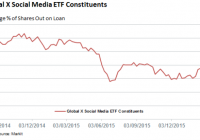
Social media shares have borne the brunt of the recent market selloff but few short sellers are lining up to short the market despite its recent underperformance as tracked by the Global X Social Media ETF (NASDAQ: SOCL ). Social media companies make up half of the once hotly tipped but now largely discredited , “FANG” trade of fast growing tech companies with a global presence. The market’s recent shunning of these high flying mercurial shares, spurred on by a spate of disappointing tech earnings and wider fears surrounding the health of the global economy means that every one of the acronym’s four constituents are trading over 10% off their recent highs. The headwinds faced by the sector’s flagship stocks are reflected in the overall sector as the Global X Social Media ETF hit a two and a half year low earlier this month. While the fund has rebounded somewhat in the last 10 days, it is still down by 13% ytd which is more than twice the fall seen by the rest of the market. The headwinds felt by the sector have been relatively universal as eighty percent of the ETF’s constituents have seen their shares retreat year to date. Collapse catches short sellers out This recent collapse of the once popular trade looks to have caught short sellers out as the ETF’s constituents entered 2016 with a below average short interest. In fact, demand to borrow the fund’s constituents fell by over a third last year and short interest stood near a two year low prior to the selloff. This indifference towards social media shares runs against that seen in the rest of the market where short selling stands at multi year highs. While there has been a 7% increase in demand to borrow social media shares since the start of the year, that number also trails the increase in shorting activity seen in the S&P 500 where average short interest is up by double digits since the start of the year. Lack of appetite universal As with the fall in share prices, the lack of appetite to sell social media shares short is fairly universal as only seven of SOCL’s constituents see any material short interest as defined by having more than 3% of shares out on loan. Pandora (NYSE: P ) is the most shorted of the lot with 8% of its shares now out on loan. Its shares have fallen by a quarter as investors’ fret about the company’s prospects in an increasingly crowded streaming field. Ironically, Groupon (NASDAQ: GRPN ), which was the highest conviction short at the start of the year, has become a painful short as its shares surged following Alibaba’s (NYSE: BABA ) disclosed stake in the online discounter. Short sellers have covered 10% of their positions as their trades went against them. The only firm to see a material rise in short interest across the field since the start of the year has been LinkedIn (NYSE: LNKD ) after its shares nearly halved in the wake of a disappointing earnings update. While short interest in the professional social media firm has since quadrupled, the 2.1% of LNKD shares now out on loan is still less than that seen at the start of 2015. Investors not buying dip Investors in SOCL have shown little patience to ride out the recent volatility as over $32m of funds have flowed out of the ETF since the start of the year. These strong outflows represent over a quarter of the AUM managed by the fund at the start of the year which underscores the wave of negative sentiment felt by the sector since the start of the year.

5 Alternative Mutual Funds To Dodge Volatility In 2016

U.S. stock markets have been volatile for a pretty long time. Market volatility can make anyone feel anxious. It threatens the one thing that everybody holds dear – their money. To weather such market swings and book in profits, alternative mutual funds are the best available choice. Their potential to hedge risks, provide unwavering returns and diversify portfolio helps to stand out from other mutual fund classes, particularly in difficult times. Up-and-Down Markets Since June 30, 2015, concerns regarding Grexit have made the markets volatile. Later, from August 24 to August 27, 2015, the Chinese stock market crash unleashed a downward spiral. Add to it the continuous rout in oil prices, uncertainty about the Fed rate hike and selloff in bank stocks and you know why the U.S. markets have been so unstable. The CBOE Volatility Index (VIX) has been proof enough. VIX is “a key measure of market expectations of near-term volatility conveyed by S&P 500 stock index option prices.” VIX being a fear-gauge index moves contrary to market trends. In the first week of January the index gained 48.33%, while in the second week it gained a meager 0.04%. On the other hand, the index declined 17.32% and 9.58% during the last two weeks, respectively. Come February, the index recorded gains of 15.74% and 8.64%, respectively, in the first two weeks, while in the third week it fell 19.17%. This shows that investor sentiment is constantly fluctuating and the stock market is subject to gyrations. Meanwhile, the VIX settled at 20.72 on Wednesday. Any reading above 20 indicates high volatility in the markets. How to Play This Volatility? The best way to navigate market volatility is by investing in alternative mutual funds, which will not only minimize risk but will also provide stable returns. These types of funds are available to investors of all income levels and provide that extra edge brought by diversity. These funds mostly include market-neutral funds, long/short equity funds and trading-leveraged equity funds. Let us now discuss these three types of funds in some details. Market-Neutral Mutual Funds Market-neutral funds aim to adopt a precision approach by shorting 50% of their assets and holding 50% long. This approach seeks to identify pairs of assets whose price movements are related. The fund goes long on the outperforming asset and shorts the underperformer. Say, for example, you take a $1 million long position in Pfizer and a $1 million short position in Wyeth. Both are large pharmaceutical companies. Now, if pharmaceutical stocks fall, you will lose because of your long position in Pfizer but will gain because of the short position in Wyeth. A market-neutral fund is designed to provide stable returns at relatively lower levels of risk regardless of market direction. This is particularly relevant in today’s highly volatile scenario when the objective is to protect the capital invested. Long/Short Mutual Funds Equity long/short funds seek to gain from both winning and losing stocks, irrespective of the current market scenario. These funds use conventional methods to identify stocks that are either undervalued or overvalued. It profits from shorting the overvalued stocks and by buying the undervalued stocks. Weights are subject to change and are dependent on the management’s view regarding the market. For example: Say an investor buys a long/short mutual fund for $100, then the fund manager will invest it in assets that are expected to do well. The manager shorts $30 in stocks that are believed to be overvalued. In the process, he receives $30 in cash. He will now use the $30 to buy more assets with an upside potential. So, now he has a total of $130 invested in long positions and $30 in short positions. This type of long/short fund is called a 130/30 mutual fund. Trading-Leveraged Equity Funds Leveraged funds use borrowed money to increase returns in a short spell of time. These funds generally strive to return a certain multiple of the short-term returns of an equity index. For example, a 2X S&P 500 fund aims to generate twice the returns that the S&P 500 manages to achieve. Leveraged funds are primarily marked “ultra”, “bull” or “2X”. Leveraged funds also offer benefits such as diversification. These funds invest in a diversified portfolio of assets which minimize risk, while escalating returns. In addition to this, investors enjoy the benefits of “dollar cost averaging,” where a young investor depositing $10,000 in these funds reaps the same benefits a high net worth individual receives, say by depositing $50,000,000. These funds also enjoy tax deductions. 5 Alternative Mutual Funds to Invest In The investment community is a dynamic one where new products will come into play and make the most of the stock markets. In times of market volatility, alternative mutual funds are such new product classes that are equipped to protect investors’ portfolio and provide steady returns. Here we have selected five such alternative mutual funds that boast a Zacks Mutual Fund Rank #1 (Strong Buy) or #2 (Buy), have positive 3-year and 5-year annualized returns and carry a low expense ratio. Calamos Market Neutral Income A (MUTF: CVSIX ) seeks high current income. CVSIX invests mainly in convertible securities and employs short selling to enhance income and hedge against market risk. The fund’s 3-year and 5-year annualized returns are 1.9% and 2.7%, respectively. Annual expense ratio of 1.11% is lower than the category average of 1.7%. CVSIX has a Zacks Mutual Fund Rank #1 and has a minimum initial investment of $2,500. Gateway A (MUTF: GATEX ) seeks to capture most of the higher returns associated with equity market investments, while exposing investors to significantly less risk than other equity investments. The fund’s 3-year and 5-year annualized returns are 3% and 3.5%, respectively. Annual expense ratio of 0.94% is lower than the category average of 1.82%. GATEX has a Zacks Mutual Fund Rank #1 and a minimum initial investment of $2,500. Diamond Hill Long-Short A (MUTF: DIAMX ) seeks to provide long-term capital appreciation. DIAMX invests its assets in U.S. equity securities of any size capitalization that are undervalued and sells short equity securities of any size capitalization that are overvalued. The fund’s 3-year and 5-year annualized returns are 5.4% and 6.3%, respectively. Annual expense ratio of 1.4% is lower than the category average of 1.82%. DIAMX has a Zacks Mutual Fund Rank #1 and a minimum initial investment of $2,500. Aberdeen Equity Long-Short A (MUTF: MLSAX ) seeks long-term capital appreciation with a total return greater than the S&P 500 Index. MLSAX invests a large portion of its assets in long and short positions in equity securities of publicly traded companies in the U.S. The fund’s 3-year and 5-year annualized returns are both 0.1. Annual expense ratio of 1.56% is lower than the category average of 1.82%. MLSAX has a Zacks Mutual Fund Rank #2 and a minimum initial investment of $1,000. ProFundsUltraSector Health Care Investor (MUTF: HCPIX ) seeks daily investment results, before fees and expenses that correspond to one and one-half times the daily performance of the Dow Jones U.S. Health CareSM Index. The fund’s 3-year and 5-year annualized returns are 22.9% and 23.9%, respectively. Annual expense ratio of 1.61% is lower than the category average of 1.99%. HCPIX has a Zacks Mutual Fund Rank #2 and a minimum initial investment of $15,000. A higher minimum investment helps the fund manager to control cash flows, which eventually helps management of assets on a regular basis. Original Post