Tag Archives: etfs

Monday Morning Memo: ESG Criteria As A Tool For Stock Selection

By Detlef Glow Stock selection is one of the most critical aspects for equity fund managers, since that is the point where they are supposed to deliver so-called alpha as value added from active management and therefore the justification for their management fee. I have had a number of meetings with portfolio managers over the past 20 years, and most of them told me they try to find high-quality stocks. That said, one can imagine the quality of a stock is defined differently by each manager. Asked how they evaluate quality, most managers told me they have implied quantitative screens for financial data, and they meet with the management of companies to verify future expectations of the companies’ operation. But few of the fund managers told me they use environmental, social, or governance (ESG) criteria for stock selection. Nevertheless, nowadays a number of portfolio managers employ at least one ESG criterion in their screening process. This shows that the integration of ESG criteria has gained ground in the conventional asset management industry. From my point of view it is not surprising that even conventional fund managers have started to use ESG criteria, since these data deliver a unique view of a company that is not dependent on financial data. Fund managers who employ ESG data and criteria in their selection process have an opportunity to gain a competitive edge through the use of information that is not used by their competitors. But, what information can be gathered from ESG criteria? Using ESG criteria the research process should lead to companies that have good policies on environmental and social aspects and a strong management that follows best-practice guidelines and has no conflicts of interest. In more detail ESG data can be used to identify so-called corporate-specific risks, i.e., the risk of fatalities, outages, fraud, or strikes as well as macro risks such as labor intensity or a shortage of skills, weather impacts, data protection, security issues, or possible water shortages. From my perspective the lack of education is a key factor of why ESG criteria will not be used widely in the asset management industry in the short term. But, with the turnover in staff and the educational efforts by industry associations and promoters of advanced education courses, the use of ESG criteria will become more popular over time. There is evidence that investors from Generations X and Y are more demanding with regard to information about how their money is invested. In addition, surveys have shown that investors from these generations are also more tuned to a lifestyle of health and sustainability and want to invest their money in funds that have similar goals in place. This means the demand from investors for products using a sustainable investment approach should increase, since Generations X and Y have just started to become investors. From my point of view this demand will be the main driver for a change in thinking and acting within the wider asset-management industry. Early adaptors might be the winners in this trend, since they can build up a reputation as thought leaders, along with a performance track record, prior to their competitors. The views expressed are the views of the author, not necessarily those of Thomson Reuters.

Best And Worst Q3’15: All Cap Value ETFs, Mutual Funds And Key Holdings

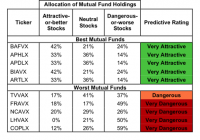
Summary All Cap Value style ranks fifth in Q3’15. Based on an aggregation of ratings of 0 ETFs and 257 mutual funds. BAFVX is our top-rated All Cap Value mutual fund and COPLX is our worst-rated All Cap Value mutual fund. The All Cap Value style ranks fifth out of the twelve fund styles as detailed in our Q3’15 Style Ratings for ETFs and Mutual Funds report. It gets our Neutral rating, which is based on aggregation of ratings of 0 ETFs (no All Cap Value ETFs are currently under coverage) and 257 mutual funds in the All Cap Value style. See a recap of our Q2’15 Style Ratings here. Figure 1 shows the five best and worst rated All Cap Value mutual funds. Not all All Cap Value style mutual funds are created the same. The number of holdings varies widely (from 21 to 521). This variation creates drastically different investment implications and, therefore, ratings. Investors seeking exposure to the All Cap Value style should buy one of the Attractive-or-better rated ETFs or mutual funds from Figure 1. Figure 1: Mutual Funds with the Best & Worst Ratings – Top 5 (click to enlarge) * Best mutual funds exclude funds with TNAs less than $100 million for inadequate liquidity. Sources: New Constructs, LLC and company filings LSV U.S. Managed Volatility Fund (MUTF: LSVMX ) (MUTF: LVAMX ) is excluded from Figure 2 because its total net assets are below $100 million and do not meet our liquidity minimums. The Brown Advisory Value Equity Fund (MUTF: BAFVX ) is the top-rated All Cap Value mutual fund and earns a Very Attractive rating. The Copley Fund (MUTF: COPLX ) is the worst-rated All Cap Value mutual fund and earns a Very Dangerous rating. Oracle Corporation (NYSE: ORCL ) is one of our favorite stocks held by All Cap Value funds and earns our Attractive rating. Over the past decade, the company has grown after-tax profit ( NOPAT ) by 15% compounded annually. Oracle currently earns a top quintile return on invested capital ( ROIC ) of 25%. Despite one of the highest ROIC’s in the business and consistent profit growth, ORCL remains undervalued. At its current price of ~$39/share, Oracle has a price to economic book value ( PEBV ) ratio of 1.1. This ratio implies that the market expects Oracle’s profits to grow by no more than 10% over current levels for the remainder of its corporate life. If Oracle can grow NOPAT by just 5% compounded annually for the next ten years , the stock is worth $53/share – a 36% upside. Intersil (NASDAQ: ISIL ), a previous Danger Zone pick , is one of our least favorite stocks held by All Cap Value funds and earns our Very Dangerous rating. Since 2009, Intersil’s NOPAT has fallen by 31% compounded annually. The company currently earns a bottom quintile ROIC of 1% and has a NOPAT margin of only 2%. Such a low margin leaves little room for error in the highly competitive semiconductor industry. With such poor fundamentals, Intersil’s stock, despite being down 18% year to date, remains overvalued. To justify the current price of $11/share, Intersil must grow NOPAT by 30% compounded annually for the next 19 years. Betting on double digit NOPAT growth for such an extended period of time is overly risky given the past profits profile of this company. Investors should, instead, invest in quality stocks like Oracle. Figure 2 shows the rating landscape of all All Cap Value mutual funds. Figure 2: Separating the Best Mutual Funds From the Worst Funds (click to enlarge) Sources: New Constructs, LLC and company filings D isclosure: David Trainer and Max Lee receive no compensation to write about any specific stock, style, style or theme. Disclosure: I/we have no positions in any stocks mentioned, and no plans to initiate any positions within the next 72 hours. (More…) I wrote this article myself, and it expresses my own opinions. I am not receiving compensation for it. I have no business relationship with any company whose stock is mentioned in this article.

It’s Better With Beta

The title of Larry Swedroe’s latest book, The Incredible Shrinking Alpha, raises a question: what happened to the idea that skilled managers can consistently beat the market? In a recent interview with Swedroe, we discussed the idea that this ability hasn’t really disappeared: it’s just that “alpha has become beta.” What exactly does that mean? In investing jargon, alpha is the name given to the excess return a fund manager achieves through skill. Beta , on the other hand, refers to the returns available to anyone who is willing to accept a known risk. When Swedroe says “alpha has become beta,” he simply means that anyone who understands how to structure a portfolio can increase their expected returns by simply changing their exposure to specific types of risk, known as “factors.” A factor is a characteristic of a stock that affects its expected return and risk. Factor investing (sometimes marketed as “smart beta”) means identifying which of these characteristics might predict higher returns in the future-even if it also brings more risk-and then building a diversified portfolio that captures those returns in a systematic way, without resorting to picking individual stocks. And then there were three As I’ve written about before , the so-called Fama-French Three Factor Model was a revolution in investing. In a landmark 1993 paper , Eugene Fama and Kenneth French argued that the vast majority of a stock portfolio’s returns could be explained not by the manager’s genius, but by its exposure to beta (market risk), small-cap stocks (which are expected to outperform large caps over time) and value stocks (companies with low prices relative to fundamentals such as book value, dividends and earnings, which tend to outperform growth stocks). But it didn’t end there. Later in the 1990s, a fourth factor was identified: momentum , or the tendency for stocks that have recently performed well (or poorly) to continue in the same direction. In the last few years, researchers have identified several more. First was the profitability factor : companies with a high ratio of gross profits to assets tend to outperform, even though these are generally growth stocks, not value stocks. That was followed by the investment factor , which is based on the counterintuitive idea that capital expenditures on new acquisitions and ventures usually fail, and therefore lead to lower stock returns in the future. The factor zoo If you this all sounds overly complicated, you’re not alone in that opinion. One finance professor famously described the “zoo of new factors” now in the academic literature. “Something like 300 factors have been identified,” Swedroe says. “Because there is a big premium on being published, you want to be the professor who finds a factor: then you can go and get a job on Wall Street.” One commentator reported that “some quant shops now use an 81-factor model to build equity portfolios.” The good news, says Swedroe, is that no one needs anything close to an 81-factor portfolio. “The thing to understand is that some of these factors are really just manifestations of some other factor,” Swedroe says. In a new paper , Fama and French acknowledge that once you consider beta, size, value, profitability and investment, none of the other factors have any meaningful explanatory power. (This idea is discussed in the final appendix to The Incredible Shrinking Alpha .) Five is enough In our interview, Swedroe used an analogy to explain why simple portfolios get you most of the way there. “Say you’re taking a drive across Canada, and it’s 3,000 miles. And let’s say that during each leg of your journey you drive halfway. So the first leg you drive 1,500 miles, and the next leg you drive 750 miles, and so on.” You make progress every day, but each successive leg of the journey has less of an impact. “It’s the same thing with a portfolio: if you add bonds to a stock portfolio, that’s a big move. Then you add international stocks, and that’s a pretty big move too, though not as big as adding bonds. Then you start adding small-cap and value. Once you’re at that eighth or ninth asset class, yes, you will pick up something, but you’re already most of the way there. So we want to focus on the factors that really matter the most: the ones with the big premiums, as well as the ones that help diversify. And I think the literature is pretty clear now that we’ve got these five.” Swedroe also points out that more factors may mean fewer stocks. “If you keep adding screens, what happens is you get a less and less diversified portfolio. You could start out with a small-cap portfolio that is 2,500 stocks, and then you make it small-value and you’re down to 1,500. Add another screen and you’re down to 700. At some point you don’t have enough of a diversified portfolio. So you have to make decisions about how to do this.” One decision might just be to stick to a plain-vanilla Couch Potato strategy. In fact, if you’re a DIY investor you probably should . Factor investing may be able to increase your returns slightly over the long term, but only if you have the expertise to manage a more complicated portfolio. Consider it the icing, not the cake itself .