Tag Archives: etfs

It’s A Risk Adverse World Out There

Summary Investors have been pulling back on the risk handle for some time now and shedding areas of their portfolio that may be susceptible to heightened volatility. The interesting thing about the high beta index is that it contains some very big winners this year. This has created a wide chasm between the so called “safe stocks” and “aggressive stocks”. Investors have been pulling back on the risk handle for some time now and shedding areas of their portfolio that may be susceptible to heightened volatility. Virtually anything connected to the energy or materials sectors has been torched this year. That extends to emerging market countries and high yield bonds , which have also felt the effects of the commodity crash. One of the more creative ways to view this trend is to look at the disconnect between high beta stocks and low volatility names. The PowerShares S&P 500 High Beta Portfolio (NYSEARCA: SPHB ) and PowerShares S&P 500 Low Volatility Portfolio (NYSEARCA: SPLV ) are two excellent indexes for this task. These two ETFs invest in a basket of 100 stocks within the S&P 500 universe that are showing the highest and lowest sensitivity to the benchmark over the last 12-months. Each stock within the portfolio is given an equal share (1%) of the asset allocation and the underlying holdings are evaluated and rebalanced on a quarterly basis. As you can see on the chart below, the divergence between the two has really accelerated over the last three months. SPLV is now trading within close proximity to all-time highs, while SPHB is quite near its 2015 lows. The interesting thing about the high beta index is that it contains some very big winners this year. Netflix Inc (NASDAQ: NFLX ) and Expedia Inc (NASDAQ: EXPE ) are both in the top 10 holdings of this fund and continue to show relative strength. Nevertheless, over one-third of the portfolio is made up of energy and industrial companies that have seen their share prices crater. Two of the worst have been Freeport-McMoRan Inc (NYSE: FCX ) and Chesapeake Energy Corp (NYSE: CHK ). By contrast, the low volatility sectors in SPLV are primarily geared towards financial and consumer staples names. Many of these stocks have either moved sideways in a plodding fashion or continued to buck the overall market malaise by heading higher. This has created a wide chasm between the so called “safe stocks” and “aggressive stocks”. On a year-to-date basis, SPHB is down -7.50% versus a 2.90% gain in SPLV. For comparison purposes, the benchmark SPDR S&P 500 ETF (NYSEARCA: SPY ) is up just 2.00% so far this year. While it’s easy to dismiss this divergence as simply a difference in index construction, I believe it also represents an excellent example of investor behavior and risk characteristics . High beta stocks are known to experience very rapid rallies during favorable market environments, but that also translates into quick breakdowns when the tide turns. Much of this fundamental risk versus reward has been forgotten or dismissed over the last several years as stocks march higher with very little in the way of volatility or fear. Earlier in the year, I transitioned a portion of the equity sleeve in my Strategic Income portfolio to the iShares MSCI U.S.A. Minimum Volatility ETF (NYSEARCA: USMV ). This fund takes a similar tact as SPLV by selecting a subset of stocks with lower overall price fluctuations than the broader market. These indexes are designed for more conservative investors that still want to participate in the upside of the market with less downside risk. One drawback to owning this fund in an income portfolio is that I am sacrificing some short-term yield by not owning a strict dividend-focused index. In addition, I could potentially miss out on a big rally in high yield or beaten down stocks. Yet based on the current market environment, I feel that this strategy is prudent to lower the beta of the portfolio and focus on total return. The Bottom Line In a true bear market or crisis situation, there is no such thing as a “safe stock”. Even low volatility indexes are going to experience sizeable declines as risk aversion sets in. However, that same risk is also rewarded during periods of cyclical strength in equities. By being proactive with your asset allocation and security selection, you can reduce your risk during unfavorable periods and take advantage of new opportunities when they fit your criteria. Disclosure: I am/we are long USMV. (More…) I wrote this article myself, and it expresses my own opinions. I am not receiving compensation for it. I have no business relationship with any company whose stock is mentioned in this article. Additional disclosure: David Fabian, FMD Capital Management, and/or clients may hold positions in the ETFs and mutual funds mentioned above. The commentary does not constitute individualized investment advice. The opinions offered herein are not personalized recommendations to buy, sell, or hold securities.
High Beta Underperforming Low Volatility

As the market continues to trade sideways in its, seemingly, directionless trade, it is helpful to observe various intermarket relationships and technical indicators to see what exactly is driving returns and to check-up on the overall health of the market. One interesting dynamic of the market this year is the underperformance of high beta stocks in relation to low volatility stocks. In a typical bull market, high beta stocks outperform as market psychology shifts to a “risk on” mindset where cyclical companies (such as high beta and high growth stocks) are favored over non-cyclical companies that provide lower, more protected exposure. This has not been the case this year. High beta stocks have underperformed low volatility stocks measured by the ratio of the performance of the PowerShares S&P 500 High Beta Portfolio ETF (NYSEARCA: SPHB ) over the PowerShares S&P 500 Low Volatility Portfolio ETF (NYSEARCA: SPLV ) . As the ratio moves higher, high beta is outperforming low volatility and as the ratio moves lower, low volatility is outperforming high beta. The performance dispersion can partially be explained by the difference in sector weighting of these two ETFs. Given SPHB’s high beta, cyclical tilt, overweights in Energy and Industrials have been a big drag on performance. Conversely, SPLV has no Energy exposure and higher weightings to Consumer Staples and Health Care, two sectors that traditionally carry lower volatility and have outperformed the broader market this year. These are a few examples of why the low volatility strategy is outperforming not only high beta names this year, but has also caught up to the S&P 500. This being said, it is interesting to note that growth stocks are still outperforming value stocks in the same time period, shown by the relationship between the iShares S&P 500 Growth ETF (NYSEARCA: IVW ) and the iShares S&P 500 Value ETF (NYSEARCA: IVE ) . While this is not a new dynamic to this bull market, the amplified disparity in performance since the end of June is noteworthy as investors continue to favor companies with higher growth rates in this slow, bump along environment. High beta stocks may reverse trend and outperform the low volatility strategy should the market resume a trend to new highs, but until then, low volatility is in play. Share this article with a colleague

Today’s Strong Competitive Wealth-Builder ETF Investment: IYG

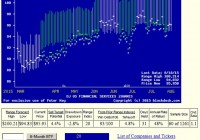
Summary From a population of some 350 actively-traded, substantial, and growing ETFs this is a currently attractive addition to a portfolio whose principal objective is wealth accumulation by active investing. We daily evaluate future near-term price gain prospects for quality, market-seasoned ETFs, based on the expectations of market-makers [MMs], drawing on their insights from client order-flows. The analysis of our subject ETF’s price prospects is reinforced by parallel MM forecasts for each of the ETF’s ten largest holdings. Qualitative appraisals of the forecasts are derived from how well the MMs have foreseen subsequent price behaviors following prior forecasts similar to today’s. Size of prospective gains, odds of winning transactions, worst-case price drawdowns, and marketability measures are all taken into account. Today’s most attractive ETF Is the iShares US Financial Services ETF (NYSEARCA: IYG ) . The investment seeks to track the investment results of an index composed of U.S. equities in the financial services sector. The fund generally invests at least 90% of its assets in securities of the underlying index and in depositary receipts representing securities of the underlying index. It seeks to track the investment results of the Dow Jones U.S. Financial Services Index (the “underlying index”), which measures the performance of the financial services sector of the U.S. equity market. It is a subset of the Dow Jones U.S. Financials Index. The fund is non-diversified. (from Yahoo.Finance.ETF.Profile) The fund currently holds assets of $774 million and has had a YTD price return of +5.49%. Its average daily trading volume of 107,208 produces a complete asset turnover calculation in 75 days at its current price of $95.95. Behavioral analysis of market-maker hedging actions while providing market liquidity for volume block trades in the ETF by interested major investment funds has produced the recent past (6 month) daily history of implied price range forecasts pictured in Figure 1. Figure 1 (used with permission) The vertical lines of Figure 1 are a visual history of forward-looking expectations of coming prices for the subject ETF. They are NOT a backward-in-time look at actual daily price ranges, but the heavy dot in each range is the ending market quote of the day the forecast was made. What is important in the picture is the balance of upside prospects in comparison to downside concerns. That ratio is expressed in the Range Index [RI], whose number tells what percentage of the whole range lies below the then current price. Today’s Range Index is used to evaluate how well prior forecasts of similar RIs for this ETF have previously worked out. The size of that historic sample is given near the right-hand end of the data line below the picture. The current RI’s size in relation to all available RIs of the past 5 years is indicated in the small blue thumbnail distribution at the bottom of Figure 1. The first items in the data line are current information: The current high and low of the forecast range, and the percent change from the market quote to the top of the range, as a sell target. The Range Index is of the current forecast. Other items of data are all derived from the history of prior forecasts. They stem from applying a T ime- E fficient R isk M anagement D iscipline to hypothetical holdings initiated by the MM forecasts. That discipline requires a next-day closing price cost position be held no longer than 63 market days (3 months) unless first encountered by a market close equal to or above the sell target. The net payoffs are the cumulative average simple percent gains of all such forecast positions, including losses. Days held are average market rather than calendar days held in the sample positions. Drawdown exposure indicates the typical worst-case price experience during those holding periods. Win odds tells what percentage proportion of the sample recovered from the drawdowns to produce a gain. The cred(ibility) ratio compares the sell target prospect with the historic net payoff experiences. Figure 2 provides a longer-time perspective by drawing a once-a week look from the Figure 1 source forecasts, back over two years. Figure 2 (used with permission) What does this ETF hold, causing such price expectations? Figure 3 is a list of securities held by the subject ETF, indicating its concentration in the top ten largest holdings, and their percentage of the ETF’s total value. Figure 3 Source: Yahoo Finance IYG Concentrates 60% of its assets in its top ten commitments. This provides a responsive measure of the action of market prices of stocks in this essential sector. The major holdings are all established, dominant participants in the financial services industry. Figure 4 is a table of data lines similar to that contained in Figure 1, for each of the top ten holdings of IYG. For convenience, the IYG data itself is included. Figure 4 (click to enlarge) Column (5) contains the upside price change forecasts between current market prices (4) and the upper limit of prices (2), regarded by MMs as being worth paying for protection from adverse price change. The average of +7.2% of the top ten IYG holdings is well above the market-average proxy of SPY of +5.3%. Diversification of IYG’s other 40% of holdings damps its overall upside (as MMs see it) to only +4.4%. But in the same stroke the risk side of the equation in (6) for IYG is brought down to worst-case price drawdowns of -2.8%, below the defensive market-tracking ETF SPY norm of -3.2%. In an environment many consider imbued with high market risk, IYG may provide a very attractive balance. The ability of IYG holdings to recover from those worst-case drawdowns and achieve profits (8) occurred in 93% of experiences. The equity population only recovered less than two thirds of the time, and while the SPY experiences were more consistent, the achieved gains were much smaller. SPY has had only +3.5% gains previously from like forecasts of +5.3%. Another qualitative consideration is the credibility of IYG after previous forecasts like today’s. Its net average price change gain (column 9) has been 1.1 times the size of the upside forecast average, +4.8% compared to +4.4%. The equity population’s actual price gain achievement, net of losses has been a pitiful +3.2% compared to promises of 13.5%. Conclusion IYG provides attractive forecast price gains, supported by its equally appealing largest holdings. Both the ETF and many of its major holdings offer very attractive prospects in near-term price behaviors, demonstrated by previous experiences following prior similar forecasts by market makers. But it may be considered a defensive commitment in the face of widespread anticipation of further market weakness. A more constructive strategy would be to seek out individual stock opportunities offering odds-on achievement of low double-digit price gains where past similar forecasts encountered only small worst-case price drawdowns during their relatively short holding periods en route to sell targets. The blue summary row of Figure 3 labeled “20 best odds forecasts” tells what the current top-ranked wealth-building opportunities are offering, as a comparative competitive norm. YTD in 2015, 2062 of these 20-a-day list members have reached closeouts in an average of 2-month holding periods, providing a +30% annual rate of average price-change gains. Disclosure: I/we have no positions in any stocks mentioned, and no plans to initiate any positions within the next 72 hours. (More…) I wrote this article myself, and it expresses my own opinions. I am not receiving compensation for it (other than from Seeking Alpha). I have no business relationship with any company whose stock is mentioned in this article.