Tag Archives: earnings-center

Seeking Alpha Globally

Summary Today, investing ideas outside of the US are underrepresented. Seeking Alpha should adopt a more international focus. Opportunities abound from Russia, to China and South Korea. I love my country. I have had family members fight, bleed, and die in every one of America’s wars since the founding. While I enjoy travelling as much as possible, I am always grateful to come home (okay except from New Zealand, but almost always grateful to come home). StW members come from around the world; so should our investments. As much as I love America, fixating on the US market when it comes to investing can be an expensive mistake. Additionally, since launching Sifting the World , I have gotten to know dozens of members from around the world who would be interested in discussing more international investing ideas. Today Seeking Alpha is US-centric in terms of editorial focus and technological ability to, for example, accept foreign tickers. A more global aperture is one of the exciting new directions that it can grow in under the new leadership . America in Context In terms of the opportunity set, it is worth placing the US in context. It represents about 2% of Earth’s surface area and 7% of its land. We are 5% of the population. The market cap is between a third and a half of the world equity market cap. But the gross domestic product is only about a fifth of the world’s combined GDP. So in terms of the pursuit of investing ideas, it might be reasonable to look for at least half abroad. In fact, it might make sense to go for the 80% that is proportionate to the non-US GDP of the rest of the world. There are opportunities there today. Also, country share of the world GDP is hardly static. So having a geographically diverse portfolio can avoid overweighting dominant markets when they eventually decline, as they all eventually have done in the past. Home Country Bias Investors around the world overweight exposure to companies in their home countries. This lack of diversification is caused in part by the preference to be exposed to the familiar. But investors should try to be rational and the home country bias is ubiquitous but not rational. Like the children in Lake Wobegon, we cannot all be “above average”. This illusory superiority results from a dangerous and expensive cognitive bias. Comparing countries I compare country markets on the basis of economic freedom, corruption, currency, courts, and legal systems. These are the factors that form my basis of an opinion on whether my rights as an investor will be protected. When I invest, I actively engage with boards and managements to ensure that they are maximizing shareholder value. Often, this is a collaborative, mutually beneficial process. Occasionally, it is confrontational and litigious. So, it is important to know ahead of time whether my rights can be enforced. I analyze transparency before fundamentals, because there is little use in finding a bargain if the numbers are false. For example, as recently as 2011, over 60% of my short ideas were Chinese. Had their numbers been real (they were fraudulent), they would have been among my favorite long ideas. But before one valued them, it was worth a deep investigation into the fact that they were lying in their financials and that there was little that an American investor could do about it. Once country markets are weighted by the above attributes, I turn to fundamental valuation metrics. I blend a combination of price relative to earnings, cash flow (with an emphasis on cash flow from operations), book value, and sales. I also look at dividend yield and the cyclically adjusted PE ratio/CAPE. None of these metrics gives me an answer, but a blend gives me a bracket in which to place individual countries. International Opportunities What recent opportunities have arisen? I would start by answering that question by saying that the answer based upon transparency and fundamentals had little overlap with my intuition. One measures in part because intuition is so often faulty. I have shorted equities in countries that I love (I am a lifelong Sinophile with an admiration for Chinese history and culture that surpasses most of my Chinese friends) and bought equities in countries where I have deep reservations (Russia’s government has horribly persecuted friends of mine). I subjected each country around the world to analysis, isolating a number of promising candidates for extra scrutiny. Additionally, I have spent more time on countries with equities at particular bargains. In the course of this analysis, I moved beyond my daily focus on securities in North America ( Canada , a market that I love, being so close and familiar that it hardly feels foreign). Three that particularly stood out were Russia, China, and South Korea. Over the course of the past year, I have dedicated extra research to those three. Russia Russia has been a favorite long idea of mine since last December. My primary tool for implementing this thesis has been shorting the leveraged inverse Russian ETF RUSS . I discussed the idea in December and again in February . To date, it is down over 70% and will probably decline further over time. Specific actionable securities Prospectively, what is the best way to get Russian exposure? My current favorite is EOS Russia (ISIN-code: SE 0002016261). Shares of this fund, which are primarily dedicated to Russian electric distribution, cost 1.4x EV/EBITDA, 1.8x P/E, and 10% of book value. China China has been a favorite short idea of mine since April . I shorted the leveraged ETF, YINN . It has declined by over 30% since then but could fall further as Chinese companies allow halted securities to trade freely. Specific actionable securities In addition to shorting YINN via equity or options, you may consider a long in one of the more promising Chinese ADRs with takeover offers as a YINN hedge. My favorites include Taomee (NYSE: TAOM ) and YY (NASDAQ: YY ). South Korea My favorite country market is South Korea . For Korean exposure without having to pick through individual securities, I have a high level of confidence in Weiss Korea Opportunity Fund ( OTCPK:WISKF ). Specific actionable securities A favorite South Korean equity of mine which might be worth your consideration is Ilsung Pharma (003120). Ilsung is a small but profitable pharma company with a pile of cash and 2% ownership in Samsung C&T (000830 KS). It cost about two-thirds the value of its liquid cash and securities and about half of its book value. It is worth book. Samsung C&T is part of the Samsung chaebol which owns stakes in various businesses, the most valuable of which is Samsung Electronics. The Lee family that controls Samsung is trying to merge Cheil Industries with Samsung C&T. Elliott Associates owns over 7% of Samsung C&T and opposes the deal. The vote is on Friday July 17 and it will be a close one. If it goes through, it will strengthen the hand of heir apparent Lee Jae-yong. Based upon his position as Vice Chairman of Samsung Electronics and his economic stakes in the chaebol’s components, he is likely to emerge as the family leader in the future. Elliott’s concerns appear to be wholly valid. The transaction appears to be a form of self-dealing that massively understates the value of Samsung C&T in absolute terms and relative to Cheil. The key question is whether or not Elliott’s form of activism will work in Korea this time. The vote requires the support of two-thirds of votes cast. The National Pension Service, which owns eleven percent, has dutifully closed ranks in favor of the deal. Elliott will probably need to convince another fifteen percent to vote against the deal in order to block it. As of today, the deal and Samsung generally appear to be firmly in Lee control. But if that changes, there could be additional value for Samsung C&T holders. Whether or not Elliott wins (and I hope that they do as their victory would enrich all fellow Samsung C&T holders and further open up Samsung and Korea generally to shareholder scrutiny), Samsung C&T is quite cheap at a discount to NAV of over 40%. Conclusion We can each be as patriotic about our home as we like, and while it can be a strong feeling, patriotism is an emotion. Investing is about thinking. The marketplace should be a meritocracy in which the best ideas, products, and investments win. To that end, we should constantly search the world for foreign opportunities that are better than what we have at home. Disclosure: I am/we are short YINN. (More…) I wrote this article myself, and it expresses my own opinions. I am not receiving compensation for it (other than from Seeking Alpha). I have no business relationship with any company whose stock is mentioned in this article. Additional disclosure: Chris DeMuth Jr is a portfolio manager at Rangeley Capital. Rangeley invests with a margin of safety by buying securities at deep discounts to their intrinsic value and unlocking that value through corporate events. In order to maximize total returns for our investors, we reserve the right to make investment decisions regarding any security without further notification except where such notification is required by law.
Reaves Utility Income Fund: Monthly Payout Currently Offering A 6% Yield

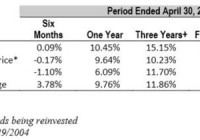
Summary Reaves Utility Income Fund is a CEF that invests in a broad range of utilities. Reaves is selling at a discount to NAV and offers a relatively safe 6% monthly yield. Reaves is not likely to outperform of underperform the utility indexes. About a year ago someone offered Reaves Utility Income Fund (NYSEMKT: UTG ) as a better alternative to my list of utilities in the comments section of an article I had written. I have been following the fund since that time and have placed this fund in some of the accounts I manage. UTG recently released its semi-annual report as of 4/30/2015. Total assets of the fund were $76,000 short of $1 billion and the net asset value (NAV) of the fund was $32.71 per share. UTG is currently selling for around $29.75 per share with a NAV of $30.37 as of 7/10/15. The recent underperformance of interest rate sensitive stocks has hurt both the NAV and selling price of the fund. UTG currently yields 6.1% with a monthly payout at just over $0.15 monthly. The price fluctuation of utilities does not affect the payouts of the companies so it may be an opportune time to consider this fund and/or utility stocks if one believes that interest rates will not rise shortly. UTG is a CEF or closed-end fund that aims to provide a high level of after-tax total returns consisting of tax-advantaged dividend income and capital appreciation. It targets 80% of its investment in dividend-paying common and preferred stocks as well as debt instruments of utility companies. The other 20% can be invested in other types of securities and/or debt instruments. It also uses options of utility companies in the search for returns. The historical returns of the fund when compared to the historical returns of the S&P Utilities Index and the Dow Jones Utility Average are shown in the table below: (click to enlarge) Source: UTG Semi-annual Report UTG also offered a graph showing the allocation of funds in its quarterly report as well. It is shown below: (click to enlarge) Source: UTG Semi-annual Report This graph shows that the fund’s definition of utility is rather broad. The fund holds railroads, roads, and oil and gas MLPs as well as REITs and media companies. UTG has loans for $290,000,000 with an interest rate of around 2%, which it uses for leverage. The top 10 holdings of the fund as of 3/30/15 were: NextEra Energy 5.27% ITC Holdings Corp 4.74% Union Pacific Corp. 4.67% Verizon Communications 4.26% American Water Works Co., Inc 3.96% Duke Energy Corp. 3.66% Scana Corp. 3.65% Dominion Resources, Inc. 3.59% BCE, Inc. 3.46% Sempra Energy 2.98% Expenses of this fund are about average for a closed-end fund. Investment advisory and administration fees last year ran $9.6 million or a little over 1% of the asset value of the fund. Other fees and interest on the loans add on another .5%, making a total of 1.5% to run the fund. Leverage probably covers the costs of administration with the additional dividend income it produces. Conclusion: This CEF is a good option for someone who wants to add utilities to their portfolio without the concern of researching individual companies. It appears to be a good bet for the retiree since it offers a monthly payout where much of the dividend qualifies for the 15% tax rate. The fund’s returns have kept up with the major utility indexes over its lifetime and will probably continue to do so in the foreseeable future. One should not expect to outperform the utility indexes with this CEF, but one will not likely underperform them either. Disclosure: I am/we are long UTG. (More…) I wrote this article myself, and it expresses my own opinions. I am not receiving compensation for it (other than from Seeking Alpha). I have no business relationship with any company whose stock is mentioned in this article. Share this article with a colleague

HEDJ Vs. DBEU: Same Vista, Different Perspectives

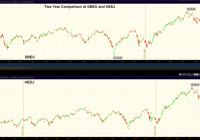
Summary Two well-structured funds but with two different approaches. One is very comprehensive the other selective. One hedges the Euro, the other hedges non-Eurozone currencies as well. The EU is going through some tough times. However, investors should look for potential opportunities rather than avoiding the region altogether. There are two funds which cover all of Europe. The Deutsche X-trackers MSCI Europe Hedged Equity ETF (NYSEARCA: DBEU ) is quite comprehensive with approximately 448 holdings as well as having multiple currency hedges. The second fund is the WisdomTree Europe Hedged Equity ETF (NYSEARCA: HEDJ ) . It is far more selective, holding approximately 134 securities and hedges only the Euro. The WisdomTree fund has been established longer having been incepted 12/31/2009 during the most troubled financial crises years. Deutsche Bank X-Tracker fund is more recently establish, incepted on 10/1/2013. (click to enlarge) The funds allocate sectors differently. For example, WisdomTree allocates its top three sectors, Industrials, Consumer Staples and Consumer Discretionary nearly equally. The Deutsche X-Tracker fund’s most heavily weighted sectors are Financials, followed by nearly equal in Health Care and Consumer Staples. (click to enlarge) The Deutsche X-Tracker fund’s heaviest concentrations are Great Britain, France, Switzerland and Germany while WisdomTree’s distribution is most heavily concentrated in Germany, France, Spain and the Netherlands. (click to enlarge) Five of the X-Tracker top ten holdings are global Health Care giants. They account for just over 43% of the 10 heaviest weighted holdings. On the other hand, the WisdomTree fund is less defensive and more diversified. No single top 10 holding comprises more than 13% of those 10 heaviest weightings. (click to enlarge) Since the funds came to market several years apart, their side by side performance comparison must be broken up into parts. The WisdomTree Hedged Europe Equity fund began trading January 7 of 2010, closing at $47.48. The X-Tracker fund began trading 3 years and 9 months later, October 1 2013 closing at $25.22. HEDJ’s closing price on the first day of DBEU’s trading was $53.80. The first of the two tables below shows HEDJ’s performance from its inception to the day of DBEU’s inception and then HEDJ’s performance over the entire life of the fund. Annualized Returns for HEDJ 1/1/10 through 10/1/2013 From 12/31/2009 to 7/6/2015 Dividend 2.67% 3.35% Stock 3.31% 4.50% Total 5.76% 7.29% The second table compares the two since DBEU’s inception date of 10/1/2013. Annualized from 10/1/13 HEDJ DBEU Dividend 4.82% 6.12% Stock 7.26% 3.27% Total 11.87% 9.27% HEDJ tracks the parent company’s WisdomTree Europe Hedged Equity Index . On the other hand, DBEU tracks Morgan Stanley Capital International MSCI Europe Hedged Equity Index. It’s important to note that both funds are passively managed. Here is a brief comparison of each of the top five holdings by sector weighting as of July 7, 2015. Top 5 Comparison Table WisdomTree HEDJ Top Five Holdings by Weighting X-Trackers DBEU Top Five Holdings by Weightings Anheuser-Busch Inbev (NYSE: BUD ) Consumer Staple P/E 18.68 Price to Cash Flow 12.11 Dividend Yield 2.11% Pay Out Ratio 26.69 Growth 5.07% Fund Percent Holding 5.733% Native Currency Euro Nestle ( OTCPK:NSRGY ) Consumer Staple P/E 15.22 Price to Cash Flow 22.03 Dividend Yield 3.20% Pay Out Ratio 0.00 Growth -0.59 Fund Percent Holding 2.768% Native Currency Swiss Franc Telefonica (NYSE: TEF ) Telecom Services P/E 20.84 Price to Cash Flow 5.18 Dividend Yield 6.52% Pay Out Ratio 0.00 Growth -2.82% Fund Percent Holding 5.517% Native Currency Euro Novartis (NYSE: NVS ) Health Care P/E 22.79 Price to Cash Flow 21.41 Dividend Yield 2.70% Pay Out Ratio 0.00 Growth 1.74 Fund Percent Holding 2.687% Native Currency Swiss Franc Banco Bilbao Vizcaya Argentari (NYSE: BBVA ) Financial P/E 17.37 Price to Cash Flow 11.91 Dividend Yield 4.71% Pay Out Ratio 33.28 Growth -26.32 Fund Percent Holding 5.021% Native Currency Euro Roche Holdings ( OTCQX:RHHBY ) Health Care P/E 24.54 Price to Cash Flow 18.98 Dividend Yield 3.01% Pay Out Ratio 73.94 Growth 1.46 Fund Percent Holding 2.329 Native Currency Swiss Franc Siemens ( OTCPK:SIEGY ) Industrial P/E 12.89 Price to Cash Flow 9.46 Dividend Yield 3.70% Pay Out Ratio 46.28 Growth 2.23% Fund Percent Holding 4.937% Native Currency Euro HSBC (NYSE: HSBC ) Financial P/E 13.23 Price to Cash Flow N/A Dividend Yield 5.65% Pay Out Ratio 58.31 Growth -14.86% Fund Percent Holding 2.035% Native Currency Great British Pound Daimler ( OTCPK:DDAIY ) Consumer Discretionary P/E 11.09 Price to Cash Flow 6.53 Dividend Yield 3.11% Pay Out Ratio 33.19 Growth 10.97% Fund Percent Holding 4.642% Native Currency Euro BP PLC (NYSE: BP ) Energy P/E 44.12 Price to Cash Flow 5.92 Dividend Yield 5.95% Pay Out Ratio 163.64 Growth -16.11% Fund Percent Holding 1.462% Native Currency Great British Pound Data from Reuters; Data TTM unless otherwise indicated It’s interesting to note that all 10 of WisdomTree’s top holdings are headquartered in the Eurozone. On the other hand, only four of X-Tracker’s top ten holdings are headquartered in the Eurozone. Royal-Dutch Shell is headquartered in both London and the Netherlands. The rest are headquartered in non-Eurozone Great Britain or non-EU member Switzerland. According to X-Trackers and WisdomTree, both hedge with forward contracts, although WisdomTree hedges only the Euro. What this implies is that U.S. Dollars invested in the WisdomTree fund may be more exposed to currency fluctuations since 9 of the 28 EU members are not Euro zone countries, although one of the nine, Denmark maintains a very close Euro peg and the Czech Republic maintains a conversion cap. The last comparisons are made of a few average metrics. The top ten holdings of the WisdomTree Fund outperform the X-Tracker fund in every category. However it is important to observe that HEDJ has a higher beta whereas the X-Tracker fund performs virtually with the market. Top Ten Averages P/E Price/Cash Flow Dividend Yield Payout Ratio Growth Beta HEDJ 18.191 10.816 4.085 37.50 2.004 1.295 DBEU 25.219 14.367 3.987 71.732 -3.19 1.044 There are a few ‘outliers’ in each fund, dual-listed companies, for example DBEU holds Investec, headquartered in South Africa and Carnival Cruise headquartered in U.S. Lastly, 81 of the 134 holdings in the WisdomTree fund also are held in the X-Tracker fund; in other words just about 61% of the WisdomTree fund intersects the X-Tracker fund. To sum up each fund covers Europe, though one is far more broad based than the other, although there is some overlap of each fund. The WisdomTree Fund is a more selective fund, whereas the X-Tracker fund is a broad representation of the entire European market. Also, the investor needs to weigh-out the need for currency hedging. Hedging mitigates the risk but does not eliminate it and the hedge might work against the portfolio under some circumstances. The WisdomTree fund hedges only the Euro; the X-Tracker Funds hedges the Euro, Swedish Krona, Great British Pound, Danish Krone, Swiss Franc and Norwegian Krone. The Europeans will not be too quick to give up on their long awaited and hard won economic union. Modern Europe in spite of all its shortcomings has a state-of-the-art infrastructure, an overall advanced economy and culture. More than likely Europe will resolve its current issues as well as those in the future. The question for the investor is how to be properly positioned: through the selective WisdomTree European Hedged Equity Fund or the broader based Deutsche X-Tracker MSCI Europe Hedged Equity ETF? The WisdomTree fund has the potential to outperform the market quicker. However, the higher volatility incurs higher risks. On the other hand, the X-Tracker fund’s volatility matches the market hence minimizes the risk. Either one of the funds will eventually reflect better times. The investor would be wise to at least consider investing in a European fund, but to completely ignore Europe would be foolish. Disclosure: I/we have no positions in any stocks mentioned, and no plans to initiate any positions within the next 72 hours. (More…) I wrote this article myself, and it expresses my own opinions. I am not receiving compensation for it (other than from Seeking Alpha). I have no business relationship with any company whose stock is mentioned in this article. Additional disclosure: CFDs, spread betting and FX can result in losses exceeding your initial deposit. They are not suitable for everyone, so please ensure you understand the risks. Seek independent financial advice if necessary. Nothing in this article should be considered a personal recommendation. It does not account for your personal circumstances or appetite for risk.