Tag Archives: author

Is Indexing Just Another Wall Street Fad?

Here’s an interesting comment from value investor Seth Klarman on the rise of indexing (this is from 1991!): Klarman is obviously biased because he’s in the business of selling a high fee asset management platform. If indexing is right, then his form of highly active alpha chasing asset management is wrong. This is basically what Bill Ackman was saying when he lashed out against indexing earlier this year. Anyhow, I think Klarman and Ackman are brilliant and I could never do what they’ve done over the years, but I did want to highlight some of the comments here because there are common concerns that I don’t think are fully warranted. SK: Indexing is predicated on efficient markets. CR: No, this is one point I’ve reiterated in my repetitive posts on the myth of passive investing . Indexing doesn’t work because markets are efficient. Efficiency has nothing to do with it . Indexing works because the costs of active management are so high. Bogle outlined this thinking back in 2003 . SK: The higher the percentage of all investors who index, the more inefficient the markets become as fewer and fewer investors would be performing research and fundamental analysis. CR: This is the paradox of indexing. Indexing, by definition, requires active management. In order for the passive indexers to remain passive, they need active managers to make the markets that fulfill their indexing needs. There cannot be a world of only passive indexers. So, if indexing is eating the world, then there should be more opportunities for active managers in the form of market making and index arbitrage opportunities. Active managers like high frequency trading firms are flourishing in this world. Indexing doesn’t kill active management. It just forces it to change. And if Klarman is right, then he should embrace indexing as it could create more opportunities for more active managers to discover inefficiencies. SK: If everyone practiced indexing… CR: Nope, this is impossible. Indexing requires active management to implement the various index fund strategies that exist. Speaking of which, there are so many “indices” out there today that the whole idea of indexing has become rather nebulous. The indexing world is comprised of all sorts of different strategies that try to take advantage of different inefficiencies in the market. Index funds are just product wrappers doing exactly what Seth Klarman is trying to do in his hedge fund. For instance, the Vanguard Value Fund is trying to capture the value premium by holding a specific set of stocks that meet a certain “value” criteria. The only real difference between this index fund and Seth Klarman’s hedge fund is that the Vanguard fund is lower fee, more tax efficient and more diversified. SK: “[Indexing] means that in a proxy contest, it makes no real difference to the manager of an index fund whether the dissidents or the incumbent management wins the fight”. CR: The vast evidence on the failure of active managers over the decades shows that public market investors don’t understand corporations better than managements. I don’t see how this evidence adds credence to the idea that we should want public investors to be even more active in the daily management activities of corporations… If anything, the failure of active managers means we should want public investors to voice fewer opinions about how companies should be run and instead of voting with their proxies, stick to voting with their wallets. SK: I believe that indexing will turn out to be just another Wall Street fad. CR: Well, this was fabulously wrong. Indexing assets have exploded since 1991 as more active strategies have floundered.
Goldman Sachs Files For 2 New ETFs

In the last couple of years, ETFs have witnessed surging popularity as they continue to grow and evolve. With a number of products being launched and fees being slashed, ETFs have grown more competitive over time, forcing issuers to foray into spaces where none has gone before. Goldman Sachs (NYSE: GS ), which has recently filed two new ETFs, Goldman Sachs Hedge Fund VIP ETF and Goldman Sachs High Sharpe Ratio ETF , will use the bank’s own research reports, Hedge Fund Trend Monitor and U.S. Weekly Kickstart strategy report, respectively, as the basis of selection. Let’s dig a little deeper. Proposed Funds in Detail As per the SEC filing, the proposed Goldman Sachs Hedge Fund VIP ETF will track the performance of the Goldman Sachs Hedge Fund VIP Index. The Index provides exposure to equity stocks, which are expected to influence the long portfolios of hedge funds. These equity securities generally appear most frequently among the top ten equity holdings of U.S. hedge funds that select their positions based on fundamental analysis. The index comprises 50 securities with a market capitalization of approximately $2.5 billion to $715.6 billion, as per the filing. Meanwhile, Goldman Sachs High Sharpe Ratio ETF will track the performance of the Goldman Sachs High Sharpe Ratio Index, thereby providing exposure to large-cap U.S. stocks with the highest projected Sharpe ratio – a widely used measure of risk-adjusted return. The index comprises 50 securities with a market capitalization of approximately $4.2 billion to $212.3 billion, as per the filing. The constituents of the index are equal-weighted with a 2% basket weight each. This is the first ETF to be constructed around the Sharpe ratio. Both the funds are expected to be listed on the NYSE Arca. The expense ratio and the ticker code of the funds are yet to be disclosed. How Does it Fit in a Portfolio? The proposed Goldman Sachs Hedge Fund VIP ETF will be a good option for investors seeking high returns and who possess a healthy risk appetite. As per an Investopedia report, The Goldman Sachs Hedge Fund VIP Index has appreciated approximately 80% since mid-2012 while the S&P 500 was up approximately 51% in the period. Thus, the Hedge Fund VIP Index outperformed the S&P 500 even during a raging bull period. However, given the current bearish environment led by global growth worries, China turmoil and slump in oil prices, investors should be cautious (read: Best ETF Strategies to Survive Market Turmoil ). Goldman Sachs High Sharpe Ratio ETF will be an innovative product providing risk-adjusted return with low concentration risk. The Sharpe ratio can be defined as excess return i.e. difference between asset return and risk free return for per unit of risk dominated by standard deviation. However, the Sharpe ratio is sometimes criticized as it does not differentiate between upside and downside deviation. Thus, it penalizes stocks for its potential to gain. Although the filing did not state the fees the new ETFs will charge, it is expected that they will not be very high, considering Goldman’s strategy of charging below-average fees for a number of ETFs including smart-beta ETFs. The Goldman Sachs ActiveBeta U.S. Large Cap Equity ETF (NYSEARCA: GSLC ) launched in September 2015 has accumulated $300.8 million in its asset base and has an expense ratio of 0.09% (read: Can Goldman Dominate the Smart Beta ETF Industry? ). ETF Competition These new funds, if approved, could be interesting options for investors seeking a diversified exposure amid the current market turmoil. Goldman Sachs High Sharpe Ratio ETF doesn’t have a direct contender. The fund would definitely get the first mover advantage, as it will be the first ETF in the space. Meanwhile, Goldman Sachs Hedge Fund VIP ETF providing exposure to a niche market may face competition from other ETFs tracking hedge funds’ stock holdings. The Global X Guru ETF (NYSEARCA: GURU ) is one of the popular ETFs in this space with an AUM of $119.7 million and trades in average volume of almost 40,000 per day. The fund has a high expense ratio of 0.75% and returned slightly almost 10% so far this year. Another ETF is this space is the AlphaClone Alternative Alpha ETF (NYSEARCA: ALFA ) with an AUM of $106.4 million. The fund trades in average volume of almost 44,000 per day. The fund has a high expense ratio of 0.95% and returned slightly almost 7% so far this year. So, the road ahead is definitely promising for the new ETF as it has potential to provide a lucrative option to investors. Link to the original post on Zacks.com

Bears Miss Out On Social Media Payday

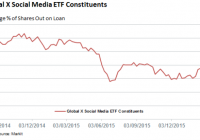
Social media shares have borne the brunt of the recent market selloff but few short sellers are lining up to short the market despite its recent underperformance as tracked by the Global X Social Media ETF (NASDAQ: SOCL ). Social media companies make up half of the once hotly tipped but now largely discredited , “FANG” trade of fast growing tech companies with a global presence. The market’s recent shunning of these high flying mercurial shares, spurred on by a spate of disappointing tech earnings and wider fears surrounding the health of the global economy means that every one of the acronym’s four constituents are trading over 10% off their recent highs. The headwinds faced by the sector’s flagship stocks are reflected in the overall sector as the Global X Social Media ETF hit a two and a half year low earlier this month. While the fund has rebounded somewhat in the last 10 days, it is still down by 13% ytd which is more than twice the fall seen by the rest of the market. The headwinds felt by the sector have been relatively universal as eighty percent of the ETF’s constituents have seen their shares retreat year to date. Collapse catches short sellers out This recent collapse of the once popular trade looks to have caught short sellers out as the ETF’s constituents entered 2016 with a below average short interest. In fact, demand to borrow the fund’s constituents fell by over a third last year and short interest stood near a two year low prior to the selloff. This indifference towards social media shares runs against that seen in the rest of the market where short selling stands at multi year highs. While there has been a 7% increase in demand to borrow social media shares since the start of the year, that number also trails the increase in shorting activity seen in the S&P 500 where average short interest is up by double digits since the start of the year. Lack of appetite universal As with the fall in share prices, the lack of appetite to sell social media shares short is fairly universal as only seven of SOCL’s constituents see any material short interest as defined by having more than 3% of shares out on loan. Pandora (NYSE: P ) is the most shorted of the lot with 8% of its shares now out on loan. Its shares have fallen by a quarter as investors’ fret about the company’s prospects in an increasingly crowded streaming field. Ironically, Groupon (NASDAQ: GRPN ), which was the highest conviction short at the start of the year, has become a painful short as its shares surged following Alibaba’s (NYSE: BABA ) disclosed stake in the online discounter. Short sellers have covered 10% of their positions as their trades went against them. The only firm to see a material rise in short interest across the field since the start of the year has been LinkedIn (NYSE: LNKD ) after its shares nearly halved in the wake of a disappointing earnings update. While short interest in the professional social media firm has since quadrupled, the 2.1% of LNKD shares now out on loan is still less than that seen at the start of 2015. Investors not buying dip Investors in SOCL have shown little patience to ride out the recent volatility as over $32m of funds have flowed out of the ETF since the start of the year. These strong outflows represent over a quarter of the AUM managed by the fund at the start of the year which underscores the wave of negative sentiment felt by the sector since the start of the year.