Criteo On Being Facebook ‘Frenemy’ And Why Ad-Blocking Didn’t Stick
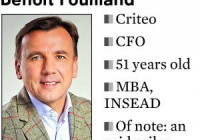
Ad tech firm Criteo saw its stock slip last year on fears that it would lose sales after consumer electronics giant Apple opened the door to ad blocking on its iOS devices. After all, Criteo ( CRTO ) embeds browser cookies — tiny text files that let websites recognize users and their preferences when they return to a site — for 52% of the 100 largest retail and travel websites in the U.S. Criteo gets paid for serving ads only if a user clicks on them, and it collects a bigger cut if the user goes on to buy a product from or otherwise engage with that advertiser. But Criteo bucked those concerns after the Apple ( AAPL ) ad-block threat didn’t play out. In mid-February, the Paris-based company posted healthy Q4 earnings that showed rising numbers of clients, a continuing advertising partnership with social media leader Facebook ( FB ), efforts to invent “disruptive products” and plans to beef up its business in China, one of the world’s largest e-shopping markets. On other levels, Criteo still competes with Facebook and is also a rival of ad networks run by major Internet companies, including Alphabet ( GOOGL )-owned Google and Amazon.com ( AMZN ). IBD recently spoke with Criteo CFO Benoit Fouilland about what it’s like being a Facebook “frenemy” and where the company will direct its efforts and resources this year. IBD: Wall Street worried that ad blocking might hurt your company’s revenue, which depends on people seeing ads and then taking action. But impact has been minimal so far. Why is that? Fouilland: There has been considerable talk about ad blocking over the last two months, and there has been some overreaction about that topic. But ad blocking has been here for quite a long time. It’s not a new phenomenon, although Apple made the announcement that iOS 9 would enable the use of ad blockers. But in reality, a maximum of 10% of the users worldwide are using ad blocking, primarily within desktop, although there is some use in mobile. Why do people use ad blocking? It’s a very simple reason — because they can’t stand the very intrusive ads that some industry players are using, in particular the pop-ups or pre-roll video type of ads that are very annoying. But we are not using any of those intrusive formats for one simple reason — our business model is to create engagement. We get paid only if there is engagement with our ads. So we don’t want to annoy anybody with our ads. We want to create an incentive for people by showing them very relevant ads, non-intrusive ads, to give them an incentive to click on the ads. IBD: What is your company’s ad partnership with Facebook? Fouilland: Facebook has been our partner for more than three years. They have a lot of advertising inventories that they wish to monetize. We were an early partner with Facebook when they launched their first initiative, which was the Facebook Exchange, which they created to monetize their ad inventory on desktop. More recently, Facebook has been developing a new solution to monetize its ad inventory within the mobile application, as Facebook is more and more used through mobile. We have been the first partner in that effort, as they publicly disclosed in Q4 2014. IBD: Could Facebook eventually start offering that service themselves and then not need Criteo? Fouilland: They don’t have the predictive capability, which is the core of what we do at Criteo — to predict the behavior of the user based on all the integrations that we have with advertisers. They don’t have all of the breadth of relationships with advertisers, with integration into the shopping data of the advertiser. All of that is what we bring to Facebook. But we are in an industry where very often your friends are sometimes also your enemies. But in this particular case, I think we have a very mutually beneficial partnership, where we bring to them unique capabilities with respect to performance-driven advertising demand. IBD: Can you talk about your company’s innovation efforts? Fouilland: Out of 1,800 people in the company, we’ve got 400 people in research and development. That R&D team is divided between Paris and Palo Alto. In the U.S., we have about 100 people on the West Coast. The core of our technology is machine-learning technology, and those are mathematical algorithms that predict the behavior of users. So the core is research and constant improvement on those algorithms. We have a team of 50 people working on a proof of concept on search marketing. We have a small team working on another concept of what we call offline — how can we make the link between what is happening within your store to what is happening online. That’s a very interesting field. You see more and more people going online and then searching for items in stores and vice versa — people who look at products in the store and then go online to buy them. If you are able to link information about purchase intent in-store or online, it could offer new opportunities. We also have a proof of concept going on in the U.S. and Europe where we capture shopping intent data within stores, thanks to using beacon technology. IBD: In your industry, there are so many companies right now. Do you see consolidation ahead? Fouilland: If you look at performance advertising — and particularly display advertising — it’s an industry where scale matters a lot. Today, if you look at the competitive landscape, most of our direct competitors that have emerged after us have been somehow acquired over the last 18 months. They were not acquired as a consolidation movement in the industry, but more because it became very clear for those direct competitors that they were sub-scale, and they joined broader groups. For example, TellApart has been acquired by Twitter ( TWTR ), and you’ve seen that Tesco-Dunnhumby in the U.K. acquired Big Data tech firm Sociomantic, which was another competitor in Europe. I would not call that a real consolidation, though, because it’s not that the market has consolidated and there are only a few players left now. It’s more that with some players ahead of the game, like ourselves, it was difficult for the new entrants who were sub-scale in this very much “winner-take-all” type of dynamic in our industry. Most of the smallest competitors have been acquired by larger players — not that those smaller competitors are out of the market, but they are now under the umbrella of larger players. IBD: Will Criteo be looking to make any acquisitions this year? Fouilland: We’ve made four acquisitions in the history of the company, so we are active at (surveying) the market for good companies that could bring us complementary technologies. We are considering making acquisitions only if there is a strong rationale from a tech standpoint to ensure that it would help us accelerate our development. IBD: What is your company’s strategy in China? Is Alibaba Group ( BABA ) one of your customers there? Fouilland: We opened an office in Beijing two years ago, and we are in the process of opening another office in Shanghai. We have roughly 25 people on the ground in China. We made a significant investment last year in setting up a data center in Shanghai, the reason being that we ultimately manage a lot of data in order to target users. We are one of the very few international companies with data-center capabilities within mainland China. We now have the foundation for developing domestic demand in China. That’s certainly an area of focus for us in 2016. I can’t make any comment specifically about Alibaba. We have partnerships with multiple large players in China.