Tag Archives: apple

Rate Cut Puts New Zealand ETF In Focus

Taking cues from global growth worries, the Central Bank of New Zealand surprisingly cut interest rates to a new record low on March 9 and hinted at additional easing, if need be. The move followed the bandwagon of global policy easing, especially in the developed world to boost economic growth and inflation. The central bank of New Zealand slashed its official cash rate by 25 bps to 2.25% to counter threats emanating from soft global growth mainly around China and the Eurozone. Also, uncertain global financial markets, the commodity market rout, a struggling dairy sector – one of the key contributors to the country’s GDP – and troubles in the housing market led the bank to ease its policy unexpectedly, per tradingeconomics . Prior to this, the bank had lowered its key interest rate by 25 bps in December 2015. Consumer prices in New Zealand nudged up 0.1% year over year in the fourth quarter of 2015, missing market expectations and marking the lowest level since the third quarter of 1999. This raised concerns among policy makers. Super accommodative monetary policies from Japan to the Eurozone made the New Zealand dollar stronger and kept consumer prices below the target range of 1-3%, per Bloomberg . So, a rate cut is essential to attain the 2% inflation goal by early 2018. Investors should note that New Zealand became the first nation in the developed world to raise its benchmark interest rate in March 2014. This was followed by three more hikes to 3.5% till July 2014. However, the trend reversed from June 2015 when the central bank resorted to a 25 bp rate cut to 3.25%. Market Impact The New Zealand dollar soon lost strength against the greenback following the announcement, though by 0.2% in one day (as of March 9, 2016). While a rate cut is normally viewed as a step forward in expediting growth and boosting the stock market, we are uncertain about how much return can be reaped by the strategy that New Zealand has adopted. It is true that many other developed economies are presently practicing way more accommodative policies. But they haven’t been able to make a jumpstart in their growth goals. Still, the move was probably necessary to give export a boost. The coming few days should go in favor of the New Zealand stock market. All these possibilities definitely turn our attention to the only pure-play ETF on this nation – the iShares MSCI New Zealand Capped ETF (NYSEARCA: ENZL ) . ENZL in Focus This ETF tracks the MSCI New Zealand Investable Market Index, giving investors exposure to 29 stocks. The product is not immensely popular with an asset base of $69.1 million and trading volume of about 35,000 shares per day. It charges investors 47 bps in annual fees. The fund is not widely spread across individual securities. It puts nearly 65% of the assets in the top 10 holdings with Auckland International ( OTCPK:AUKNY ), Spark New Zealand Ltd (NXTCY) and Fletcher Building ( OTCPK:FCREY ), taking the top three positions. The trio makes up for a combined 30% share. From a sector perspective, utilities, healthcare, industrials, telecom, consumer discretionary and materials receive a double-digit allocation each. In terms of performance, ENZL is up about 1.5% so far this year (as of March 8, 2016). In the last one year (as of March 8, 2016), the fund lost just 2.2%. The ETF currently yields 4.18% in dividend per annum making it a useful destination for income-seeking investors, especially at this low-yield environment. The fund has a Zacks ETF Rank #3 (Hold) with a Medium risk outlook. Original Post
Can Emerging Market ETFs Sustain The Rally?

After surviving a lackluster stretch, emerging market ETFs recoiled lately as a relief rally bolstered the demand for risky securities. The deterrents that came in its path earlier seem to have cleared as the U.S. rate hike bets have taken a backseat, marring the price of the greenback at the start of 2016. Impressive gains were noticed in commodity prices in the wake of a weaker dollar. Also, hopes of further stimulus from the eurozone and Japan, China’s relentless efforts to shore up its waning economy and the hunger for higher current income (as a drive for safety encouraged the need for fixed-income investing, which in turn affected U.S. Treasury bond yields) made emerging market space a rising star lately. The winning trend can be validated by 10.4% and 11.1% returns realized respectively by the two most popular ETFs, the iShares MSCI Emerging Markets ETF (NYSEARCA: EEM ) and the Vanguard FTSE Emerging Markets ETF (NYSEARCA: VWO ), in the past one month (as of March 8, 2016), against gains of 7.6% for the all-world exchange-traded fund, the iShares MSCI ACWI index ETF (NASDAQ: ACWI ), and a 7% uptick in the S&P 500-based fund, the SPDR S&P 500 Trust ETF (NYSEARCA: SPY ). As of now, the drivers of the rally look fragile. Investors may cheer the recent reserve requirement ratio cuts in China, but these have hardly boosted the Chinese markets. Rather, weak Chinese trade data has been pushing its market down, along with other emerging market securities. On the other hand, the recent rally in oil prices is anything but stable, keeping a check on the broad-based global market recovery. Meanwhile, the U.S. economy came up with some upbeat economic numbers on manufacturing, jobs, inflation and consumer confidence. All these once again brought back rate hike talks on the table. If any such cues are given by the Fed in its upcoming meeting, the emerging markets will once again lose luster. All in all, the operating backdrop is not all bright. So, investors should practice caution while targeting this investing arena. Below, we highlight a few ETFs that can be considered in the days to come (see all emerging market ETFs here ). High Yield – WisdomTree Emerging Markets Equity Income ETF (NYSEARCA: DEM ) As foreign investors normally park their money in the riskier emerging market bloc for higher yields, what could be a better choice than DEM? This $1.31 billion ETF holds about 320 stocks. Though the fund is heavy on trouble zones like China, Russia and Brazil, and might see a sell-off ahead, a 30-day SEC yield of 6.29% would provide some protection against capital erosion. Also, the fund has highest exposure in the relatively better-placed zone, Taiwan. The fund has a Zacks ETF Rank #3 (Hold) and is up about 6% this year (as of March 8, 2016). Low Volatility – iShares MSCI Emerging Markets Minimum Volatility ETF (NYSEARCA: EEMV ) A low-volatility portfolio is yet another key to long-term success. For investors seeking exposure to the emerging markets, EEMV could be an intriguing pick. The $2.9 billion ETF charges 25 bps in fees. In total, the fund holds over 250 stocks in its basket, with each accounting for less than 1.71% share. The fund has a slight tilt toward financials, with 26.8% share, while information technology, telecommunication services and consumer staples round off the next three spots. The fund has retreated 0.2% in the year-to-date frame (as of March 8, 2016), was up 6.2% in the last one month and it has a Zacks ETF Rank #3. High Quality – SPDR MSCI Emerging Markets Quality Mix ETF (NYSEARCA: QEMM ) High-quality ETFs are generally rich on value characteristics, as these focus on stocks having high-quality scores based on three fundamentals factors – the performance of value, low volatility and quality factor strategies. This fund follows the MSCI Emerging Markets Quality Mix Index, holding a large basket of 744 stocks. It has amassed about $97.3 million and charges a low fee of 30 bps per annum. The fund puts more weight in China, Taiwan and South Korea. The Zacks Rank #3 fund was up 7.7% in the last one month, but off 1.2% year to date, and it yields about 2.13% (as of March 8, 2016). Original Post

Why Equity Outperforms Credit

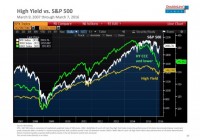
In my new paper on asset allocation I go into quite a bit of detail about why certain asset classes generate the returns they do. Understanding this is useful when thinking in a macro sense and trying to gauge why financial assets perform in certain ways in both the short-term and the long-term. It’s important to understand the fundamental drivers of these returns in order to avoid falling into the trap that these assets generate returns due to the way they’re traded in the markets. One of the more common misconceptions I see in the financial space is that credit traders are smarter than equity traders. This is usually presented with charts showing how credit “leads” equity performance or something like that. One of the more egregious offenders of this is a chart that has been going around in the last few days from Jeffrey Gundlach’s presentation showing credit relative to equity: One might look at this and conclude that these lines should necessarily converge at some point. As if the credit markets know something that the equity markets don’t. This is usually bandied about by bond traders who are convinced that stock traders are a bunch of dopes.¹ But this is silly when you think of things in aggregates because, in the long-run, the credit markets generate whatever the return is on the instruments that have been issued and not because bond traders are smarter or dumber than other people.² For instance, XYZ Corporate Bond paying 10% per year for 10 years doesn’t generate 10% for 10 years because bond traders are smart or stupid. It generates a 10% annualized return because the issuing entity pays that amount of income over the life of the bond. In fact, the more traders trade this bond the lower their real, real return will be. Trying to be overly clever about trading the bond, in the aggregate, only reduces the average return earned by its holders as taxes and fees chew into that 10% return. The “bond traders are smarter than stock traders” myth is hardly the most egregious myth at work here though. The bigger myth is the idea that equity must necessarily converge with credit over time. For instance, let’s change the time frame on our chart for a bit better perspective: If you’d bought into this notion that credit and equity converge starting in 1985 you would still be waiting for this great convergence. The reason for this is quite fundamental though. Corporate bonds only give owners access to a fixed rate of income expense paid by the issuing entity. Common stock, however, gives the owner access to the full potential profit in the long-term. If we think of common stock as a bond then common stock has essentially paid a 12% average annual coupon over the last 30 years while high yield bonds have only paid about a 8% coupon. In the most basic sense, credit and equity are different types of legal instruments giving the owner access to different potential streams of income. Equity, being the higher risk form of financing, will tend to reward its owners with higher returns over long periods of time. Why equity outperforms credit is hotly debated, but it makes sense that equity outperforms because the return on financing via equity must be higher than the potential return an investor will earn on otherwise safe assets. That is, if I am an entrepreneur who can earn 5% from a low risk bond it does not make sense for me to invest my capital in an instrument or entity that might not generate a greater return. In this sense, equity generates greater returns than credit because it’s not worth the extra risk to issue equity if the alternative is a relatively safe form of credit. Of course, it doesn’t always play out like this in the short-term, but if you think of equity as a sufficiently long-term instrument then it will tend to be true over the long-term because it’s the only rational reason for equity to be issued in the first place.³ ¹ – As an advocate of diversified indexing I can rightly be included as a “dope” about both asset classes. ² – This return could actually be lower due to defaults, callability, etc. ³ – “Long-term” in this instance has been calculated as at least a 25 year duration for equity. This is a sufficiently long period during which we should expect to see equity consistently earn a risk premium over credit.