Author Archives: Scalper1

Why Equity Outperforms Credit
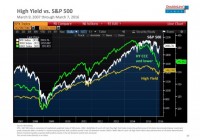
In my new paper on asset allocation I go into quite a bit of detail about why certain asset classes generate the returns they do. Understanding this is useful when thinking in a macro sense and trying to gauge why financial assets perform in certain ways in both the short-term and the long-term. It’s important to understand the fundamental drivers of these returns in order to avoid falling into the trap that these assets generate returns due to the way they’re traded in the markets. One of the more common misconceptions I see in the financial space is that credit traders are smarter than equity traders. This is usually presented with charts showing how credit “leads” equity performance or something like that. One of the more egregious offenders of this is a chart that has been going around in the last few days from Jeffrey Gundlach’s presentation showing credit relative to equity: One might look at this and conclude that these lines should necessarily converge at some point. As if the credit markets know something that the equity markets don’t. This is usually bandied about by bond traders who are convinced that stock traders are a bunch of dopes.¹ But this is silly when you think of things in aggregates because, in the long-run, the credit markets generate whatever the return is on the instruments that have been issued and not because bond traders are smarter or dumber than other people.² For instance, XYZ Corporate Bond paying 10% per year for 10 years doesn’t generate 10% for 10 years because bond traders are smart or stupid. It generates a 10% annualized return because the issuing entity pays that amount of income over the life of the bond. In fact, the more traders trade this bond the lower their real, real return will be. Trying to be overly clever about trading the bond, in the aggregate, only reduces the average return earned by its holders as taxes and fees chew into that 10% return. The “bond traders are smarter than stock traders” myth is hardly the most egregious myth at work here though. The bigger myth is the idea that equity must necessarily converge with credit over time. For instance, let’s change the time frame on our chart for a bit better perspective: If you’d bought into this notion that credit and equity converge starting in 1985 you would still be waiting for this great convergence. The reason for this is quite fundamental though. Corporate bonds only give owners access to a fixed rate of income expense paid by the issuing entity. Common stock, however, gives the owner access to the full potential profit in the long-term. If we think of common stock as a bond then common stock has essentially paid a 12% average annual coupon over the last 30 years while high yield bonds have only paid about a 8% coupon. In the most basic sense, credit and equity are different types of legal instruments giving the owner access to different potential streams of income. Equity, being the higher risk form of financing, will tend to reward its owners with higher returns over long periods of time. Why equity outperforms credit is hotly debated, but it makes sense that equity outperforms because the return on financing via equity must be higher than the potential return an investor will earn on otherwise safe assets. That is, if I am an entrepreneur who can earn 5% from a low risk bond it does not make sense for me to invest my capital in an instrument or entity that might not generate a greater return. In this sense, equity generates greater returns than credit because it’s not worth the extra risk to issue equity if the alternative is a relatively safe form of credit. Of course, it doesn’t always play out like this in the short-term, but if you think of equity as a sufficiently long-term instrument then it will tend to be true over the long-term because it’s the only rational reason for equity to be issued in the first place.³ ¹ – As an advocate of diversified indexing I can rightly be included as a “dope” about both asset classes. ² – This return could actually be lower due to defaults, callability, etc. ³ – “Long-term” in this instance has been calculated as at least a 25 year duration for equity. This is a sufficiently long period during which we should expect to see equity consistently earn a risk premium over credit.

Market Lab Report – How Experience Can Work Against You

Experience can work against a trader especially in this age of quantitative easing where statistics and tendencies that used to be true are now false. One of the biggest challenges has been to take every signal the VIX model issues. Due to my, call it over-experience, I have not taken two signals this year that were issued by the model, both which were highly profitable (+24.67% and +7.39% using 2x ETF UVXY) . I also delayed taking this morning’s fail-safe which would have resulted in a loss of -3.2% (using 2x ETF UVXY) instead of a -6.89% loss (using 2x ETF UVXY). I did so with good intention because experience showed blah blah blah… If we substitute the word “experience” with the word “ego”, only then does the learning begin. The backtests are what they are and have shown the model to work well across a variety of markets. So it is key for me at this point to let the model and its self-learning fail-safes do its thing without overriding any of its signals or fail-safes . That means having a strong stomach to withstand the very rare time when it might get whipsawed three times in a day. The very rare times this has occurred in backtests, the losses from all three losing trades never amounted to more than 6% (using 2x ETF UVXY). Any losing trade typically has a loss of breakeven to -3%.  That said, the model has scored a few 15%+ intrasignal gains as we have indicated in the reports since its launch in late December 2015. Those who took such quick, steep profits are still up nicely this year. That said, the backtests and results shown in the VIX performance table excludes taking such early intrasignal profits . Still, even without early profit taking, the model was up in every rolling 12-month period over the entire testing period. With that in mind, a complete rundown of all trades, both backtested and real-time, showed that taking certain profits early has further increased reward overall without increasing risk. Thus, the model will now include early profit taking on certain buy signals as we know some members are unable to watch their positions but instead monitor emails from VoSI to guide their trades. We will only do this for buy signals (buying volatility) since the market tends to take the stairs up and the trapdoor down, thus the +15% profits achieved in a day or two as demonstrated in real-time by the model. As we have mentioned, it is important to know that the model can have a string of small losses. Indeed, the model is going through a drawdown at present if we exclude the intrasignal 15%+ profits . Losing periods can last a few months. The key is to take every signal since losses tend to be small while gains can be quite large, especially on buy signals where the model buys volatility. Unfortunately, it is improbable to know the magnitude of potential profit of any given signal. Nevertheless, the model has well outperformed the major averages every year in the backtests. Keep in mind that the only thing that does not change is change, so past results can never guarantee that future results will be equivalent. Indeed, it was easy to become overconfident when the model would go on hot streaks at certain times in prior years only to be sometimes followed by a drawdown period. It did this most recently in 2015 from February to August when its sizable profits were followed by a lengthy drawdown. The sizable profits over this period were especially surprising given the trendless nature of 2015, a year which by some media accounts was the toughest year in 78 years. With regards to the model, overconfidence ruled the day. But then the model had a drawdown so oversizing would have been a bad strategy. Keeping greed, fear, and over-experience in check is always a valuable lesson as greed can lead to oversizing a position while fear and over-experience can lead to not taking a trade. The model’s two signals that I overrode can make a big difference, especially in these markets that seem to grow increasingly challenging with each passing year such that finishing the year up 15-25% is astounding, let alone making that return in one trade. The reassuring news is that the model is working as it should, with or without the early taking of profits. But the early taking of profits in place serves to further increase reward without increasing risk.

If Arista Networks ‘Superbly Positioned,’ What Drove Down Stock?

Needham issued a glowing report on Arista Networks ( ANET ) Thursday, but it fell 4.1% to 61.11 in the stock market . And Arista’s No. 1 switching rival  Cisco Systems ( CSCO ) closed down 0.8% to 27.38. On a trading day when indexes started out on an up note, declined and ended mixed, a fractional slip for Cisco after its 2.1% gain Wednesday can be taken in stride. However, both stocks saw rather wide trading ranges Thursday — especially Arista — coming off its 3% gain Wednesday. There “could be confusion on SONiC,” Needham analyst Alex Henderson told IBD. SONiC stands for “software for open networking in the cloud,” free software-defined networking (SDN) that makes Cisco’s high-speed switches less needed. Microsoft ( MSFT ) announced this contribution to the Open Compute Project at the OCP U.S. Summit in San Jose, Calif., on Wednesday. “SONiC will enable cloud operators to take advantage of hardware innovation while giving them a framework to build upon an open source code for apps on the network switch and the ability to integrate with multiple platforms,” posted Kamala Subramaniam, principal architect of Azure Networking, on a Microsoft blog Wednesday. “SONiC is not just prototyped software but deployed today and planned to run at scale in the future.” Arista is part of Microsoft’s team that created SONiC, along with Broadcom ( AVGO ), Dell and Mellanox Technologies ( MLNX ). Broadcom stock closed up 1.7% to 144.42. But Microsoft stock fell 1.5% to 52.05 Thursday and Mellanox slipped 0.6% to 48.42. As for Arista, SONiCally confusing or not, the company is “superbly positioned” to grow, Henderson wrote in a research note issued Thursday. “We like to think we are pretty technology savvy, but we always feel humbled when we go into Arista and delve into the technology landscape in detail,” Henderson said. “We hit a number of key issues including the 10G to 25G transition, the quality of the Broadcom Tomahawk, the opportunities in storage, the potential of the Jericho chip in the Edge router market, and the advantages Arista has in the SDN market. “This last point is particularly punctuated by the Microsoft contribution of . . . SONiC to the Open Compute Foundation. We come away convinced that ANET has multiple avenues of growth, and we expect continuing share gains.” He reiterated Needham’s buy rating and 105 price target. Henderson noted that “Cisco has been questioning the quality of the Tomahawk chip” but Arista, which made the Tomahawk chip set available in its switches in September, “argues the bugs in this first pass are minor and easily worked around in software” and has “good traction in the market already.” He said Arista “seems to be seeing accelerating conversion of storage area networks (SAN) to storage over IP as “major customers drive to a single unified architecture over IP.” He also observed a “solid ramp,” starting in the second half of this year, for Arista’s 25G/50G/100G speed transition and learned that “Arista thinks some portion of that (Edge router) market can be addressed with much lower-cost switches.” Arista’s “Linux-based, open, programmable and merchant silicon-based products are winning, and the trends continue to increase its advantage,” Henderson said. “We expect ANET to continue to outperform Cisco.” He probably means Arista should outperform Cisco’s growth rate. In the fourth-quarter, Arista grew adjusted earnings per share by 51% to 80 cents, on revenue up 42% to $245 million. In Cisco’s last quarter, ended in January, it grew adjusted EPS by 8% to 57 cents on flat revenue of $11.9 billion. In the current quarter, analysts polled by Thomson Reuters expect adjusted earnings to grow 22% for Arista and 2% for Cisco. Image provided by Shutterstock .