Author Archives: Scalper1

Factor-Based ETFs Provide Increased Stability, Returns

During a volatile market climate where ETFs are especially getting hit hard, an increased utilization of factor-based investing has the opportunity to provide more stable and higher returns. Factor-based investing allows investors to increase exposure to certain factors, including size, value, quality and momentum. Last year, MSCI introduced a variety of multi-factor indexes that offer investors a better strategy that could be just right for this market environment. These indices cover US, World, Emerging Markets, and more. Click to enlarge The 1 year return of the MSCI US Momentum Index (NYSEARCA: MTUM ) distinctly outperformed iShares Russell 1000 Value ETF: Click to enlarge (Source: Bloomberg) A Focus on Momentum Momentum-based investing has proven to be a successful strategy in a volatile market climate, as seen with AQR’s posted returns in their liquid alternative funds. Such a strategy can provide returns in a downed market as well because the strategy works both ways. A hedge fund can short a portfolio of negative momentum securities and vice versa. For MSCI with their new diversified multi-factor indices, it’s all about choosing the right exposure to multiple factors, not just momentum. They’re targeting four main factors (listed above), including momentum. The MSCI USA Momentum Index didn’t perform well in the past year (-8.04%), but the MSCI diversified multi-factor indices have seen much better returns. MSCI is able to increase or decrease their exposure to certain factors that they see as favorable or unfavorable. Such optimization is extremely strategic as risk level of the underlying index is maintained. These multi-factor indices aren’t brand new strategies, either. The MSCI World Diversified Index returned an annualized 9.8% over a 16-year period during backtests, which is double the return of the regular MSCI World Index. The main methodology is to increase factor exposures to achieve higher historical returns. Which Factor is the Best? With the recent sell-off and market environment that is arguably a mess, what is the right factor to increase exposure to? With the MSCI World DMF index, which has one tilt towards value, there was a positive exposure to earnings yield even in this market. There is no one best factor, which is the point of these indices. A combination of multiple positive exposures with tilts towards different factors (momentum, size, value, quality, leverage, etc.) is what has made these MSCI products produce better returns than the run-of-the-mill ETFs. For example, the MSCI World DMF Index had positive exposure to stocks of lightly levered companies, lower residual volatility and smaller size: (SOURCE: MSCI ) The above described strategies for ETFs is something investors should make note of as clearly alternative strategies are needed in this market situation. Consistent optimization of diversified multi-factor products, like those of MSCI’s, are not completely immune to risk, but have now proven to have broken away from the poor performance of regular ETFs in the past year. Factor-based investing is very optimal for this market is a very forward-thinking investing strategy. Disclosure: I/we have no positions in any stocks mentioned, and no plans to initiate any positions within the next 72 hours. I wrote this article myself, and it expresses my own opinions. I am not receiving compensation for it (other than from Seeking Alpha). I have no business relationship with any company whose stock is mentioned in this article.
VIX: A Hedge To Consider For Your Portfolio

It is not uncommon to see the markets follow irrational trends. Sometimes, the markets will climb up or drop down on information that may indicate contrary trends. This past month I’ve been watching the markets with immense caution; I was a little surprised that we have seen US stocks rise for a fifth straight week. For the long run, I have a handful of stocks I think will grow exceptionally, but for the most part I believe we are entering a bear market, and I have thus prepared myself with hedges. The headlines, and the data and statistics that are coming in from Central banks and governments across the world are not exactly signaling optimism for the markets, yet the markets are trending towards all-time highs. ^SPX data by YCharts I think it’s absurd that the S&P 500 is approaching all-time highs, especially at a time like this. I will not go in depth as to why I think we are due for a major correction (again), but I will simply write a basic summary about why we are likely going to continue falling into a bear market, and about why investing in the VIX index might be smart. The reasons for a bear market heavily outweigh the reasons for a bull market right now. Commodities have staged an odd recovery the past couple of weeks that hasn’t exactly made much sense. Most importantly right now is the prices of oil; oil has proved to be latched on to the movement of stocks and vice versa. Brent Crude Oil Spot Price data by YCharts Brent crude oil has spiked over $10 USD in less than a couple months, but why? The world oil supply has remained at roughly 98 mb/d the past couple of months and demand has also been idle. I firmly believe oil will stage a recovery, but this recovery seems fake and is happening way too fast, which is alarming. In addition to the suspicious rise in commodity prices, there is tons of debt everywhere. People are getting crushed by margin calls, people are still accumulating debt, and energy companies are on the brink of bankruptcies. Banks are also having a hard time. Many major banks are hitting 52-week lows, although they have recovered slightly; but that point aside, they are still going to have to deal with lower interest rates. Nations around the world are following a general trend of lowering interest rates, even into the negative and this will likely hurt major bank stocks. Banks have also proven to be central to market crashes in recent history. It was a little surprising to see the markets react so positively to the Fed’s latest press release. Yellen gave the people a lot of “ifs” and “buts” and “maybes”, and I feel it did not justify the market spike we have just seen. On top of all this, we are seeing a ton of political turmoil, which inevitably affects the markets. There are a lot of problems right now in the world: Brazil is on the brink of a political and economic collapse, Europe is dealing with the refugee crisis which in turn is giving right wing groups serious power and support, Brexit is a serious possibility and would have potential consequences on markets worldwide (and in my personal opinion the Brexit would negatively impact the world markets), and then there’s the Middle East tension. I don’t want this article to be a sensationalist piece, but there are a lot of similarities between what is going on right now and the 1930s. Basically, I believe we are in for a roller coaster ride, and if there are people out there who are long on the markets as a whole, maybe a hedge or two would greatly benefit your portfolio. The VIX index The VIX is an index that uses options to predict stock market volatility, and it is commonly referred to as the fear gauge. ^VIX data by YCharts As you can see from the chart we have had numerous spikes in a short span of time. The last time we’ve seen this type of market volatility was in 2011, and I believe this time there is potential for the volatility to be even greater. Depending what market one invests in, it is entirely possible to put some money in an index that tracks the movement of the VIX. When the time comes for the market to crash, one’s portfolio will be protected with a hedge in the VIX, but this is definitely a highly risky trade. For example, Canadians, or those who invest in the TSX can invest in HVU. As I write this article the VIX is approaching lows it hasn’t seen since early 2015, but I believe the market volatility has just begun. Catching the bottom of the VIX and riding it up during a major spike could be very profitable, but once again this is to be used as a swing trade, and the ETF should not be held for more than a couple of weeks at most. Generally, I want readers to tread with caution in this current market environment. Everything seems off, and the markets are being irrational at the moment, thus a crash or a longer bear market might be in store for us. Hedging your portfolio is important, and remember to do your own research. Disclosure: I/we have no positions in any stocks mentioned, and no plans to initiate any positions within the next 72 hours. I wrote this article myself, and it expresses my own opinions. I am not receiving compensation for it. I have no business relationship with any company whose stock is mentioned in this article.

Market Lab Report – Review of Pocket Pivots for the Week of March 14-18, 2016

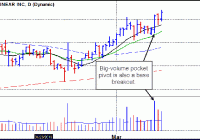
This has been a good week for pocket pivots that we’ve identified and reported on in terms of upside follow-through. Please note that Five Below (FIVE) did not qualify as a pocket pivot per our report of 3/17 as it did not close at least break even on that day. The company also is expected to report earnings on Tuesday so can still be watched given that it is holding up in a tight consolidation. Maxlinear (MXL) GM – Following Wednesday’s pocket pivot MXL gave buyers a shot at a lower-risk entry on Thursday when it briefly pulled into the 10-day line early in the day. This is the sort of pullback following a pocket pivot that you want to keep an eye on. The pocket pivot also coincided with a clean new-high base breakout, and the stock follow-through on Friday with further upside. Dr. K – The current base showcased two powerful upside moves on two strong earnings reports, thus increasing the odds the stock will outperform the general market should the uptrend in the market continue. Indeed, it has well outperform the S&P 500.  Universal Forest Products (UFPI) GM – UFPI has blasted higher following Thursday’s pocket pivot as volume ballooned. From here only a pullback back into the rising 10-day moving average at 79.45 would offer your lowest-risk entry points. Dr. K – While the uptrend in the general market has been much due to defensive names, some rotation into cyclical names has been observed. The industry group rank of UFPI is a strong 5 out of 202 groups. Ebix (EBIX) GM – Another nice follow-through after a pocket pivot is seen here in EBIX. I also liked the initial position of this pocket pivot on Thursday as the stock had pulled back into its green 20-day exponential moving average. When it was able to poke its head back above the black 10-day moving average it cleared as a bona fide pocket pivot. Note that Friday’s action also qualified as a second pocket pivot given that the stock moved up and off of the 10-day moving average on very heavy volume. Dr. K – Each time this stock has reported earnings over the last several earnings reports, it has moved higher, thus it is unsurprising that it was one of the first stocks to hit new highs on March 1. The constructive pullback allowed an optimal entry point into the stock.Â