Author Archives: Scalper1

IPO Market Freeze In Q1 Hit Lowest Point Since Great Recession
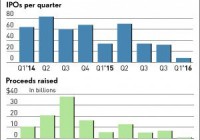
A chill that hit the IPO market in December turned into an all-out freeze in the first quarter, with the number of initial public offerings hitting a low not seen since the Great Recession of 2007-09. Just eight IPOs got out the door in Q1, down 76% from 34 in Q1 2015. That was the fewest IPOs since Q1 2009, which had just one. The $700 million in proceeds raised was the lowest total in 20 years, down 87% from the $5.5 billion raised in Q1 2015, according to Renaissance Capital, which manages two IPO-focused exchange traded funds . All eight IPOs were in the medical sector, and most of those only happened thanks to substantial buying of shares by existing shareholders and a reduction in the initial asking prices. Insider buying accounted for 67% of shares sold in the IPO of Editas Medicine ( EDIT ), and 48% at Corvus Pharmaceuticals ( CRVS ), for example. Recent trends provide hope that the IPO window will reopen in the second quarter, though the big names expected to be waiting for an opening — companies such as Uber and Snapchat — have been quiet on the IPO front. “While the IPO market has been frozen, we know it will open up again,” said Kathleen Smith, principal at Renaissance Capital. “There’s a buildup of companies waiting for the appropriate time to raise capital.” The primary cause of IPO droughts has always been weakness in the stock market. Markets started tanking in late December and bottomed in mid-February. The uptrend in market indexes could ease jitters and bring institutional investors — and companies — back to the IPO table. The IPO rebound will likely proceed slowly at first, as it did in 2009, Smith says, but she see signs some IPO icebreakers could hit the market in April or May. Companies that could debut include US Foods, the second-largest food-service distributor, which submitted an IPO filing in early February that could raise up to $1 billion. Another is MGM Growth Properties, a real-estate investment trust backed by MGM Resorts ( MGM ) that also could raise up to $1 billion, Renaissance estimates. But there’s no sign yet that any high-profile names will come forward soon to spark a heat wave. This week, Uber CEO Travis Kalanick said the ride-hailing company would wait as long as possible before coming public. It’s among a large number of private companies that have raised hundreds of millions, in some cases billions, of dollars, with estimated market valuations well above $1 billion. An IPO is about the only route for investors in those privately held companies to get a healthy return from those investments. The IPO chill has been worsened by the sickly performance of last year’s high-profile new offerings. Among them was Fitbit ( FIT ), the maker of wearable fitness devices. Fitbit had a heart-pounding start, with the stock jumping 48% on its first trading day June 18, pricing at 20 and closing above 29. Fitbit stock peaked at 51.90 in August, but now trades near 13. Box ( BOX ), the online storage service provider, had a similar story. It popped 66% on the first trading in January and closed at 24.73 on day one, which is still its peak. Box now trades near 12.50. Among all IPOs of 2015, their stocks are down 18% on average from their IPO price and down 28% after the first trading day, Renaissance says. The firm says the ultimate pace of the 2016 IPO market remains tough to call, yet it does expect some eye-catching IPOs to launch and deliver attractive returns to investors. Image provided by Shutterstock .

My ‘Wisdom’ On Smart Beta And Factor Investing

The latest installment from Tadas Viskantas’s series on “financial blogger wisdom” (is that an oxymoron?) asked a bunch of smart people (and also me) about smart beta. I was short: Smart beta and factor investing are the newest versions of high(er) fee active management promising the fairy tale of “market beating” returns in exchange for higher fees and usually delivering lower returns (after taxes and fees). Regulars know I am not a big fan of Smart Beta and Factor Investing (sorry to all my friends in the industry who love these approaches!). For the uninitiated, Smart Beta basically involves taking an index fund and changing it so it captures a “smarter” type of return. For instance, you might take a market cap weighted index fund like the S&P 500 and equal weight it so that it doesn’t expose you to the procyclical tendencies of the market cap weighted fund which will tend to be overweight the riskiest stocks at the riskiest points in the market cycle. The evidence that this is countercyclical is weak as Vanguard has shown and as I expressed in my new paper . Further, you will generally pay higher taxes and fees in these funds without a high probability of better results. For instance, the equal weight S&P 500 has a pretty mixed performance versus the market cap weighted S&P as it’s performed better on a 10-year basis, but underperformed on all periods shorter than 10 years. The nominal returns are slightly better over longer periods, but that’s only because the equal weight fund has a much higher standard deviation with 95% of the total correlation. So, the intelligent asset allocator has to ask themselves why they’d pay for 95% of the correlation while guaranteeing higher taxes and fees without a reasonably high probability of better risk-adjusted performance? Should you really pay higher fees for the empty promise of “market-beating returns”? I say no. The same basic story can be laid out for factor investing. There’s a great irony in the idea that the founder of the Efficient Market Hypothesis says you can’t pick stocks that will beat the market, but you can construct index funds that will be comprised of the stocks that will beat the market. The problem is no one knows what are the right stocks to put in a “momentum” index before they earn the momentum premium. And just like active mutual funds, no one should pay a premium for an asset manager who claims that they can construct an index that will be comprised of stocks that will benefit from “market beating” returns in the future. You just end up guaranteeing higher fees and taxes in exchange for the empty promise of market-beating returns. To me, these are just the new forms of “active” investing charging people higher taxes and fees for indexing strategies that won’t outperform.

3 Tips For Investing In Emerging Markets

By Tim Maverick Having been a neglected asset class for some time, emerging market stocks are enjoying a healthy rebound so far in 2016. The story of how we got here is a familiar one. When developing stock markets got overbought, they became overvalued. As a result, nervous investors – mainly from the United States – dumped those assets. But the selloff led to a sharp 180-degree turn – emerging markets then traded at a 28% discount to developed countries. Research Affiliates, founded by noted investor Rob Arnott, explains that emerging market stocks have only been cheaper than current levels six times. Each of those periods sparked an average five-year return of 188%. That should grab any investor’s attention. So what’s the best way to invest in emerging stock markets? Based on my decades of experience as both an advisor and an investor, I’ve compiled three quick tips to help you make sense of this market trend . Tip #1: Do NOT Use Index Funds I’m not a fan of index funds in general… but especially when it comes to emerging markets. It’s a sure-fire way to be unsuccessful. Why, you ask? First, because indices severely restrict your investable universe. And they’re usually restricted to the most overbought and overvalued stocks. Case in point: The Institute of International Finance points out that only $7.5 trillion out of a total of $24.7 trillion in emerging market equities are covered by indices from MSCI and JPMorgan (NYSE: JPM ). The rest are simply ignored as if they don’t exist. Yet, it’s those ignored stocks that usually boast the best bargains and room for growth. Tip #2: Avoid The Closet Index Trackers Even if you do avoid index funds directly, there’s another problem: “Closet trackers.” These are fund managers who like playing it safe. They couldn’t care less about outperforming the benchmark index for their shareholders. These managers have at least 50% of their funds in index stocks, so their funds will mimic the underlying index. Needless to say, that’s not what you want. Worryingly, a study from the World Bank revealed that 20% of equity funds were index trackers or closet trackers. This is a complete waste of money from an investor’s viewpoint. You’re paying for active management, but you’re not getting it. One example of a mutual fund company that usually goes off the beaten track and often invests in smaller companies is the Wasatch Core Growth Fund No Load (MUTF: WGROX ). Though I do not own their emerging market fund, I do own their frontier markets fund – Wasatch Frontier Emerging SmallCountries Fund (MUTF: WAFMX ) – for exposure to the smaller frontier markets. Please note: The fund is closed to new investors if you try buying it through your brokerage, but if you go directly to the fund company, it’s still open. Tip #3: Get Local Exposure If you truly want exposure to developing markets, guess what? You’ll need to own shares in local companies. And while it may seem like a clearer route to a profit, don’t do what many U.S. advisors espouse and have your sole exposure through multinational companies. Yes… there are many great multinationals with huge emerging market businesses – a company like Colgate Palmolive Co. (NYSE: CL ) comes to mind – they’re not the best way to gain exposure to developing markets’ economic growth. I like to use this analogy when explaining this point to clients: Let’s say a Japanese investor wanted exposure to the U.S. economy. His broker recommends Toyota Motors Corp. (NYSE: TM ). After all, Toyota sells a lot of cars in the United States. Silly, right? Toyota shares aren’t a good way to play the overall U.S. economy, as the stock only represents a very select fraction of market success. Neither is investing in emerging markets solely through multinationals. Investing in emerging local companies is the best way to profit from more specific foreign trends. There are all manner of resources available these days for researching foreign companies and stocks. It does take a bit of work, but the rewards can be well worth the time. Alternatively, you can leave the work to proven, active fund managers. Regardless of which route you prefer, now is a good time to build positions in emerging markets. Original Post