Author Archives: Scalper1
ETFs To Lose Or Gain From Solid July Job Data
The U.S. labor market continued its strength with steady job gains in July, which were enough to increase the chances of the Fed pulling its trigger on the first rate hike in almost a decade as early as next month. The Fed in its last FOMC meeting stated that it is on track to increase interest rates albeit at a slower pace if the job market shows further improvement. And this is exactly what happened. The U.S. economy added 215,000 jobs in July driven by higher construction and manufacturing employment that more than offset the collapsing mining sector. Though the number was marginally below the market expectation of 225,000, unemployment remained steady at seven-year low of 5.3%. Additionally, average hourly wages rose five cents to $24.99, bringing the year-over-year increase to 2.1%. Jobless claim were the lowest level since June 2008 at 10.4% against 10.5% in June. Further, the economy appears closer to full employment given that the number of full-time U.S. jobs as a share of total employment reached to 81.7%, marking the highest level since November 2008. The decent job data suggests that the economy continued to gain momentum in July after growing 2.3% in the second quarter. To make the case for rates hike stronger, a surging service sector, increasing business activity, higher consumer spending, a recovering retail and housing market, and rising consumer confidence point to even strong economic growth that would translate into more jobs and the resultant higher rates. ETFs to Watch The news has extended the losing streak for the Dow Jones Industrial Average to the seventh day – the longest since August 2011. Additionally, the index is currently hovering at its six-month low. As a result, a few ETFs were severely impacted by the solid jobs data while a few are expected to gain in the weeks ahead. Below, we have highlighted some that are especially volatile post jobs data and increased chances of rates hike: ETFs to Lose SPDR Gold Trust ETF (NYSEARCA: GLD ) Gold will continue to remain under immense pressure as higher interest rates would diminish gold’s attractiveness since the yellow metal does not pay interest like fixed-income assets and the product tracking this bullion like GLD will lose further. The fund tracks the price of gold bullion measured in U.S. dollars, and kept in London under the custody of HSBC Bank USA. It is the ultra-popular gold ETF with AUM of $23.5 billion and average daily volume of around 5.7 million shares a day. Expense ratio came in at 0.40%. The fund is down 7.9% so far in the year and has a Zacks ETF Rank of 3 or ‘Hold’ rating. iShares MSCI Emerging Markets ETF (NYSEARCA: EEM ) As the Fed moves closer to interest rate hike, emerging markets will slump further. The most popular emerging market ETF – EEM – lost about 7% in the year-to-date timeframe and has seen huge capital outflow which has pulled its total asset base down to $24.2 billion. The fund tracks the MSCI Emerging Markets Index and charges 68 bps in annual fees from investors. Holding 847 securities, the product is widely spread out across various securities but is tilted toward the financial sector at 29.3%, followed by information technology (17%). Among the emerging countries, China takes the top spot at 23.6% while South Korea and Taiwan round off the next two spots with double-digit exposure each. The fund has a Zacks ETF Rank of 3. iShares 20+ Year Treasury Bond ETF (NYSEARCA: TLT ) The U.S. government bonds and ETFs tracking the long end of the yield curve are the most vulnerable to higher interest rates. The ultra-popular long-term Treasury ETF – TLT – tracks the Barclays Capital U.S. 20+ Year Treasury Bond Index and has AUM of $4.9 billion. Expense ratio came in at 0.15%. Holding 29 securities in its basket, the fund focuses on the top credit rating bonds with average maturity of 26.9083 years and effective duration of 17.2035 years. The fund is almost flat from a year-to-date look and has a Zacks ETF Rank of 3. ETFs to Gain PowerShares DB USD Bull ETF (NYSEARCA: UUP ) A rise in interest rates will pull in more capital into the country and lead to further appreciation of the U.S. dollar. UUP is the prime beneficiary of the rising dollar as it offers exposure against a basket of six world currencies – euro, Japanese yen, British pound, Canadian dollar, Swedish krona and Swiss franc. This is done by tracking the Deutsche Bank Long U.S. Dollar Index Futures Index Excess Return plus the interest income from the fund’s holdings of U.S. Treasury securities. In terms of holdings, UUP allocates nearly 58% in euro while 25.5% collectively in Japanese yen and British pound. The fund has so far managed an asset base of $1.3 billion while sees an average daily volume of around 2.6 million shares. It charges 80 bps in total fees and expenses and has added 6.5% in the year-to-date time frame. The fund has a Zacks ETF Rank of 2 or ‘Buy’ rating. Deutsche X-trackers MSCI EAFE Hedged Equity ETF (NYSEARCA: DBEF ) The strength in the greenback is compelling investors to recycle their portfolio into the currency hedged ETFs. For those seeking exposure to the developed market with no currency risk, DBEF could be an intriguing pick. The fund follows the MSCI EAFE U.S. Dollar Hedged Index and holds 913 securities in its basket with none accounting for more than 1.82% share. However, it is skewed toward the financial sector, which makes up for more than one-fourth of the portfolio, while consumer discretionary, industrials, health care, and consumer staples round off the top five with double-digit exposure each. Among countries, Japan takes the top spot at 21%, closely followed by United Kingdom (19%), France (10%) and Switzerland (10%). The ETF has AUM of $14.4 billion and trades in a solid volume of more than 4.7 million shares a day. It charges 35 bps in fees per year from investors and has a Zacks ETF Rank of 3. Link to the original article on Zacks.com
The Uncertainty Around The Fed’s Liftoff Keeps GLD From Falling
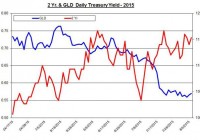
Summary The uncertainty around the possibility of a rate hike in the coming months benefits GLD. Nonetheless, a September rate hike is still on the table. Short-term treasury yields are adjusting for higher rates in the coming years. The non-farm payroll report came a bit short of market estimates with a gain of 215,000 jobs. Nevertheless, the SPDR Gold Trust ETF (NYSEARCA: GLD ) bounced back over the weekend and kept slowly rising at the beginning of the week. GLD could resume its descent, however, if the FOMC were to raise rates next month. But the market is still on the fence about the timing of the historic lift off. So September is still on the table? The market still seems confused about the Fed’s timing of the first rate decision. And the mixed signals we have received in recent weeks – from FOMC participating members such as James Bullard and Dennis Lockhart , who keep suggesting that a lift off is imminent, through the economic data, which for the most part, keep showing the U.S. economy is growing but not much faster than earlier this year, and the previous FOMC meeting , which had a dovish sentiment – haven’t made things any easier for the market’s estimates. Case in point, the implied probabilities for a September rate hike, which were nullified a few days ago, have gone back up to 54%. For December, the odds are 75%. Nonetheless, any delay in the first rate hike is likely to keep GLD from falling to a new low. Short-term rates are picking up Besides the implied probabilities derived from the bond market, the rates of short- and long-term rates also provide an interesting account of the changes in the demand for treasury bills. Specifically, the long-term yields (say for 10 years and higher) have actually come down in the past few weeks while short-term rates for 6 months to 3 years have risen. It seems that even though the market is slowly adjusting to the fact that low cash rates aren’t here to stay, the long-term rates, which are mostly driven by, besides the Fed’s short-term rates, inflation expectations and risks haven’t gone up. (click to enlarge) Source: U.S. Department of Treasury and Bloomberg This could be because the market considers lower inflation in the long run than it did in the past or that the risk in investing in U.S. treasury bills could rise while over the short run, the rise in yields is mostly related to cash rate hikes. When it comes to inflation expectations, they have gone up in the past few months, as you can see in the chart below: (click to enlarge) Source: Federal Reserve Bank of Cleveland Nonetheless, the 5-year and 10-year expectations are still below the Federal Reserve’s inflation target of 2%. Even Federal Reserve Vice Chairman Stanley Fischer recently pointed out that the current U.S. inflation is very low, mainly due to low commodities prices and that global deflationary trend “bothers” the Fed, even though it’s only one among several factors that impact the FOMC’s decisions about policy. Conversely, Lockhart suggested in a recent press conference that the first rate hike won’t depend on U.S. inflation – so even if inflation doesn’t reach the 2% mark anytime soon, which is a very fair assessment, liftoff is still a viable possibility next month. And who said there isn’t confusion in the markets about the Fed’s policy? For GLD, lower long-term yields could actually benefit its price, as it did in the past when yields plummeted to historic low levels. But this hasn’t been the case. Even though for gold, long-term yields are more likely to impact the direction of gold prices, the recent rally of short-term yields may have also contributed to the weakness in the gold market. (click to enlarge) Source: U.S. Department of Treasury and Bloomberg Moreover, the correlations among GLD and the U.S. treasury yields aren’t too strong with the strongest correlations for the short-term yields – 2-year bonds. In the past, the long-term treasury yields had a much stronger and significant correlation with GLD. Thus, the uncertainty around the Fed’s policy over the short term is a strong factor in moving both short-term yields and GLD. The JOLTS report will be released this week and will provide another indicator about the U.S. labor market – last month’s report showed a modest fall to 5.36 million job openings. Next week, the FOMC will release the minutes of the July meeting, which could provide a bit more guidance about the last rate decision and what’s up ahead especially considering it’s the last piece of information from the FOMC before the September meeting. The labor market showed another solid growth in jobs but didn’t beat expectations. The FOMC keeps the rate hike decision uncertain, which for now actually benefits GLD. As long as there remains a possibility of a rate hike later rather than sooner, GLD could, at best, slowly rise and at worse remain range bound. But as the U.S. labor continues to improve, the odds of a rate hike in September will rise – a scenario that could bring back down GLD. For more please see: ” Gold and Inflation – Is there a relation? ” Disclosure: I/we have no positions in any stocks mentioned, and no plans to initiate any positions within the next 72 hours. (More…) I wrote this article myself, and it expresses my own opinions. I am not receiving compensation for it (other than from Seeking Alpha). I have no business relationship with any company whose stock is mentioned in this article.