Author Archives: Scalper1

Factory Robots Being Ordered At Record Pace

Robots are marching into factories in North America at a record pace, according to the Robotic Industries Association. A record 14,232 robots, valued at $840 million, were ordered from North American robotics companies in the first half of 2015, an increase of 1% in units and 7% in revenue over the year-earlier period, which held the previous record, the trade group said. “We’re encouraged by the continued strength in the North American robotics

Optimal Global Equity Allocation WIth Individual Stocks

Summary Even a smallish portfolio stock can be well diversified internationally. Individual investors typically do not rely on asset correlations in their investment decisions. Portfolio risk-return efficiency can be enhanced by exploiting asset correlations. An “optimized” portfolio doesn’t neutralize stock risk: returns are likely to issue from well-known risk factors. In previous articles, I have discussed both minimum volatility portfolios and domestic equity allocation . In the former article, we saw both that accounting for the volatility and correlation how expanding the equity set can lead to better investment outcomes in terms of terms Sharpe ratios (risk-reward efficiency). In the latter article, we saw how a collection of individual stocks with a bit of discretion can perform better than a portfolio of risk-diluted ETFs. This article blends the two approaches by creating a stock-based portfolio with some of the qualities of an allocation-based strategy, but using individual stocks. The goal is to develop a portfolio of 20-50 stocks – this is about the number needed to create a reasonably diversified portfolio whilst remaining tractable enough to manage. Individual investors with small portfolios typically reduce risk through large-cap and dividend stocks, emphasizing careful stock selection over portfolio construction. In contrast to that intuitive and legitimate approach, the idea here is to reduce risk by exploiting the statistical covariance of the entire global equity market. This will be done using constrained mean-variance optimization. The next section describes the process and structures that define the solution portfolio, but if you want to use this article as a “quick pick list” for risk-efficient stocks with low correlation, feel free to jump down to results and discussion. Investable Universe With over 37,000 equities to invest in worldwide, security selection is a daunting process. Like most ETF benchmark indices that number needs to be winnowed down for reasons of both tractability and investability. What might be considered the closest proxy for the world portfolio, (NYSEARCA: VT ), has only about 7,300 securities. In this exercise, the initial pool screened for stocks with at least 3 analyst estimates left about 6,200 assets. This screen acts as an implicit liquidity screen, and biases the sample toward large-cap stocks and well-followed small/mid-caps. The next screen limits stocks to those with dividend yield greater than the median (1.9%) and the forward earnings yield (EPS/price) is likewise greater than the median (5.25%). The expected dividend has to be less than expected profit, and book value must be positive. This leaves about 1,100 stocks. The equities are divided into 4 market capitalization based classes: micro ( Additional disclosure: I own some of the stocks in the solution portfolio as similar optimization techniques belong to my normal repertoire of security selection.

What To Do When Financial News Headlines Jump Out At You

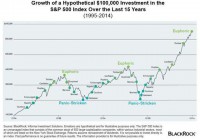
I’ve written about how my aunt calls me when the markets worry her. Needless to say, she’s been calling a lot. Rising interest rates. Sinking oil prices. A strong dollar and weak earnings. Greece, China and Puerto Rico. The news headlines make hay of these swings, and investor emotions can ride along with the dramatic stories. The stock market will spike one day, you feel optimistic and invest, then the market drops back down the next day. Earlier this year, we talked about how the markets would seem more volatile than in recent past. Well, they have delivered on that forecast. After years of relative calmness and steadily rising returns, markets have been jumpier lately. (click to enlarge) Turn your gaze away from the headlines, and instead, take a good look at your investments. It is what you do within your portfolio that matters. Here are four strategies to help your investments navigate the turbulence: Diversify . Market cycles typically move in different patterns. I will save you the academic rationale, but you may want to have some investments zig while others zag. This is the crux of what we call diversification. So the most important way to manage portfolio risk overall is to diversify across stocks, bonds, geographic regions and sectors. Getting this mix right is really important. If you’re new to investing, a low-cost way to achieve a balanced portfolio in one single trade is through a diversified iShares Core Allocation exchange traded fund (ETF). If you already have an established portfolio, review your holdings regularly and talk to your financial planner about diversifying. Go min vol . If you want broad market exposure with potentially less risk, minimum volatility ETFs might be a good fit. These funds seek to track market indexes with a mix of historically less volatile stocks, so you can still invest in global, U.S., developed international and emerging markets with potentially fewer bumps in the road. Bargain shop . Who doesn’t like a good discount? Truth is many U.S. stocks have gotten quite expensive , and it has been harder and harder to find true value. So when the market drops, it can be a great buying opportunity. Talk to your planner about potential deals in the market that can complement your long-term portfolio. Stay put . If your investments are in good shape, make no sudden moves. Over time, markets tend to balance out, and you’re likely to do better staying invested in a diversified portfolio than engaging in frenzied, sometimes expensive, trades. As I do with my aunt, work your way through the four steps above to ensure your investments are sturdy. Successful investors don’t panic over headlines. They stay educated and stay invested. Learn more about what to know and what to do from the mid-year update of The BlackRock List , and get back to enjoying your summer. Original Post Share this article with a colleague